FilmWonk Podcast – Episode #58 – “Birdman” (dir. Alejandro González Iñárritu)

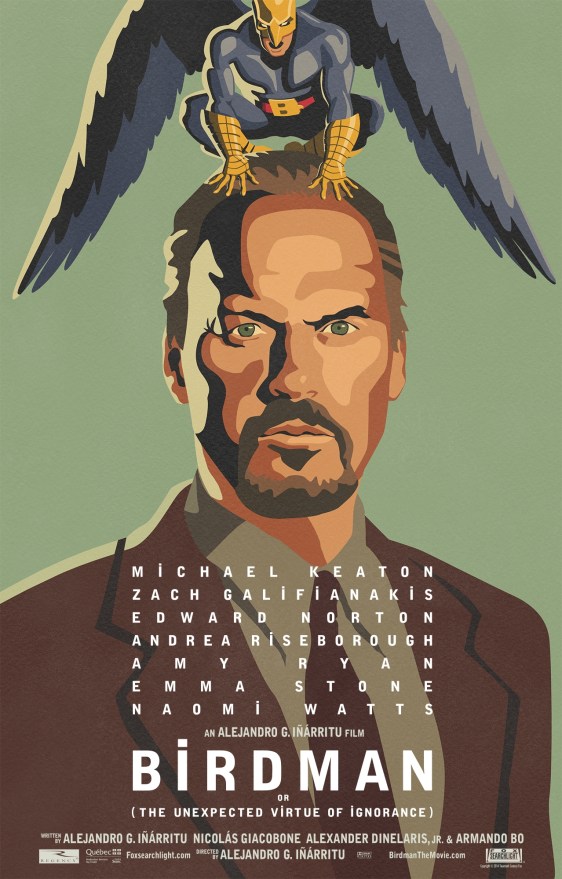
Poster for

This week on the podcast, Glenn and Daniel tackle Alejandro González Iñárritu‘s welcome and unexpected triumph of dark comedy, Birdman. Explore a creative, single-shot world in which art imitates life imitating art, we slightly overuse the word “outstanding,” and a tour de force cast and cinematographer deliver one solid performance and well-staged scene after another (39:15).

May contain NSFW language.

FilmWonk rating: 9 out of 10

Show notes:

  • Music for tonight’s episode includes The Animals’ classic, “Don’t Let Me Be Misunderstood”. A cover of this song performed by Brent Smith appears in the film’s excellent trailer, but that version is unfortunately unavailable.
  • Raymond Carver‘s What We Talk About When We Talk About Love is indeed a real short-story, published in 1981.
  • We referred to a recent episode of the Cracked Podcast – check it out here, and David Wong‘s vaguely self-helpy article that preceded it.
  • In case my non sequitur about Ed Norton’s bird-hair didn’t make sense, here’s a rundown of the random place my mind went.
  • In the final act of Ratatouille, the late, great Peter O’Toole delivers a monologue as the surly food critic Anton Ego. The speech – made of equal parts truth and self-indulgence – is almost an inverted “The Reason You Suck” speech, and goes as follows:

    “In many ways, the work of a critic is easy. We risk very little, yet enjoy a position over those who offer up their work and their selves to our judgment. We thrive on negative criticism, which is fun to write and to read. But the bitter truth we critics must face, is that in the grand scheme of things, the average piece of junk is probably more meaningful than our criticism designating it so.”

Listen above, or download: Birdman (right-click, save as, or click/tap to play on a non-flash browser)

Gregg Araki’s “White Bird in a Blizzard” – An enigmatic coming of age.

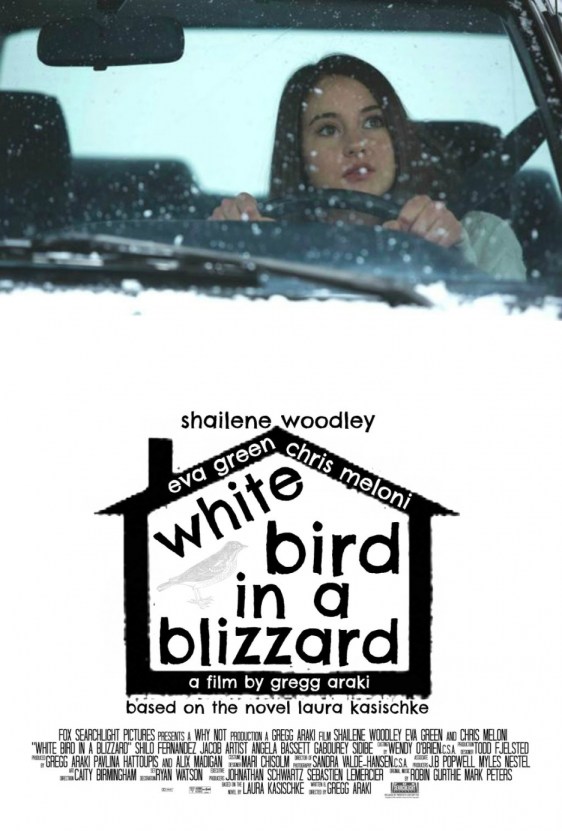
Poster for "White Bird in a Blizzard"

In our podcast review of Divergent, co-host Daniel commented that Shailene Woodley could probably play a high school girl forever. For that particular film, neither of us meant this as a compliment. Following her fascinating but nonetheless sidelined role in The Spectacular Now, I was quite curious to see what Woodley would make of a solo lead in a film that is equal parts stylized mystery and erotic bildungsroman. White Bird in a Blizzard is adapted from a novel (by author Laura Kasischke), and as is often the case with such things, it relies heavily on voiceover, and occasionally gets a bit too far up its own ass with literary metaphors. But that’s the last dismissive thing I’ll say about this film, because after 10-15 minutes of this, I was completely sold on both Woodley’s casting and on the premise of the film itself.

The film begins with the introduction of Kat Connor (Woodley), whose mother Eve (Eva Green) disappears without a trace. Christopher Meloni plays Kat’s beleagured father Brock, and we learn through flashbacks just how little regard her parents had for each other. The production design during these sequences can best be regarded as a dystopian mash-up of Mad Men and The Stepford Wives. Eve is unsatisfied both domestically and sexually, and Kat (then at age 8, played by Ava Acres) is disturbingly aware of the minutiae of her parents’ sex life, or lack thereof – her mother’s nightly solo trips to bed, unsatisfied, and her father’s none-too-secret locked stash of Hustler mags in the basement. After Eve vanishes (when Kat is 17), the flashbacks spend much less time on her discontented marriage with Brock, and far more time on her relationship with her daughter. Kat’s teenage sexual awakening is fully on display in this film, and the film strikes an interesting balance between her various boundary-prodding dalliances and her mother’s competitive attitude about her youth and beauty.

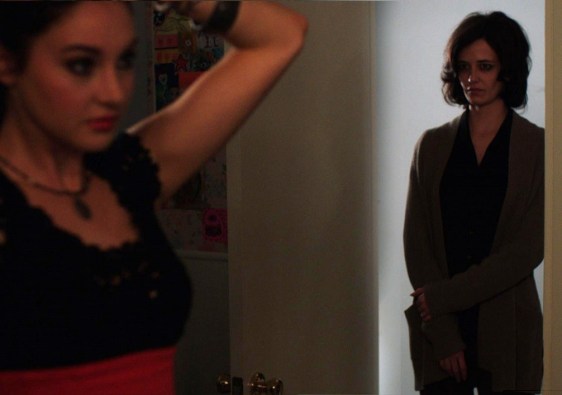
Still from "White Bird in a Blizzard"

Green is much closer in age to the younger version of the character, and yet seems to sell the middle-aged, despondent version far more through her performance than through any sort of age makeup. As she vamps around the screen – frequently with a glass of wine in hand – she stares creepily at Kat and tells her just how closely she resembles her younger self. This character is Betty Draper in one moment, and channeling the best of Helena Bonham Carter in the next – it’s really quite an impressive balancing act. Given that all of these flashbacks seem to be taking place in Kat’s memory (sometimes literally, as she recounts them to Angela Bassett as her therapist), it’s hard to shake the feeling that Kat is an unreliable narrator. That these are merely her last interactions with her mother as best she can distantly recall them – a bitter recollection of a half-remembered ghost.

Shiloh Fernandez gives a nice turn as Phil, the boy next door (and Kat’s not-too-serious boyfriend). As Kat puts it, he reminds her a great deal of her father – scratch the surface, and you just find more surface. This is perhaps why she meanders elsewhere over the course of the film, seducing 40-something Detective Scieziesciez (Thomas Jane), who is assigned to her mother’s case. The film’s treatment of their erotic interaction is nothing short of masterful. At this point in the film, it’s unclear whether Kat has yet turned 18 (she mentioned previously that she was a few weeks away), and the police detective more than twice her age clearly knows that he’s toeing – and then leaping across – a dubious ethical line. The resulting encounter strikes a frankly miraculous balance – a pair of consenting adults who prod the edges of an improbable power dynamic until they emerge as equals. This becomes one of the most tense and fascinating relationships in the film, and it could never have done so without such a tonally perfect opening scene.

Much like Ellar Coltrane‘s central character in Boyhood, it is a single youth – Kat – whose development is fully on display in this film. And no matter what’s happening in the background, the film only works if we care about this character throughout the film. Woodley is aloof at times, but only when it seems appropriate – when her character can’t be bothered to deal with the chaotic and painful changes in her life. At no point in the film does Kat feel unaffected by either her mother’s disappearance (despite her protestations to the contrary) or any of the linked events, and this makes for a nice, slow-burn mystery as she decides just how much she really wants to know the truth. This film blends mystery into a coming-of-age drama most effectively – and in a way I’ve never seen before. The mystery is ever-present, but impressively restrained to make room for the rest of the cast to get on with their lives.

FilmWonk rating: 8 out of 10

FilmWonk Podcast – Episode #57 – “Gone Girl” (dir. David Fincher)

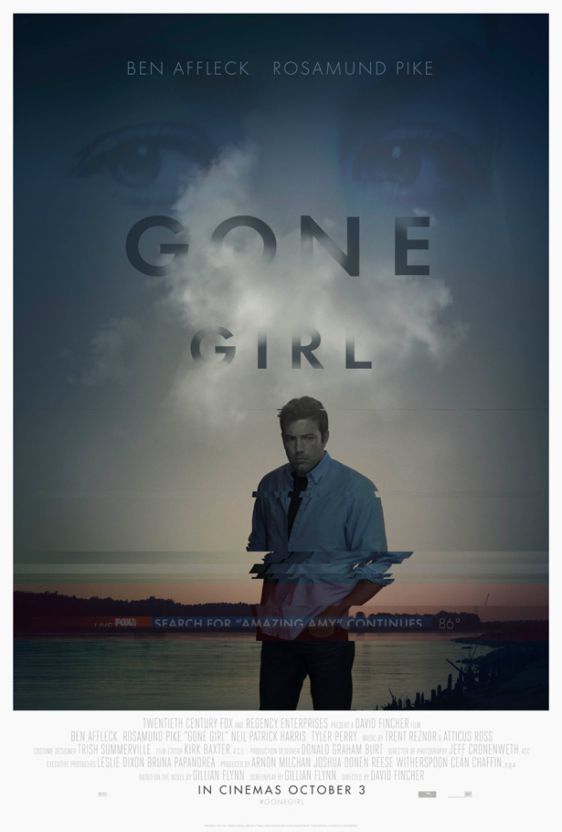
Poster for "Gone Girl"

This week on the podcast, Glenn and Daniel dig into the abiding mystery of David Fincher‘s Gone Girl, based on the novel (and written for the screen) by Gillian Flynn. (38:08)

May contain NSFW language.

FilmWonk rating: 9 out of 10

Show notes:

  • Music for tonight’s episode is the understated track “What Have We Done to Each Other?” by Trent Reznor and Atticus Ross, from the film’s score.
  • Check out Tasha Robinson‘s article on the “Strong Female Characters” problem over at The Dissolve.
  • We spoke of the excellent movie trailer work by Mark Woolen, who did the trailer for Gone Girl. Gizmodo did a feature on his work this past week, including past trailers for The Social Network and A Serious Man. Woolen also cut two trailers for upcoming films that we plan to review on the podcast: Birdman and The Theory of Everything. Check out all of his trailers here.
  • CORRECTION: The couple in the Ozarks were Greta (Lola Kirke) and Jeff (Boyd Holbrook). We mistakenly identified Scott McNairy as the actor who played Jeff – he actually played Tommy O’Hara, Amy’s former classmate.

Listen above, or download: Gone Girl (right-click, save as, or click/tap to play on a non-flash browser)

FilmWonk Podcast – Episode #56 – “The Equalizer” (dir. Antoine Fuqua)

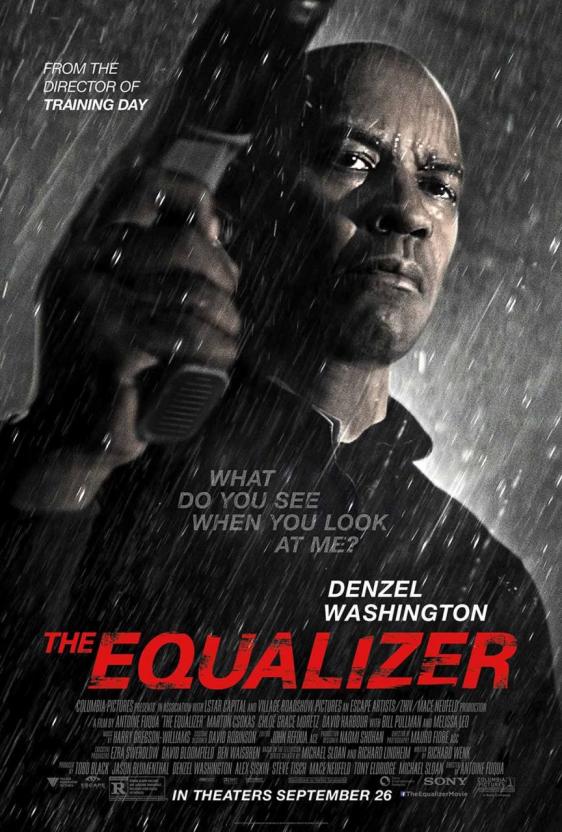
Poster for "The Equalizer"

This week on the podcast, Glenn and Daniel witness the reunion of Denzel Washington with Training Day director Antoine Fuqua – as well as a return to general badassdom – in The Equalizer. This will be the second film in as many weeks we end up comparing to Taken, and this time, it may not be to the film’s advantage (28:52).

May contain NSFW language.

FilmWonk rating: 5.5 out of 10

Show notes:

  • Music for tonight’s episode is “Sixteen” by The Heavy, from the film’s soundtrack.
  • The Philadelphia diner painting we referred to is Nighthawks, by Edward Hopper.
  • We referred to the 2000 John Singleton film Shaft, starring Samuel L. Jackson. Check out a Showtime featurette here – gives a good sense of the film.
  • We discussed the slow-motion fights in the 2009 Guy Ritchie version of Sherlock Holmes – check that out here (slow-mo begins at about 1:30).
  • Brace yourself, because we’re about to get our CinemaSins on here. One of the various improvised weapons we see McCall use in the film is a powder-actuated nail gun – i.e. a nail gun that uses gunpowder as its mechanism of propulsion to shoot construction nails. We correctly noted that this is the equivalent of a 22-caliber bullet (in fact, in some cases, actual .22 Short cartridges – minus the bullets – are used to power the mechanism). We found several videos testing the lethality of nail guns at a distance, including one from Mythbusters, and another fairly robust (albeit windy) test from YouTuber pilgrimfarmer. While these videos definitively show that a nail gun powered by compressed air is not an effective distance weapon, we were unable to find a video that demonstrated the same limitation for a powder-actuated tool. And one consistent factor for any type of nail gun is that the safety catch prevents the gun from firing unless it is pressed against a surface – a mechanism that can be easily bypassed by the user, but doesn’t allow for the cool one-handed shooting that McCall pulls off in the film. Don’t try this at home, kids. We’re professional podcasters.
  • With apologies to Ronda Rousey – Glenn’s just not an MMA guy. But he knows who Gina Carano is!

Listen above, or download: The Equalizer (right-click, save as, or click/tap to play on a non-flash browser)

FilmWonk Podcast – Episode #55 – “A Walk Among the Tombstones” (dir. Scott Frank)

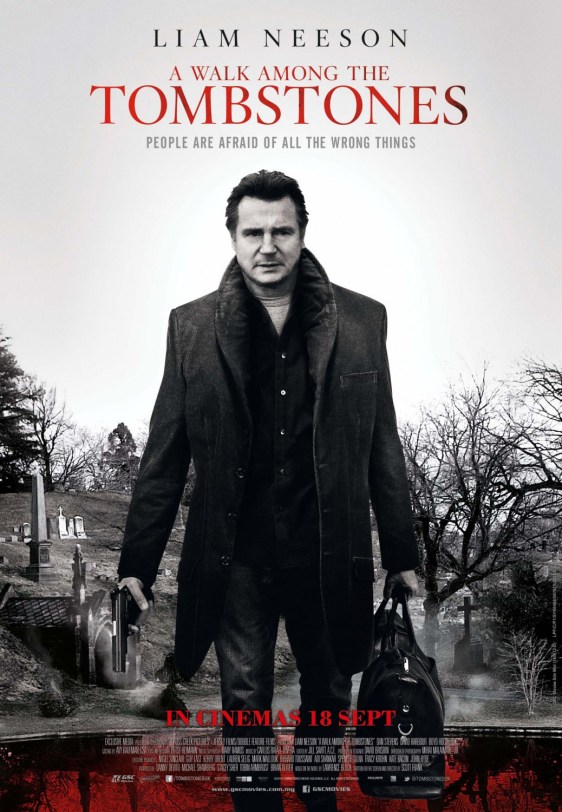
Poster for "A Walk Among the Tombstones"

This week on the podcast, Glenn and Daniel take a leisurely stroll through a pretty well-executed genre exercise by writer/director Scott Frank (The Lookout). (41:39).

May contain NSFW language.

FilmWonk rating: 7 out of 10

Show notes:

  • Music for tonight’s episode is Nouela‘s cover of “Black Hole Sun“, from the film’s trailer.
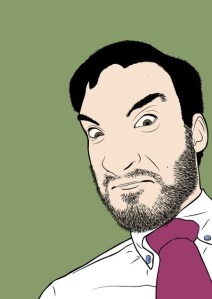
  • Joining us for this week’s episode is Seattle artist Jason B., who will happily sell you a delightful pop-art print (or a mug) of Daniel’s mug here. Check out his other artwork and blog over at Catastrophic Shift. "Office Crazed" by Jason Busse
  • The two detective characters that were name-dropped in the film were Sam Spade and Philip Marlowe (created by Raymond Chandler, whom we mistakenly mentioned instead).
  • The last (and only other) film in which we saw Brian “Astro” Bradley was Earth to Echocheck out our podcast review here.
  • We referred to a recent Cracked article about a convicted drug smuggler, now out of prison, who is now a professional speaker – that was this one, from Brian O’Dea. But we actually mixed in a detail from this article (from an anonymous writer), about how drug dealers are often not the people you expect.
  • We referred to the lackluster success rate of Alcoholics Anonymous – for reference, check out this NPR interview with Dr. Lance Dodes, who claims that AA’s success rate is as low as 5-10%.

Listen above, or download: A Walk Among the Tombstones (right-click, save as, or click/tap to play on a non-flash browser)

Seattle’s One-Reel Film Festival 2014 – Monday Roundup

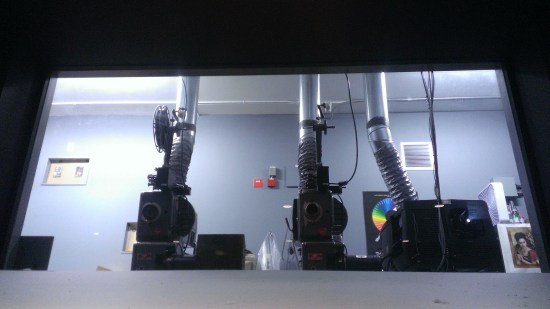
SIFF Film Center projection room

The One-Reel Film Festival is part of Seattle’s renowned Bumbershoot music and arts festival. Throughout the weekend, I’ve had the opportunity to see short films from all over the world, some of which can be viewed online (I’ve included links below where applicable). The films were arranged into blocks of around an hour apiece, which I’ve arranged in presentation order below. Bold text means I enjoyed the film, and an asterisk (*) means it was my favorite film of that block. Skip to the bottom for a list of all the films that can be viewed online.

Click here for Saturday’s films
Click here for Sunday’s films


Best of SIFF 2014: Jury Award Winners

  1. Rhino Full Throttle (Director: Erik Schmitt, Germany, 15 minutes)

    A beautiful tale about temporary friendship amid wanderlust, the expectations we impose on those who pass through our lives on a transient basis, and how to express those feelings outside of Facebook. The main character is an artist (Tino Mewes) who uses the city of Berlin as his medium and muse, using cardboard and forced perspective to carve out a magical world straight out of the minds of Michel Gondry or Terry Gilliam. The in-camera visual construction and deconstruction are marvelous, even as he finds a partner in crime, Vicky (Marleen Lohse), with whom to construct his elaborate artwork. And he loves her, because of course he does – and then this film delivers a powerfully subtle message that no, the girl in your life doesn’t lose the power to make her own decisions just because you develop a crush on her. And the main character’s journey ends up spinning this dilemma into a beautiful tale of friendship and mutual acceptance – the idea that no matter where you go in the world, your friends will always be your friends unless you give them a serious reason not to be.

    Trailer here.

  2. Twaaga* (Director: Cedric Ido, Burkina Faso/France, 30 minutes)

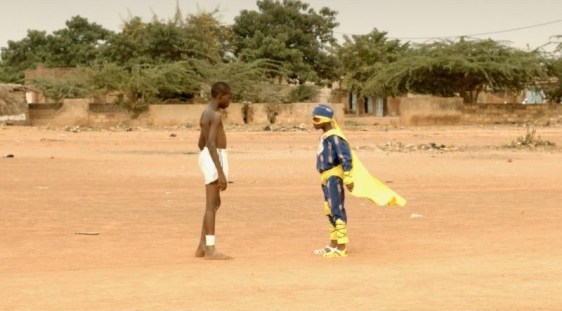
    I don’t know Burkina Faso, but this short historical family drama acquainted me with a huge amount of detail in its brief runtime, projecting the uncertainty and weirdness of a post-revolutionary environment with remarkable skill. The secretiveness, the petty grievances settled under the auspices of revolutionary fervor, and the grand uncertainty about the future are put on display through the eyes of a young boy, Manu (Sabourou Bamogo), who desperately wants to be a superhero. The film’s title, Twaaga, means “Invincible”, and evokes a tribalistic ritual that we see at the film’s outset, designed to instill revolutionary fervor by imbuing the recipient with an ancestral and magical sense of invincibility. Manu sees his brother Albert (Harouna Ouedraogo) becoming anointed in this manner, and it melds seemlessly with his superheroic desire to navigate his own childhood perils and look after his family. Manu converses with the local comic merchant about the various parallels between the X-Men and the American civil rights movement, then dons a superhero costume to confront his local bullies on the soccer field. And all around the edges of this family, the revolution rages on. This is exactly how powerful, personal storytelling is done, and it has stayed with me since I saw it.

    More info and trailer here.

  3. Maikaru (Director: Amanda Harryman, USA, 7 minutes)

    Maikaru is a powerful, personal testament from a young man who grew up in Seattle’s underbelly as a victim of human trafficking. The vast majority of the film is shot up close and personal in Maikaru’s face, his piercing gaze heightened with a pair of stylistic contact lenses that make his pupils look like stars going nova. The contrast created by his upbeat persona, artistic endeavors, and positive outlook is overwhelming as he reveals one terrible thing after another that happened to him, his siblings, and his mother during his upbringing. This is not a pleasant film, but it is certainly an important one for me to properly understand my hometown of Seattle. The Greyhound bus station at 9th and Virginia, the colony of drug culture on Pike between 2nd and 3rd… These were the bedrooms of Maikaru’s childhood, as well as for countless others that I pass each day, whose stories I may never hear.

    Watch it here.


Down Under

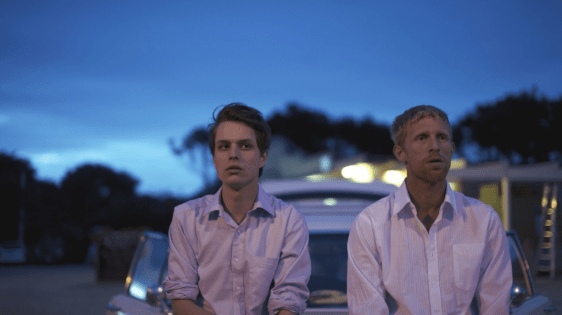
  1. Thanks For the Ride (Director: Tenika Smith, Australia, 17 minutes)

    There’s one of these every year – a short with the narrative ambition and depth of character that it would’ve worked better as a feature film, and in this case, that is almost to the film’s detriment. From the hearse driver sitting at a funeral who clearly doesn’t give a damn, to the young man with a cast on his arm who “shouldn’t be here” (according to an angry man who chases him from the funeral), these characters (played by Simon Lyndon and Matt Callan) were instantly intriguing. The resulting short left me wanting another two acts to help fill out their unlikely friendship a bit more – a few of the emotional beats (including a bit of an improbable fistfight) happened just a bit too quickly. But the film’s every attempt at emotional resonance landed well thanks to Lyndon and Callan’s solid “lovable loser” performances, and all told, the film is well worth a look.

    Watch it online here.

  2. In Autumn (Director: Rosanna Scarcella, Australia, 15 minutes)
    Is “romantic dreadnaught” an appropriate name for a film about romance that evokes a persistent and deliberate sense of impending doom? This film was…utterly boring and macabre. And if its objective was to properly express the uncertainty and malaise of middle-aged romance… Here’s where I should dismissively say, “Bravo” and get on with my life, but this film hardly even deserves credit for that. Romance is hard at any age, until the moment it stops being so. For some people, this moment might be death. And this film earns no credit for a tedious slog in the service of such a banal observation.

    More info and trailer here.

  3. A Great Man (Director: Joshua Dawson, Australia, 17 minutes)
    There’s something rather powerful about two boys lying on the grass in small-town Australia debating the definition of a great man, as they stare up at the bright full moon – a celestial body which, at that exact moment in 1969, has two great men walking on it, as a nearby radio helpfully informs us. These boys engage in the sort of Stand By Me risky exploration emblematic of this time period (at least in cinema), including dares and dangerous stunts. There’s an axiom in population studies that males slightly outnumber females at birth, but by age 25 or so, it all evens out. Because boys, the axiom says, are more likely to do stupid things that will get themselves killed before they come of age. This axiom is likely not actually borne out by statistics (boys are more likely to be victims of violence, for instance), but it’s fair to say stunts and dares do inform society’s notions of greatness and masculinity to some degree. Great men do dangerous things, the story goes, sometimes for no reason whatsoever. And as these boys debate jumping from a 50-foot waterfall, the adult in me was certainly saying “hike to the bottom and check the depth first!”, even as the teen boy in me said I should go for it, or more likely, chicken out, get called a pussy, and get on with my day. This film captures something very real about boyhood, even if it’s just the legend of great men that we grow up with, and never fully realize in the real world.

    Trailer here.


Show Me The World

  1. The Queen (Director: Manuel Abramovich, Argentina, 19 minutes)
    After watching this film (a documentary?), I just hope there’s a teen beauty queen out there who’s doing it by choice. Because this film depicts an Argentinian carnival beauty (who is perhaps 10 years old) in a manner that is nothing short of child abuse. The film is told almost entirely through an extended close-up on the girl’s face, as frigid stage mothers dance around the periphery of the frame strapping a 10-pound rhinestone monstrosity to the top of her head. They thread zip-ties through her hair, offer lidocaine creams to numb her scalp, and eventually, just straight-up pills to pop (which she refuses, despite no longer being able to feel or move her head and neck). We hear about the various scars borne across the backs of these beauty queens by the end of their teenage years, even as we see them forming across this girl’s face. This film made its point effectively, even if I’m torn as to whether the mere act of making it was despicable.

    More info and trailer here.

  2. Mother Corn* (Director: Guillermo Lecuona, USA/Mexico, 16 minutes)
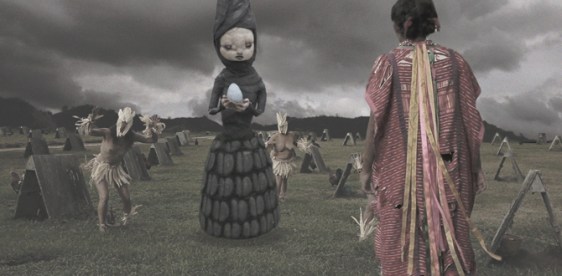
    If nothing else, this film demonstrates the sad truth that as any culture approaches extinction, it becomes, at best, a thing to be packaged and sold to tourists. This dilemma is addressed through a grandmother and granddaughter who struggle between their linguistic and cultural identity – Trique vs. Mexican. Infused with Pan’s Labyrinth style imagery, this film mingles the girl’s uncertainty with images of death, floating souls, and fantastical creatures.

    Trailer here.


Films4Adults #3

  1. The Man Who Knew a Lot* (Director: Alice Vial, France, 20 minutes)
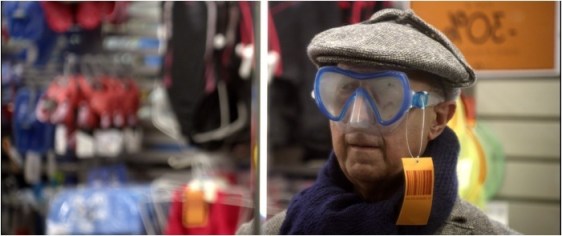
    It’s the ugly truth of every specialized touristy shop that the knick-knacks contained within – the authentic Southwestern pottery, the deer antlers, the gargoyle statues – won’t look nearly as good on your apartment shelf as they do in a perfectly lit store surrounded by similar crap. They’re selling an image, not an object. And this film takes this idea to the nth degree by taking place inside a dystopian IKEA store called Paradesign. On the show floor, scenes of everyday life and household situations in various disembodied rooms are expertly staged, complete with human beings who spend all day – indeed, live their entire lives – sitting in the chair, laying on the bed, and so forth. An old man on the first floor, Mr. Beranger (André Penvern), teams up with a little girl (Naomi Biton) who was born on a €59.99 bassinet, both of them desperate to break free from Paradesign and find out what lies beyond. The result is somewhere between WALL-E and Dark City – an oppressively well-rendered piece of short science fiction.

    More info here.

  2. Deadbeat (Director: Danielle Morgan, USA, 12 minutes)
    Still a better love story than Twilight. This film acts as an unofficial sequel to the inexorable love story between a perpetually 17-year-old vampire (John Brodsky) and his now upper-30s human lover (Melissa D. Brown). Great fun made at the expense of a genre that richly deserves it.

    More info and trailer here.

  3. Syndromeda (Director: Patrik Eklund, Sweden, 22 minutes)
    A naked, bloodied man (Jacob Nordenson) is found wandering in the middle of nowhere. What ensues is a fascinating dramatic parable about how our minds deal with trauma and uncertainty. From its non-linear storytelling to outright confabulations on the part of the main character, this film depicts a man utterly perplexed about what has happened to him, filling in the details of ambiguous sensory input with his own culturally informed ideas. And the result is a smart, solid, visually stunning horror short.

    More info here, scene from the film here.

  4. The Fall (Director: Kristof Hoornaert, Belgium, 16 minutes)
    A couple debates what to do when they accidentally hit and kill a child in the middle of the woods. Because everyone knows the road less traveled is the easiest spot to dispose of a body. This film is beautifully shot, but existentially unpleasant. And that may have been the point, obliterating Eden with original sin and all that – but the experience wasn’t exactly enjoyable.

    More info and trailer here.

  5. We Wanted More (Director: Stephen Dunn, Canada, 16 minutes)
    Just add water for instant body and existential horror, as a singer (Christine Horne) loses her voice the night before a concert tour, and imagines it appearing before her in the form of a creepy child (Skyler Wexler). Her angst about her career is compounded by having just dumped her boyfriend (it’s implied, because he proposed). This is a simple, effective premise with stirringly disturbing imagery, bringing to mind the likes of Black Swan. And it turned out to be the perfect recipe for a personally high-stakes horror short that comes to a swift and pitch-perfect conclusion.

    Trailer here.


Quick List: All of the films that are available online:

Seattle’s One-Reel Film Festival 2014 – Sunday Roundup

SIFF Film Center projection room

The One-Reel Film Festival is part of Seattle’s renowned Bumbershoot music and arts festival. Throughout the weekend, I’ve had the opportunity to see short films from all over the world, some of which can be viewed online (I’ve included links below where applicable). The films were arranged into blocks of around an hour apiece, which I’ve arranged in presentation order below. Bold text means I enjoyed the film, and an asterisk (*) means it was my favorite film of that block. Skip to the bottom for a list of all the films that can be viewed online.

Click here for Saturday’s films
Click here for Monday’s films


Dance, Dance, Dance

Still from

  1. Bookin’ (Director: John Kirkscey, USA, 19 minutes)

    This film features two pairs of dancers exploring the evolution and future of a 30-year-old Memphis hip-hop dance style, gangster-walk, which has now become a much more refined style called “jookin'”, a beat-conscious fluid series of movements that much more closely resemble classical ballet to my untrained eye. There’s lots of standing on tip-toes (“getting on point”), smooth motions of toes and feet sliding along the floor, skillful spins, etc. The other pair, classical ballet dancers from New York, try to fuse jookin’ with ballet into a new style, which the group collectively dubs “Bookin’”. It’s a fascinating project, and we get some beautifully shot sequences of each style separately, but the biggest issue with this film was that I wanted more of the dancers together. It was perhaps a mistake to film this documentary entirely on the first day the dancers met, because they unfortunately acted like two pairs of strangers. They didn’t talk to each other much during the explanatory interstitial chats, and many of the choreographed dance sequences featured one dancer standing stock-still while the other performed. It was, to borrow one of their own lines, each dancer doing their own thing. The music (written by the director) is a fascinating blend of cello and hip-hop beats, and ultimately, the combined dance did come together pretty impressively. But I’m really not sure the dancers ever did.

    More info and trailer here.

  2. ME – Story of a Performance (Director: Jopsu Ramu, Finland/Japan/Estonia, 8 minutes)

    This is a fractured, self-indulgent mess of a dance film. The dancer (Johanna Nuutinen) can twist and writhe and contort her body into some very tricky and precise shapes, which would’ve been interesting to watch if the film weren’t so interested in showing off the various particle features in Adobe After Effects instead – or blurring and contrasting the white-clad dancer out of existence into the snow or fog of the background. This film is visually unpleasant to watch, and the music was constantly stopping and starting. The result can hardly be called dance, so much as a series of aborted and distracted maneuvers.

    More info and trailer here.

  3. Globe Trot (Director: Mitchell Rose, USA, 5 minutes)

    Reminiscent of the “Where the Hell is Matt” series, this video features a variety of different dancers (of all ages, races, sexes, and body types) performing the same choreographed dance around the world. All of the scenery is gorgeous and iconic (because of course it is), and there’s something exhilarating about watching one dancer begin a move in front of the Grand Canyon, and another complete it in front of St. Basil’s Cathedral in Moscow. This film was crowdsourced from 50 filmmakers around the world, so the variations in camera quality and cinematography style feel a bit odd – but this is a fun concept and execution nonetheless.

    More info, and watch the film here.

  4. Reflejos (Director: Jordan Jay Colvard/Carla María Negrete Martinez/Alisa Chanelle Dickinson, USA, 5 minutes)

    There’s something simultaneously aggressive, erotic, and sad on display in this film, with dancers shot in extreme closeup as they move around alternately in bed and in a park (Volunteer Park in Seattle?). A few of the movements feel reminiscent of “victim-control” stage combat techniques, with dancers grabbing each other by a scruff of hair, or with an arm around the torso, and the “victim” writhing back and forth from the simulated attack. And then the film would cut seamlessly back to a pair of women in their underwear precisely rolling around in a bedroom – together, then separately, and back again. The resulting message is not precise or coherent, but it is an undeniably fascinating performance, both in terms of choreography and cinematography.

    Watch it here (borderline NSFW).

  5. Beneath Our Own Immensity* (Director: Alia Swersky, USA, 10 minutes)

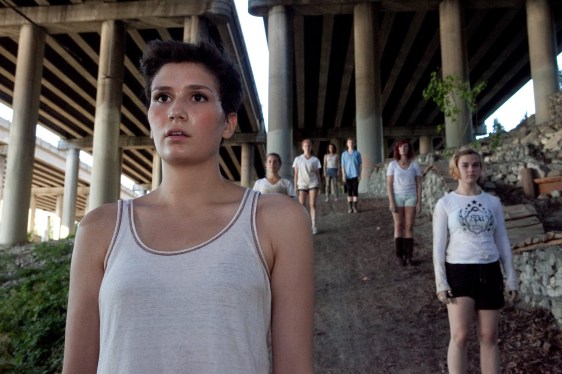
    Fascinating journey of a dance troupe under a complex series of freeway overpasses (seemingly, the north end of Seattle’s Ship Canal Bridge). The dancers begin as distinct entities, finding movement and performing complex stunts amid a field of hillside detritus – fencing sections, construction debris, etc. The music begins quite simply, relying heavily on the overhead rumble of traffic, then blends in other sounds – flowing water, billowing wind and dust, and eventually, the dancers seem to become one with the debris itself. They become mired in mud and dust, and their movements gradually begin to meld with the debris itself. A particularly intimate sequence features a man and woman hanging from a section of wooden fencing from various twists and contorted positions, then gradually sliding back down to earth, rolling over each other’s bodies, their movements always fluid and deliberate. And then the dance gets aggressive and loud as the ambient road and debris noise picks up. Exhilarating and well-shot.

    Watch it here.


Love…In the Afternoon

Still from

  1. The Crumb of It (Director: T.J. Misny, USA, 15 minutes)

    This film is beautifully acted, and deeply uncomfortable. A comedienne (Jocelin Donahue) and a pastry chef (Chioke Nassor) debate whether it’s possible to be in a relationship with someone who hates your greatest creative passion – he is tepid about her comedy, and she gets violently ill and terrified at the sight or taste of cake. There’s some deep insecurity (and, perhaps, manic depression) on display here, and the resulting relationship feels raw, intense, and authentic. This is part of a Kickstarter series of three shorts (titled Intimate Semaphores) intended to showcase female performers in meatier roles than mainstream projects tend to offer. This film did that in spades – Donahue’s performance is effective and deeply unnerving, and certainly made me curious to check out the others in the series.

    Watch it online here.

  2. Listening Is an Act of Love (Director: The Rauch Brothers, USA, 23 minutes)

    I’ll be blunt – I liked this film much more than I expected from the outset. It’s possible it spent too much time explaining the value of storytelling (literally as if to a child – the filmmaker’s nephew), when after years of exposure to This American Life, The Tobolowsky Files, and Risk!, I’m pretty well versed in that already. But I suppose I wasn’t the target audience for the first segment, and I’m sure some people have to be convinced of the project’s value. The film makes its pitch effectively before jumping into a series of deeply touching personal stories, rendered in the Rauch Brothers‘ Flintstones/Jetsons-cum-Flash style of animation.

    Watch it (and many other animated short stories) here.

  3. Life’s a Bitch* (Director: Francois Jaros, Canada (Québec), 6 minutes)

    A “romance procedural”, featuring a man dealing with the aftermath of a breakup. It hits many expected beats, but the storytelling method consists of shots that never exceed 1-2 seconds in length, and the result is a punctuated and highly amusing account of the next couple of months (or years?) of this man’s life (and, some might argue, downward romantic spiral). Quite charming.

    More info and subscription-based viewing here.


SIFF Fly Films 2014

This year, the Seattle International Film Festival (SIFF) challenged five local production companies to create a love letter to Seattle in a compilation affectionately titled, ‘Seattle, I Love You’.

  1. Sea Folk (Director: Morgan Henry and Josh Hayward, USA, 8 minutes)

    A loving non-narrative digital tribute to Seattle shipping and boating life – from the gorgeous opening drone (or helicopter?) shot of the city to the various individual boaters, to the “day-in-the-life” sequences aboard the SFD fire boat or the various Coast Guard cutters, as well as the passage of Puget Sound aboard the Washington State Ferries, each shot lovingly renders the unified aquatic world of Elliot Bay, Lake Union, and Puget Sound into something truly wondrous and otherworldly that completely envelops the city proper. The final shot, a first person view of one of Seattle’s vast car ferries returning to port, captures something so quintessentially Seattlelite – the grand feeling of knowing that you’ve seen true beauty and made it home.

    Watch it here.

  2. Fresh Pair (Director: Norma Straw, USA, 8 minutes)

    A mildly amusing look at running in Green Lake and the various weirdos you will encounter and eavesdrop on. These scenes felt just a bit too thoroughly staged, and the acting wasn’t great – the film never quite shakes the feeling that it is a Movie About Seattle rather than an actual story that happens to take place here.

    More info here.

  3. Open Mouth (Director: Randy Walker, USA, 8 minutes)

    Attempt #1: I wish I could properly evaluate this one, but the primary vocal track was not working. But the filmmakers, to their credit, gave a wonderful live rendition from their seats in the audience. Attempt #2: Success! A cute little family slice of life. The amusing awkwardness of old couples vs. teenage couples kissing is contrasted to great effect, even as a teenage boy improbably invites his parents along for his first date at the ice rink.

    Watch it here.

  4. Hannah & Otto (Director: Chris Volckmann, USA, 8 minutes)

    A cute Seattle love story – a pair of retail drones find themselves on a romantic collision course following a meet-cute in the bike lane. Well-shot, and a nice piano score.

    More info here.

  5. Secret* (Director: Tony Fulgham, USA, 8 minutes)

    Secret definitely shares some common themes with Open Mouth, in its contrast between older and younger couples, but is rendered as a drama rather than a family comedy. The various interactions between the older couple are almost entirely wordless, but reveal a level of comfort, both with their own lives, as well as their relationship, that is apparent in even cursory observation. They each have their own interests – he with his electronics and jazz, and she with her complex wire crafts – but they still enjoy a great many quiet moments together. This is contrasted sharply with the young lady next door, who is in an ailing long-term relationship with her live-in boyfriend of two years. When these unlikely neighbors finally meet, their interaction is brief and to the point, sharing a love of music and delivering some impressively subtle exposition about their respective levels of contentment with life. If the Seattle Freeze is a stereotype, this is a platonic ideal of the Friendly Seattleite. Then the old couple wordlessly squeezes hands in a quiet and comfortable moment, because for them, it’s just another nice day together.

    More info and trailer here (hey, this guy also directed the delightful SIFF 2014 trailer!).


Best of the Northwest

Still from

  1. The New West (Director: Peter Edlund, USA, 15 minutes)

    I love, love, love a noir detective story in a high school, and even as this film uses a familiar formula, it still feels aggressively modern and unpredictable. Like Straight Down Low below, this film borrows heavily from Brick, maintaining an entirely dramatic tone as it explores a dark and simple crime tale, well-told.

    More info here.

  2. The Bath* (Director: Mark Lundsten, USA, 25 minutes)

    Every tragedy is the same. And every tragedy is unique. In this depiction of a family dealing with an elderly woman (Kathleen Chalfant) with Alzheimer’s, every subtle touch feels completely authentic. Cheyenne Casebier‘s performance as Anna, the woman’s daughter, is especially strong, as she struggles in her simultaneous role as caregiver to a teenage daughter, and as guardian of her ailing parents. At its heart, this is a depiction of the inevitable end of Alzheimer’s, wherein its victims eventually have to leave home and receive professional care until their dying day.

    More info, trailer, and rent or purchase the film here (film is NSFW).

  3. Clarity (Director: Donald Saunderson, USA, 7 minutes)

    A man rides the train each day fantasizing about talking to a girl – indeed, imagines entire conversations with her (voiced over by the girl in question). The gradual, deepening sadness of this film is when it becomes apparent that the conversations are not flashforwards to a romance yet to come, but mere daydreams of a romance that will never be. There’s a fine line between having a “rich inner life” and being a dejected loner, and as the film pretty clearly spells out, that’s no way to live.

    More info here.


Films4Adults #2

  1. Aban + Khorshid (Director: Darwin Serink, USA, 13 minutes)

    This is a devastating story of a same-sex couple who is dragged off to death row in a country where their romance is illegal. The film cuts back and forth between the couple recording some sweet romantic banter on video, made even more heartbreaking after the first cut to their neighboring jail cells, as their every sweet moment on video is surely used as evidence for their conviction. This film ends exactly as it must, exactly as it still does in 7 countries even today, in 2014. The is a bit fantastical, in that it imagines that a country in which this couple’s love is a capital crime would permit that couple to comfort each other by sitting in neighboring prison cells before their execution. But even for its jailhouse confabulations that only the dead can truly bear witness to, this film speaks the truth. And it’s a story that must be told until its practice is lost to history.

    More info and trailer here.

  2. H7N3 (Director: Iris K. Shim, USA, 11 minutes)

    It may be that I spent the past week trying to destroy humanity with a designer malady in Plague Inc, but this film about a family dealing with a contagious little girl was a very effective drama for me, despite its seemingly played-out subject matter. A government doctor making house calls is already an alarmingly unfamiliar site, and C.S. Lee‘s strong performance as he struggles between his humanity and his professional obligations is a sight to see, especially after previously only seeing him as the goofy Vince Masuka on Dexter.

    More info and trailer here.

  3. White Night (Director: Sabrina Sarabi, Germany, 21 minutes)

    Fuck this movie, and its boring and ill-established pretense of wordless superior meaning in sexual humiliation and rape that springs forth inorganically out of a couple’s bedroom malaise. In the film’s final shot, the couple lies in bed not looking at each other, looking slight and pissed off. And that’s the one emotion I personally experienced by the film’s end.

    More info here.

  4. Straight Down Low* (Director: Zach Wechter, USA, 25 minutes)

    It’s a good sign for a short film’s worldbuilding chops when 5 minutes in, I’m not only on board with its Shakespearean-twinged, gangland premise, but I would happily watch an entire TV series based on it. I love a high school detective story, and Shamar Sanders‘ “The Student” is as instantly charming and captivating a detective character as Joseph Gordon-Levitt in Brick, or Kristen Bell in Veronica Mars. In fact, the film borrows a few character elements directly from Brick, even if its overall aesthetic is more like a higher-stakes, non-musical West Side Story. I’ll stop talking now so you can watch it.

    Watch it here (NSFW).

  5. EFFED! (Director: Renny Maslow, USA, 19 minutes)

    Another One-Reel, another refreshing new genre mashup. In this case, a post-apocalyptic buddy comedy featuring two guys riding a tandem bike in the middle of nowhere. Like Zombieland before it, this film has a very sweet and optimistic streak underneath its cynicism, finding great humor in the idea that people who rob and squabble with each other for resources in an anarchist wasteland can still, on occasion, be decent to each other. And it’s hilarious.

    Watch it here (NSFW).


Quick List: All of the films that are available online

A note on “NSFW”… Suffice to say, I saw a lot of films this weekend. The ones that I specifically remember containing adult content, I’ve marked as Not Safe For Work. However, outside of the “Films4Families” block, I can’t guarantee that the others will be entirely appropriate. Viewer discretion is advised.

Seattle’s One-Reel Film Festival 2014 – Saturday Roundup

SIFF Film Center projection room

The One-Reel Film Festival is part of Seattle’s renowned Bumbershoot music and arts festival. Throughout the weekend, I’ve had the opportunity to see short films from all over the world, some of which can be viewed online (I’ve included links below where applicable). The films were arranged into blocks of around an hour apiece, which I’ve arranged in presentation order below. Bold text means I enjoyed the film, and an asterisk (*) means it was my favorite film of that block. Skip to the bottom for a list of all the films that can be viewed online.

Click here for Sunday’s films
Click here for Monday’s films


Films4Families #1
Still from

  1. The Dam Keeper* (Director: Dice Tsutsumi and Robert Kondo, USA, 18 minutes)
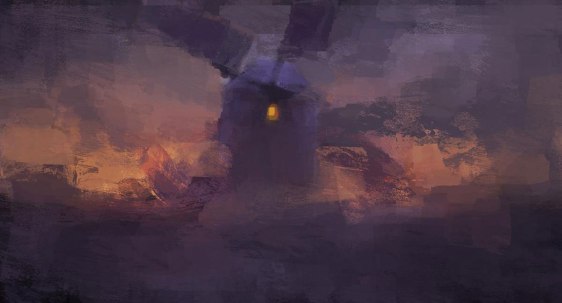
    “My father always said that a dam keeper’s job is to keep the darkness at bay.” So says the opening voiceover, as we see a little pig begin his daily grind of spinning up a windmill atop a gargantuan dam that overlooks his town. The piglet’s father is gone at the outset, leaving him as the sole guardian of what seems to be an important function for the town. This film has a gorgeous animation style – bright, colorful, cheery watercolor animation contrasted sharply with a cloud of impending darkness that lurks just outside of view. This piglet does not have a happy life – dealing with loneliness, boredom, and bullying at school. It is with a little fox character that the film introduces an alternate method of keeping the darkness at bay – creativity. Armed with his charcoal and sketch pad, the fox can mock anything or anyone with impunity, and takes a keen interest in the piglet’s misery. This was a deeply touching film, with an arresting visual style, opening with a gorgeous watercolor shot of a windmill spinning to life over the sunrise, seemingly blowing away the darkness. It dabbled in various means of keeping the darkness at bay- friends, keeping busy, the arts- but the film’s ultimate message seems to be that no single thing can do the job completely. The film also featired a beautiful mixed piano/strings score – quite poignant.

    More info and trailer here.

  2. Cootie Contagion (Director: Josh Smooha, USA, 8 minutes)
    This is a fun, trifling film about boys being silly. The visual style is uniform, Disney-channel brightness – quick cuts, and slightly better comedic timing than general acting quality. And really, that’s fine. It functions as a very slight parody of Contagion, complete with a children-only version of a CDC biohazard lab.

    More info and trailer here.

  3. The Magic Ferret (Director: Alison Parker, Canada, 12 minutes)
    A boy at an orphanage performs magic for some prospective parents, and lo, they adopt him. It’s sweet, but there’s not much to it.

    More info, trailer, and DVD available here.

  4. Little Big Hero (Director: Nirali Somaia, Australia, 6 minutes)
    A little donkey in the woods is befriended by a slightly cloying and obnoxious little girl who names him Fettuccine and decorates him with lots of girly accoutrements, including ribbons and a tutu. The animation style is a bit odd, with the characters drawn as outlines only, the background scenery visible through their transparent bodies. The music style is very Looney Tunes. A fun little trifle.

    More info and trailer here.

  5. Spacebound (Director: Kyle Moy and Ellen Su, USA, 3 minutes)
    A boy and his dog play in space as the boy runs out of oxygen. The animation is extremely basic CGI – Jimmy Neutron by way of Reboot, but lacking the context and background details of either of those. The animation looked cheap and primitive, and many foreground elements were oddly blurry. They bounce around a tiny planet with rings, some asteroids, then…the boy runs out of oxygen? So presumably they both die five seconds after the credits roll?

    Watch it here.


Face the Music

Still from

  1. The Boombox Project (Director: Paul Stone, USA, 8 minutes)
    An interesting behind-the-scenes look at an eponymous photography exhibit featuring a variety of old boomboxes – photographed in various locales, street corners, subway signs, juxtaposed with graffiti, etc. Artist Lyle Owerko talks about how he tracked them down, what generational period he’s looking to catalog like an anthropologist, etc. The boomboxes have so much character, especially in an era of interchangeable iPods and crappy white earbuds. Music players of that era brought people together – whether they liked it or not – and it’s evident from their various “battle scars” that they’ve seen a variety of situations. The first two minutes of the film function as a portfolio of Owerko’s prior work, and it’s good stuff.

    Watch it here.

  2. Moving Out (Director: Sean McCarthy, USA, 6 minutes)
    A very well-made mixed-media music video, featuring a girl guitarist named Cassandra Farrar singing her way through the post-breakup process. The video begins with her opening and tearing apart an elaborate (and partially animated) album of her relationship, then ventures into a lot of other places, as the girl wanders through photographs, paintings, and CGI land and skyscapes. The song is catchy, evocative of late-90s girl-guitar acts like Michelle Branch.

    Watch it here.

  3. Flower Shop (Director: Philip Knowlton, USA, 19 minutes)
    Flower Shop begins as a fascinating historical chronicle of a Harlem flowershop, continuously open and family-owned for three generations, from the 1930s up to 2011, when declining business and increasing competition from street vendors and supermarkets forced the store to finally close, just two weeks after being honored publicly by the borough president of Manhattan. It is a deeply personal tale of Phil Young, who finds himself carrying on the previous generation’s dream and skillset (reminiscent of Jiro Dreams of Sushi), then gradually coming to terms with the end of an era, both for him personally, and for the neighborhood at large. The next chapter of his life is off and running by the end of the film, returning to a passion that had always taken a backseat to the flowershop – music/drums.

    Trailer here.

  4. Flor de Toloache (Director: Jenny Schweitzer, USA, 4 minutes)
    A brief chronicle of the struggles and impressive music of an all-female mariachi band. Good music, but not much depth.

    Band’s official website, with performance videos here.

  5. Flamingo (Director: Carl Zitelmann, Venezuela, 6 minutes)
    This Spanish-language music video is a nightmarish parody of Merrie Melodies, incorporating old black and white stereotype characters. The animation is deceptively simple, mixing simple foreground 2D elements with complex backgrounds – starscapes, ocean, etc. There were things in this video that I’ve never seen before – and that’s not always a good thing. Case in point, the main character gets swallowed by a spider (who is voraciously devouring a string of people and spitting out the bones), then pooped out, entirely whole, into outer space. Without the language skills to comprehend what’s going on, all I could do was admire the well-rendered disturbance of it all. Like Pearl Jam might say, it’s evolution, baby.

    Watch it here.

  6. Love in the Time of Advertising* (Director: Matt Berenty and David Bokser, USA, 8 minutes)
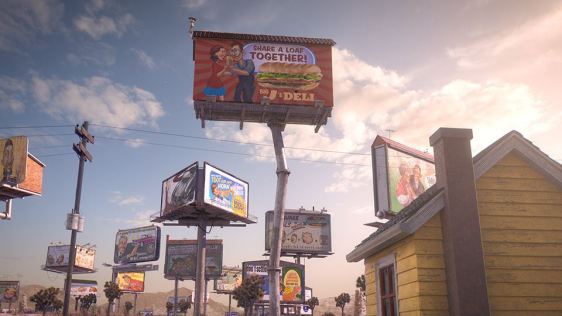
    A grand allegory on consumption, in the form of a love story between a lanky man trapped in a billboard, and the cute fat lady with glasses next door. And I point that out only by way of mentioning how uncommon a visual choice this is. Fat ladies don’t get to be primary romantic leads, and this film’s casual inclusion of such a “casting” choice (and little-to-no mention made of it) was not lost on me. The animation is gorgeous, featuring dozens or possibly hundreds of wonderfully biting and satirical billboard ads. I wanted to pause the film and read every last one of them – everything from the print style to the choice of imagery was clearly subject to a great deal of care and attention. The story is told entirely through the man’s narration (in the form of a rhyming story song) as he tries to find the perfect advertising message to win the fair lady’s heart. Decades pass, and it becomes clear that this couple is as much the butt of the movie’s satire as any of the other (entirely unseen) characters in this world – he with his hermitage and apparent inability to climb down to the lady’s house and say hi, and she with her dutiful purchases of every single thing that he puts on the billboard, to the point of her house cracking and spilling open like a hoarder nest. It’s a wonderful dark comedy in the end.

    Watch it here.


Ripped From the Headlines

Still from

  1. The Forgotten (Director: David Feldman, USA, 14 minutes)
    The Forgotten, or Los Olvidados, is an art project envisioned by Ramiro Gomez, an LA nanny and photographer. His medium, apart from photography, is painted cardboard cutouts of gardeners, movers, maids, nannies – service positions overwhelmingly occupied in California by Hispanic people – people like himself, who are easily overlooked and just as easily forgotten. Gomez takes this concept of temporary people out to a remote section of the Arizona desert, crafting a sad scene of a migrant family who has just buried a loved one who succumbed to the heat while trying to cross into the US – a fate shared by several thousand migrants each year. It’s a sad reminder amid the juvenile border crisis just how many people wander into the desert and never come back. Regardless of one’s feelings on border policy or immigration status, it’s easy for our limited monkey brains to forget that the others who are suffering in a bad situation are still human beings just like us.

    More info and trailer here.

  2. Marmato, Colombia. golden relics from the earth (Director: Santiago Ramirez, Colombia, 9 minutes)
    A sad tale of an intractable situation – a town full of traditional miners will soon cease to exist, owing to a deal struck between the government and an unnamed multinational to drastically speed up and technologically infuse the mining process, extracting in 20 years what it would’ve taken the local miners centuries to extract by hand. And as always, jobs, homes, and livelihoods are destroyed. This film tells a sad story, but doesn’t really explore its issues with any depth. It doesn’t name the company involved, or interview any of the decision-makers. It doesn’t really even show any footage of what it’s talking about – it’s just a string of disconnected voiceover tracks (often with poor sound quality), playing over unrelated footage of the town and hand-mining process, completely devoid of any context or connection. I didn’t come away from this film feeling like even the filmmakers understood the situation they were trying to document, and I certainly didn’t gain any greater understanding myself. I suppose it’s possible to find such ignorant and vehement rage poignant – they don’t even know why their lives are being destroyed. But I never had that reaction.

    More info here.

  3. Not Anymore: A Story of Revolution* (Director: Matthew VanDyke, USA, 15 minutes)
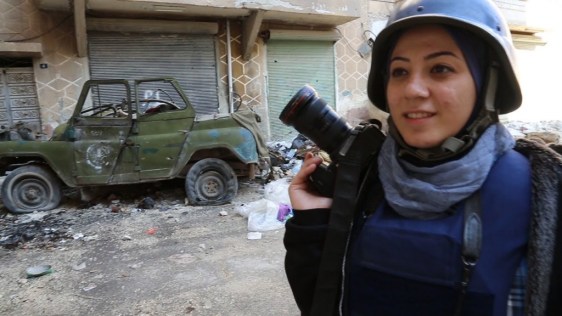
    Nour Kelze is a captivating figure – a young woman who speaks in flawless English about the horrifying experience that is her life amid the Syrian Civil War. This film is hard to watch, demands action that I can’t define or personally affect, and celebrates the bravery and fatalism of a generation forced to grow up and take control of their world, and accept the possibility and likelihood of imminent death. Nour speaks in a perfunctory manner about her life before the war – all the nice things she used to have and wear. Now, she wears a helmet, a flak jacket, and most importantly, a camera strap. She talks repeatedly about how ready she is to die, and knows it could come at any moment. And in a heartbreaking moment, she recounts the death of a friend, as close as a brother, who was shot to death on that very spot – intercut with video footage of the actual incident.

    The film ends with a soldier giving a darkly comedic monologue next to Nour sitting and petting a stray cat. There are cats in Syria, he says, and perhaps Americans would care about the situation if someone filmed the cats and stuck them on YouTube. And yet, even as he’s facetiously calling out the first world for ill-defined assistance, he never once abdicates the responsibility he and his countrymen have undertaken as revolutionaries. He’s not demanding American action – he’s just cracking wise and dark about the situation. And in the process, he also speculates that animals probably have more rights in America than the people have in Syria under al-Assad’s regime. It’s heartbreaking and hilarious and matter-of-fact. This is a hard film to watch, but it is required viewing.

    Watch it here, more info here.

  4. Isle de Jean Charles (Director: Emmanuel Vaughan-Lee, USA, 9 minutes)
    This is the way the world ends. With the seas rising and the land receding in an undeniable slow-motion apocalypse – with people standing around saying that only God knows when their island will disappear. This is a film about denial, if nothing else. It reveals that the marvelous sci-fi world of Beasts of the Southern Wild, featuring a vanishing island off the Louisiana coast, did not require nearly as much cinema magic as it seemed. Throughout this town, there are signs of storm damage and imminent decay. Trees poisoned from beneath by rising salt water, and withering away. Structures half-destroyed and abandoned. This looks like a set from The Walking Dead, and it’s a place where people still live today.

    Watch it here.

  5. After Trayvon (Director: Alex Mallis, USA, 6 minutes)
    A group of young black men have a dialogue in a Brooklyn park about what the world is like for them now after the death of Trayvon Martin – or what it was already like before. When the 300-pound bald man with a gigantic beard tells the camera that perhaps, pretty please, people could stop looking at him like he’s about to mug them (even as a large man myself, my first thought was admittedly “He could kill me with one punch”), the film gives the sense that even he doesn’t believe that’s a realistic expectation. And several of the men admit that even as they’re mistreated and profiled and stopped relentlessly by police, they are still warier among fellow black men than with whites.

    And you know what? Fuck this. As a white man, I won’t pretend to speak intelligently about their experiences, except to say that they sound terrible. There’s a lone skinny white kid sitting with the group, not saying a thing, and that’s how I feel watching this movie as the town of Ferguson implodes after another incident in which a young black man was killed. I can only imagine these men reconvened in the park this week for another intractable chat about the situation. And I can’t say anything to the men in this film except… That is awful. And I don’t know how to fix it. But I am listening.

    Watch it here.


Best of SIFF 2014: Audience Award Winners

Still from

  1. Fool’s Day* (Director: Cody Blue Snider, USA, 20 minutes)
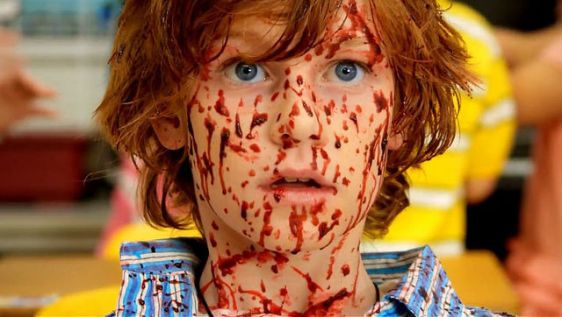
    There’s one of these every year, usually in the Films4Adults series… There are those who would argue that making a film like this, featuring a class of elementary schoolers dealing with the grisly aftermath of an April Fool’s joke on their teacher, is morally reprehensible. And those boring assholes are correct. But this film is wickedly funny, and carries on with a short-form joke far longer than a typical short film would – to its maximum extent. This feels like a solid episode of South Park, with many subtle touches and gags that elevate its simple premise to some lasting grisly amusement.

    Watch it here.

  2. The Hero Pose (Director: Mischa Jakupcak, USA, 13 minutes)
    A divorcé, Joe (Chaske Spencer) and his daughter Mia (Nikki Hahn) hang out at his Missoula home, waiting for potential Craigslist buyers to come pick up his ailing car. The girl is perhaps 8-10 years old, and seems rather smart for her age, recognizing the dysfunction in her father’s solo existence. Every moment and line of dialogue in this film felt authentic and beautiful – a particularly poignant moment occurs when Mia asks Joe about the possibility of a “good divorce”, wherein her estranged mother and father remain friends, hang out together with their respective new romances. Joe pronounces it “bullshit”, but it’s clear that the concept appeals to him. This is a good day in a family that’s having a rough situation.

    More info and trailer here.

  3. Strings (Director: Pedro Solís García, Spain, 10 minutes)
    Things I had never seen animated prior to this film: a child with a disability that renders him paralyzed. This is a bright and cheery CG-animated tale of friendship between two kids – a boy, severely handicapped, and a girl, not. Her initial earnestness that the boy should simply move his hand like this (she says, demonstrating), or talk like this (“Ho-la!”) might come off as mean, if only the girl had a malicious bone in her body – she clearly does not. And she seeks to engage the boy in a level of simulated physical activity and stimulation that probably no one else had ever tried, or bothered. She ties a rope to his leg so he can “kick” a soccer ball, swings a skiprope over him and rolls him over it, etc. The film’s end credits reveal that it is based on a true story, giving it another layer of poignancy. It’s hard not to sound condescending when calling this girl a saint – what’s implicit in this declaration is that she’s getting very little in return for her care and interest. But what she’s doing here is certainly praiseworthy, even if a little sad.

    More info and trailer here; watch another film, “La Bruxa“, from the same director.

  4. Mr. Invisible (Director: Greg Ash, United Kingdom, 14 minutes)
    This film did an excellent job of making me bored and listless at the retired widower’s sad existence, which made the reveal that much more satisfying. That’s all I’m saying.

    More info here.


Tales of Science Fiction

Still from

  1. Invaders! (Director: John Schmidt, USA, 8 minutes)
    This seems like an internet-short for kids of the 90s – chock full of nostalgia for old video game hardware, and a fairly well-done visual effects demo. There’s not much to this, but if you like old video games, this is a well-made tribute.

    More info and trailer here…possibly? The director and star are the same, but it looks like a different film.

  2. The Landing* (Director: Josh Tanner, Australia, 18 minutes)
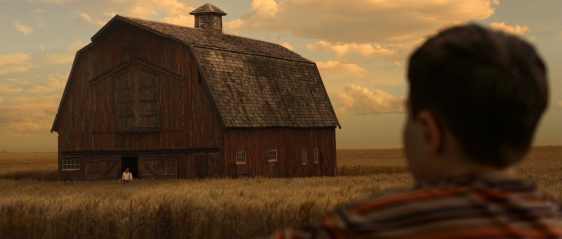
    This film takes place at the height of the Cold War – and, small pet peeve of mine, I did not need the news broadcast that mentioned JFK, Fidel Castro, and the phrase “Cold War” to confirm at its end that the broadcast takes place in 1960s (the prior rebroadcast of the 1930s radio special “War of the Worlds” notwithstanding). There’s an orgy of evidence that this takes place on a farm in the 1960s – even if it all felt just a little bit off. Perhaps the humongous barn was CGI – hard to say. It’s probably a poor mark for the pace of an 18-minute film that I found myself checking my watch by the halfway point – the film’s first half just felt like it was going through the motions. Something crashes in the field, bing-bang-boom, drunken father goes out into the field with a shotgun, bang-boom-pow, he has [something] from the spaceship hidden in the barn, and eventually his kid will see it. So…get on with it. While the film’s exposition and shorthand (e.g. An ever-present flask for the father’s alcoholism) was overbearingly rendered, the father’s toy-soldier psychology was interesting. He has an inferiority complex of sorts due to not fighting (presumably in WWII or Korea) like his soldier brothers, and he has a significant interest in warfare, who the enemy is, and so forth. While I was bothered by the first half’s slow pace, this surprisingly high-stakes father-son dilemma stuck with me a good deal more than I expected it to – and the ending was definitely worth it.

    Watch it online here.


    Quick List: All of the films that are available online

    A note on “NSFW”… Suffice to say, I saw a lot of films this weekend. The ones that I specifically remember containing adult content, I’ve marked as Not Safe For Work. However, outside of the “Films4Families” block, I can’t guarantee that the others will be entirely appropriate. Viewer discretion is advised.

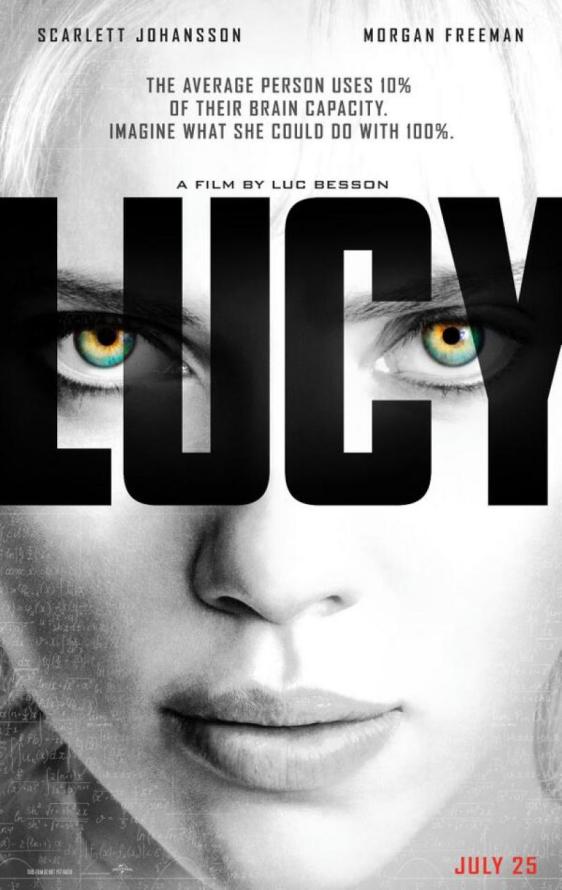
FilmWonk Podcast – Episode #54 – “Lucy”, “I Origins”

Poster for "Lucy"

This week on the podcast, Glenn and Daniel use roughly 20% of their cerebral capacity to review the new action thriller from Luc Besson, Lucy, starring Scarlett Johansson – then have a severe disagreement on the latest from Another Earth-director Mike Cahill, I Origins (58:06).

Editor’s note: Check out Glenn’s written review of I Origins here.

May contain NSFW language.

Still from "I Origins"

FilmWonk rating (Lucy): 7 out of 10
FilmWonk rating (I Origins): 6/10 (Daniel), 8.5/10 (Glenn)

Show notes:

  • (01:41): Lucy
  • (12:24): Spoilers for Lucy
  • (19:56): I Origins
  • (33:39): Spoilers for I Origins
  • Music for tonight’s episode is the track “Rebirth“, by Joseph Bauer/Hi-Finesse, from the theatrical trailer for Lucy, as well as the track “Dust It Off” by The Dø, from the I Origins soundtrack.
  • Trailer spoiler warning: Do yourself a favor and don’t watch the trailer for I Origins. Not only does it reveal major events in the film; it also presents an interpretation of the film that is at odds with at least one of our opinions.
  • Here’s a good roundup of the 10% brain myth from Dr. Steven Novella at the Neurologica Blog. Also, check out a history of the 10% brain myth from Andrew Tarantola at Gizmodo.
  • The hominid fossil Lucy was indeed an Australopithecus afarensis, but we had its location wrong – it was discovered in the Awash Valley in Ethiopia. It’s possible we were thinking of Chauvet Cave in France, where some of the oldest Paleolithic cave paintings in the world were found.
  • According to a December 2013 Harris Interactive poll, 74% of US adults believe in God, and 64% believe in an afterlife.
  • Daniel was correct about India’s biometric database – there are 600 million Indians enrolled as of May 2014.
  • A brief (albeit slightly out-of-date) rundown of Higgs Boson experimentation on Wikipedia, as some increasing confidence levels in 2014: NBCNews (23 June 2014), IFLScience (17 July 2014).
  • Glenn mentioned that Michael Pitt in I Origins looks a bit like Johnny Depp in Secret Window, an obscure and poorly received Stephen King adaptation from 2004 – have a look and decide for yourself!

Listen above, or download: Lucy, I Origins (right-click, save as, or click/tap to play on a non-flash browser)

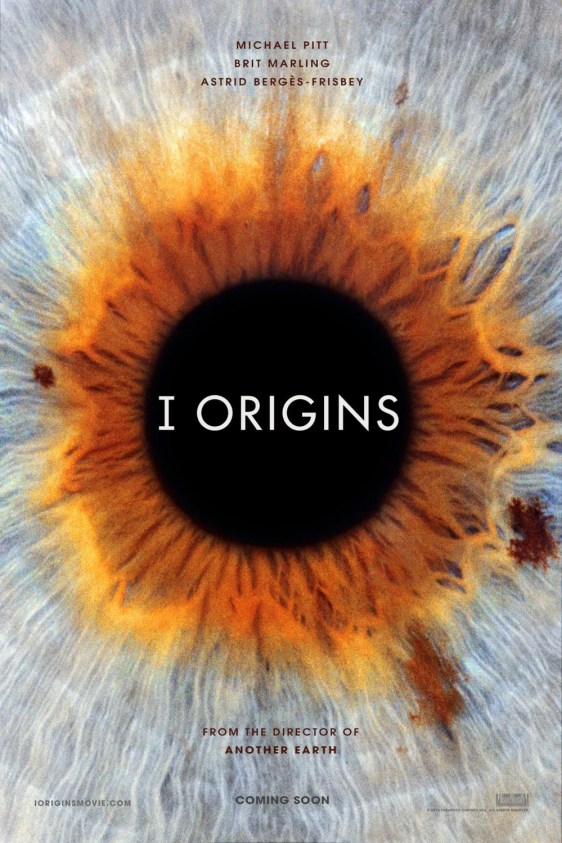
Mike Cahill’s “I Origins” – A faithful rendition of the scientific method

Poster for

Editor’s note: You can also check out our in-depth discussion of I Origins on the FilmWonk Podcast.

I worry that some people will come away from I Origins believing that it has abandoned its post in the apocalyptic battle between science and religion – that after spending easily half the film with atheistic scientist Dr. Ian Gray (Michael Pitt) fastidiously attempting to model each of the evolutionary steps in the development of the human eye, the film veers off into more conventional territory. That by delving into the supernatural, the film strips away its ambitions and becomes yet another Hollywood-kumbaya tale of how we should probably all just get along and believe what we want. But based on the evidence presented in the film, this couldn’t be further from the truth.

In the film’s opening scene, Ian meets Sofi (Àstrid Bergès-Frisbey), a model with whom he strikes up an immediate connection (i.e. they have sex in a house-party bathroom 30 seconds after meeting each other). To the film’s audience, they merely have chemistry. But to Sofi, they are driven by destiny. She believes that they knew each other in a past life, and that their improbable meet-cute is proof-positive of their supernatural connection. Like all manic pixies, she swoops away before Ian can get her name, and when they subsequently meet for real and strike up a whirlwind romance, one thing is clear – these two are deliciously, recklessly in love with one another, almost to the point of absurdity, given Ian’s care and attention to detail when it comes to his scientific pursuits.

His study is molecular biology, with a focus on the evolution of the human eye. His lab assistant Karen (Brit Marling) and fellow researcher Kenny (Steven Yeun) seek to fill in the gaps in scientific understanding of the evolution of the human eye, in order to silence one of the most prominent rallying cries of intelligent design – the notion of irreducible complexity. As the idea goes, certain structures, such as the human eye, are so biologically complex that they could not have evolved on their own from simpler structures without the guiding hand of an intelligent designer. There’s plenty more to read on this subject, but the film offers a fascinating treatment of the issue. Karen proffers that the human eye clearly did evolve, so the gaps are irrelevant – why waste time trying to fill them in? Ian counters by explaining that the gaps matter precisely because they’re being used to shoot scientifically inaccurate holes in evolution. The film distills the essence of scientific understanding into this simple back-and-forth. Why do we need to fill in the gaps? Because they’re there, and because we think we can.

Karen takes this ball and runs with it, trying to find an extant animal species that does not possess the ability or organs for the sense of sight, but possesses a particular gene that indicates that it could develop the trait. With 400,000+ sightless species to choose from, this is truly a needle-in-haystack pursuit, but Karen and Ian believe that if this species exists, they could genetically engineer an eye from scratch by forcing each of the incremental mutations to happen one at a time. Force the animal first to sense the presence of light, then its intensity, then its direction, and so on – until you have something like an earthworm with a human eye. These are the two competing forces that drive the first half of the film – there’s Ian’s romance with Sofi, driven by love (and, in Sofi’s case, by faith as well). And then there’s his drive to explain some of the deepest mysteries of the origins of life.
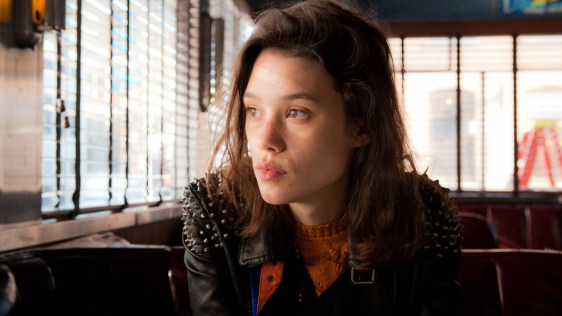
Still from

“Why do you work so hard to disprove God?” asks Sofi. “Disprove him?” replies Ian, “Who said that anyone has proven him?” Sofi’s perspective is underdeveloped and underplayed, and I’d say this is easily the film’s biggest weakness. It became evident as the film went on that this was likely a deliberate choice on Cahill’s part (Karen gets a bit marginalized as well) but I still found myself wishing for more. The film’s second half leans more heavily on Ian’s cataloguing of individual iris patterns. That is to say, he compulsively photographs people’s eyes whenever he meets them – it’s just a thing he does. And this is when the film begins to dip more heavily into the raging inferno of science vs. faith. I can’t speak at length on this subject without spoiling the film’s brilliant and mostly unpredictable second half, so I’ll just say two things.

First, Brit Marling, even for her medium-sized part in this film, continues to offer one of the most compelling screen presences I’ve seen.  I’ve enjoyed her performances in both films I’ve liked and disliked (including Mike Cahill’s last, Another Earth). Karen is actively driving the team’s research for much of the film, which is interesting, but many of Marling’s best moments come later in the film. There’s a difficult and awkward scene between Ian and Karen late in the film that was absolutely pitch-perfect. Both characters put their humanity on display in a manner that was completely unexpected. This scene was raw, real, and I can’t imagine any other pair of actors pulling it off so well.
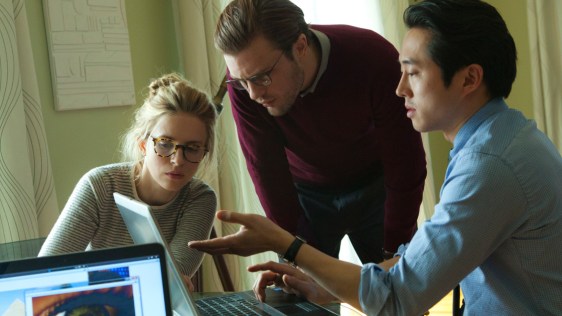
Still from

Second, this film directly addresses a point raised in the recent Ken Ham/Bill Nye debate on creationism. Just like most of Hollywood’s attempts to mingle science and faith, I personally found this debate to be a waste of time – a protracted exercise in feckless back-patting for either side. But there were two very telling answers to a question from the audience. The question, in broad strokes, was this: “What, if anything, could change your position on this issue?” You can view their answers in full in this video, but here’s an approximation. For Creationist Ken Ham, the answer was essentially “Nothing could change my mind. I’m a Christian.” For Science Guy Bill Nye, the answer was… “A single piece of evidence.”

That’s the scientific process in a nutshell – we find a piece of evidence that contradicts prior theories, so we test on and develop new ones. I Origins sets itself apart from other half-hearted Hollywood dalliances in science and religion by presenting scientists who really act like scientists. In the face of an anomaly that challenges their prior understanding, their reaction is…let’s do more science. This is a superlative point made in a subtle enough manner that I’m genuinely concerned about the audience taking the wrong idea away from the film. But all I can say is where the evidence took me personally on this film. It was a gripping, fascinating, and deeply affecting film, and it succeeded in exploring some complex and cutting-edge issues in a manner that felt consistently human and relatable. It is a stunning piece of near-future sci-fi, and easily one of the finest films of the year.

FilmWonk rating: 8.5 out of 10