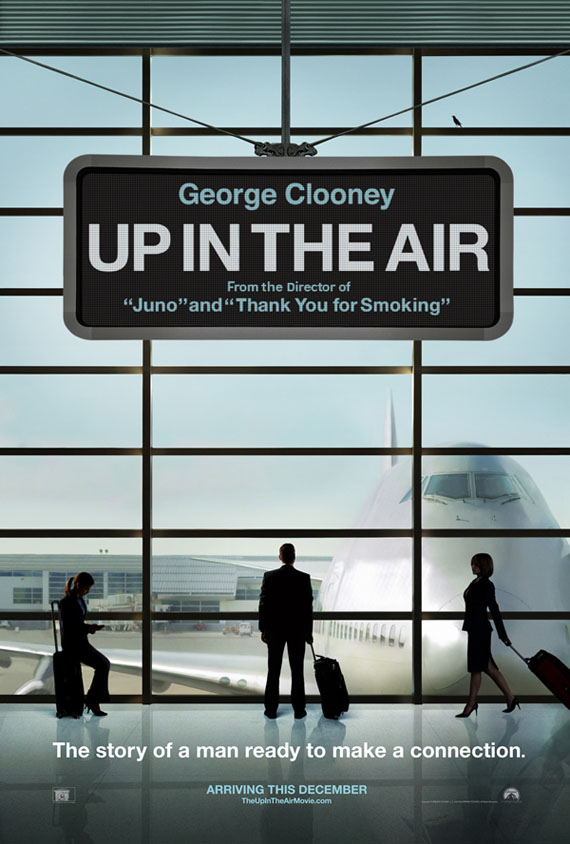
Jason Reitman’s “Up in the Air” – A brilliant and timely character piece

Jason Reitman’s Up in the Air is the story of Ryan Bingham (George Clooney), a corporate road warrior who spends over 300 days a year flying around the country firing people for a living. He spends his life in airports and hotels, brandishing an impressive collection of Executive Gold Club Cards as he bounces from one bastion of transient hospitality to the next.

“When I swipe my card”, Ryan informs us in the opening voiceover, “the system prompts her to say…”
“Pleasure to see you again, Mr. Bingham!” the clerk cheerfully announces.

Ryan is clearly in love with the road, in spite of (or perhaps because of) all the temporary trappings that come with it. The film’s treatment of air travel falls somewhere between Catch Me If You Can and Fight Club, and Ryan meets no shortage of single-serving friends along the way. One of these is Alex (Vera Farmiga), an enigmatic career gal who is on the road as often as Ryan. They bond after a brief hotel fling, and resolve to meet up the next chance they get.

And yet, those chances may soon come to an end, as Natalie Keener (Anna Kendrick), a brash, young coworker, proposes to slash the company’s travel budget and switch to firing people via videoconferencing. Facing the end of his life on the road, Ryan reluctantly agrees to take her along to show her the reality of his business. And that reality is a dubious one.

“Anyone who ever built an empire or changed the world has sat where you’re sitting,” intones Ryan as he fires a man named Steve (Zach Galifianakis, in a great cameo), “And it’s because they sat there that they were able to do it.”

This is a line we hear several times, and Clooney’s brilliant, tongue-in-cheek delivery leaves the audience constantly wondering whether or not he believes his own rhetoric. Indeed, his true motivation is one of the film’s central questions…

When Ryan isn’t passing out pinkslips, he makes appearances as a motivational speaker, advising people how to avoid connections in their lives. His message is clear – “moving is living”. He has a silver tongue, and would clearly say anything to convince Natalie why he should stay on the road. And yet as the film goes on, his firing scenes are peppered with what seem to be moments of genuine humanity. During one such scene, in which he fires a white-collar fifty-something named Bob (J.K. Simmons), Ryan gives a touching speech about what Bob needs to do in order to be admired by his kids.

And this may be the most provocative thing about Ryan. Whether or not he believes in his rhetoric, it has exactly the intended effect. Ryan has his own reasons for wanting to stay on the road (including a coveted number of frequent flier miles), but he constantly tries to impress upon Natalie how important and personal the moment of firing is. To hear him describe it, it sounds almost noble. They are the priests, administering the last rites to the doomed before they pass into oblivion, all the while assuring them that there is something bright and beautiful on the other side. “We are here to make limbo tolerable”, declares Ryan, and he is soundly mocked for it by Natalie.

The film constantly tries to have it both ways with Ryan. It is implied that he has had a multitude of one-night stands, and yet the very first one we see – Alex – is the one that might just turn serious. The film grants him semi-omniscient voiceovers that are equal parts self-aware and self-deprecating, but shies away from taking a position on whether he truly believes in what he’s doing. But somehow, Clooney’s performance just makes it all work. He plays with this ambiguity so well that the character is incredibly effective, especially in the interplay with his young colleague.

Still from Jason Reitman's "Up in the Air"

Natalie is a fascinating character – the consummate young career gal, ruthless and cynical, but with a very human side, full of all the self-imposed deadlines and anxiety about her future that all twenty-somethings tend to have. Anna Kendrick, who I’d only seen previously in a small and ineffectual role in the Twilight films, gives a masterful performance as Natalie, and is surely one of the actresses I’ll be watching for in the future.

It is only with the character of Alex that the film comes dangerously close to contrivance. She comes right out and tells Ryan to just think of her as “[himself], but with a vagina”, and assures him that she’s not a girl he needs to worry about. The character seems a bit facile at the beginning, but Vera Farmiga gives a fantastic performance. And as her relationship with Ryan develops, the character seems more and more plausible. And while it’s fairly easy to see where the story is going with this character, she does treat us to one of the film’s best scenes, in which Ryan and Alex share their views on love and marriage.

The script for Up in the Air, adapted by Jason Reitman and Sheldon Turner from a novel by Walter Kirn, contains some of the richest dialogue and most effective scenes I’ve had the pleasure of seeing this year. The performances are also something to see. In addition to the three strong leads, Jason Bateman gives a impressive turn as Bingham’s boss – he’s a ruthless company shark with just a bit of a humorous streak to him, seemingly channeling Stephen Root in No Country for Old Men. It’s like nothing I’ve ever seen from Bateman, and I was quite impressed.

We also see dozens of people being fired in this film, and most of them were quite convincingly played by real people who’ve lost their jobs during the recession. The film even includes an end-credits song that was seemingly performed on spec on the director’s answering machine. This could easily have come off as pandering to an audience in economic turmoil, but it just lends so well to the relevance and immediacy of this film.

While Up in the Air bears a few similarities to Reitman’s last bit of corporate satire, Thank You For Smoking, it has a much more somber tone. It retains the same darkly comedic style (and presents another fantastic soundtrack) while covering a lot more ground. It takes a great number of risks, but stops just short of spreading its characters too thin. And it is one of the finest films I’ve seen this year.

FilmWonk rating: 9 out of 10
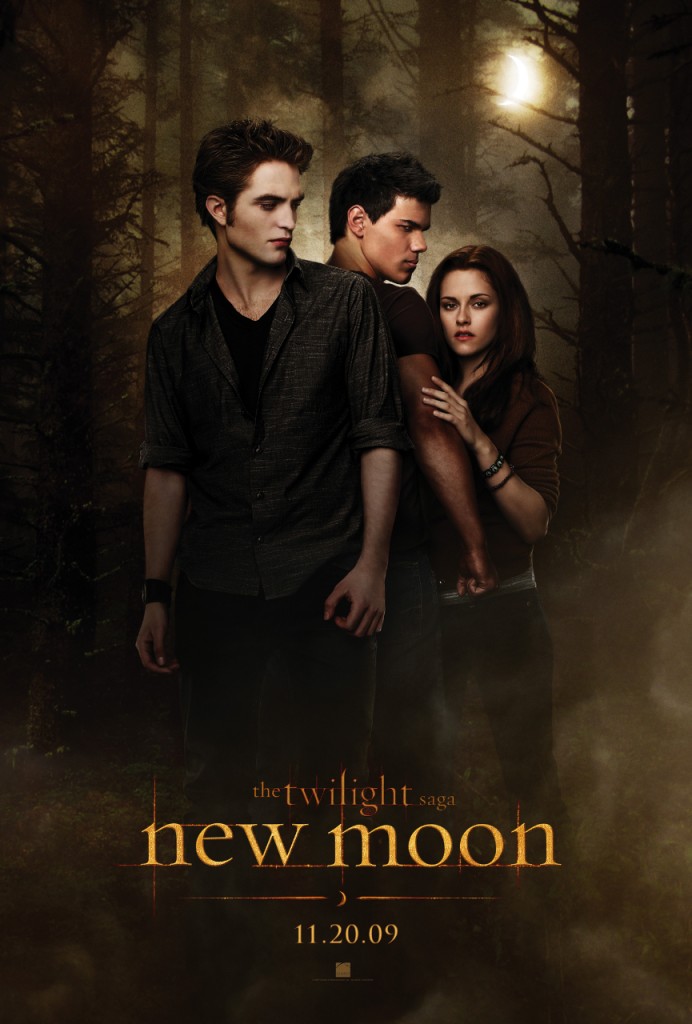
Chris Weitz’ “New Moon” – Mostly harmless, mercifully forgettable.

Poster for Chris Weitz' "New Moon".

Kristen Stewart returns to the screen as Bella Swan, a teenage girl passionately in love with the vampire Edward Cullen (Robert Pattinson). Ordinarily, I would begin with a more in-depth plot description, but that’s really all you need to know. In fact, that’s basically all that happened in the first Twilight film, minus a brief diversion of vampire baseball.

In point of fact, I would love to start this review with an impassioned screed against Stephanie Meyer’s puerile prose and hackneyed attempts at supernatural mythology… How she wouldn’t know a vampire if he strutted his hot, sparkling body up and bit her… How she’s taken the framework of an innocuous teenage love story and turned it into a ham-fisted allegory for Mormon sexual abstinence… How her quixotic creation, Edward Cullen, the overbearing and overprotective centenarian in the body of a 17-year-old has been inexplicably and irresponsibly cast as the ideal boyfriend for millions of impressionable teenage girls – as well as masturbatory fodder for their bored, cradle-robbing mothers…

I would love to say all of this. But I can’t, for two reasons. The first is that most of it is overreaching, hyperbolic nonsense. Teenagers aren’t well-known for their adherence to heavy-handed abstinence allegories, and their penchant for worrisome role models is only surpassed by their speedy disinterest in yesterday’s cheesy fad (which might explain how quickly Summit is cranking these films out). As for supernatural mythology, I don’t care any more about Meyer’s version of a vampire than I do about Tolkien’s version of an elf. She is certainly not the first offender when it comes to flouting the traditional rules. While I’m happy to criticize her vampires for their inconsistency and sparkling skin, I do so because these things are stupid, not apocryphal.

But the main reason I can’t go off on New Moon for any of the above points is that it didn’t really provoke such a reaction from me. It didn’t inspire much of any reaction, in fact. It was just a bland diversion, peppered with gratuitously half-naked adolescent boys.

On the surface, it is noticeably superior to the first Twilight film. For a start, there’s some semblance of a plot. Bella and Edward start off by talking at length in English lit class about the various ways in which they resemble Romeo and Juliet, and how they would go about killing themselves if they were ever separated. This seems rather irresponsible in a film marketed to brooding teens, but I’ll go with it. For you see, the vampires of this world are so strong, they’re incapable of even killing themselves. This rule is a bit too much like God creating a rock so big that He is incapable of lifting it for my taste, but I can also accept this, since it only leaves one [thoroughly entertaining] method of suicide at Edward’s disposal – being literally ripped limb from limb by three other vampires.

The superficial nods to Romeo and Juliet continue, as Edward is banishèd from the film a few minutes later. When Bella gets a blood-drawing paper cut at her birthday party and is nearly attacked by one of Edward’s vamp brothers, he resolves to move away and never return. Following the loss of her undead lover, Bella goes variably between a spat of faux-self-destructive teenage angst and a bit of shameless, “I like you as a friend” pursuit of her werewolf buddy Jacob Black (Taylor Lautner). True to form, Bella spends nearly half of the film failing to realize her friend’s furry little secret…
But when a bit of well-deserved werewolf jealousy and a series of nonsensical miscommunications lead Edward to believe that Bella has died, he does the prudent thing, and heads to Italy to provoke the vampire royalty into executing him. Given that Robert Pattinson’s acting hasn’t improved much from his abysmal turn in the first film, I was rather hoping Edward would succeed in this endeavor, but alas, it wasn’t meant to be.

Director Chris Weitz has previously proven his visual chops in his terribly adapted but pretty-looking 2007 film, The Golden Compass, and he has brought some much-improved filmmaking to this series. Unfortunately, any effective visual storytelling in New Moon is constantly undermined by the characters themselves. The opening scene is a gorgeous dream sequence in which Bella sees an elderly woman walking through an alpine meadow. Edward, the perpetual teen, strolls across and lovingly greets the woman, and Bella quickly realizes that she’s looking at her future self. This was one of several impressively shot sequences in the film, and brilliantly introduced Bella’s anxiety about aging past her boyfriend’s perpetual youth. But like every other theme in this film, it goes on to be explicitly spelled out about a dozen more times, which ultimately undermines it. Even as Bella pretends to make the choice of becoming a vampire so she can stay young with Edward forever, it is constantly being made for her by various characters as the film goes on.

In spite of the dubious character work, there is a bit of decent acting on display. Kristen Stewart can scarcely do wrong in my eyes after her wonderful performance in Adventureland earlier this year, and she brings back most of her charisma for this film. However, there are several moments in which she reads her lines so woodenly it sounds like she can hardly believe what she’s saying. I couldn’t help but chuckle when Bella breathily suggested that the group go see a movie (with the hilarious title of “Face Punch”), because it contains, “Action, adrenaline…woo! That’s supposed to be my thing now…”

It’s okay, Kristen. I didn’t believe it either.

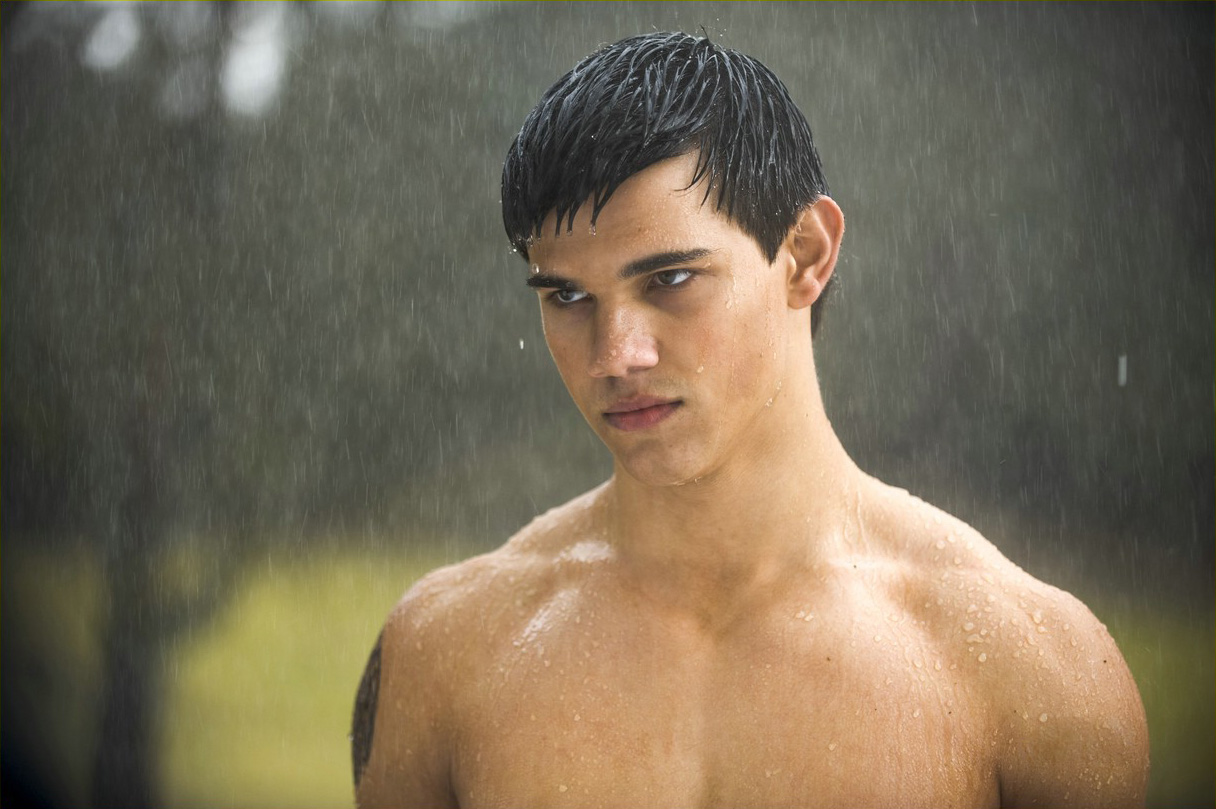
Still from Chris Weitz' "New Moon".

Taylor Lautner, on the other hand, did a fantastic job. Call me crazy (or a pederast), but I have to say I’m on “Team Jacob”, at least when it comes to acting talent. Lautner is helped along somewhat by Meyer’s genuinely interesting take on werewolves – they’re basically pack-hunter versions of The Incredible Hulk – but I have to hand it to this kid. He spends most of his screentime showing off his chiseled abs and ‘roided biceps, and that’s basically all he needed to do for the target audience. Nonetheless, he delivers every one of his ridiculous lines with the gravitas intended on the page. I’d say he was hamming it up, but he just comes off as completely earnest.

I’m not sure how to conclude this review, since I don’t really have any strong opinions about this film. If I were to take it remotely seriously, it would be offensive on a number of levels, but it’s mostly just mindless pap for the teenage masses. Every interesting or provocative plot point either gets reversed by the end of the film or hammered into the ground. There’s a love triangle, but not really… Bella becomes an adrenaline junkie, but not really… The star-crossed lovers are separated forever… But not really. A girl is forced to make a serious, life-altering choice… But not really. If nothing else, the story demonstrates Stephanie Meyer’s tenuous relationship with tragedy – her characters constantly embrace it, but shy away from any real consequences, and the storytelling is happy to let them get away with it.

The Twilight saga may have broken me. I might have to forgo the next film and wait for David Cronenberg’s gory exploitation version of Breaking Dawn (*fingers crossed*) (contains NSFW language).

FilmWonk rating: 4 out of 10

Roland Emmerich’s “2012” – Does what it says on the tin

Roland Emmerich’s 2012 may well and truly cement its director as a one-trick pony. It’s as if he wanted all the global-scale disaster of The Day After Tomorrow (and then some), but to be even less restrained by minor scientific trifles. Indeed, if there’s one word that aptly describes this film, it’s “unrestrained”. Just as Transformers 2 was a $200-million-dollar channeling of an 8-year-old Michael Bay playing with his toys, this film is Emmerich tramping through the sandbox, wreaking unimaginable havoc upon the other children. He is his own Godzilla. He is rage. He is bile. He is become death, the destroyer of worlds.

This film absolutely revels in destruction, and yet successfully strikes the tone of a light-hearted adventurous romp. It also features a truly remarkable character. Jackson Curtis (John Cusack) is a struggling divorcé sci-fi writer-cum-limo-driver. Nothing special about him whatsoever. And yet, as the film goes on, his true role is revealed. He knows exactly the right people. He gets all the right information. He is always in the right place at the right time. He can drive a limousine with a missing door through the plate-glass of a collapsing building as his un-seatbelted family holds on for dear life, and make it to the airport to take off in a fully fueled plane, seconds before the runway is swallowed into hellish oblivion – not once, but twice*… And he always comes back for more.

The film gives us little doubt about who this man is. He is the Luckiest Man in the World.

I’m sure other versions of him come to mind. Jack Bauer, John McClane, James Bond… We’ve seen characters with absurdly persistent luck before, but it’s usually shrugged off as a combination of training, enemy ineptitude, and contrived invincibility. What makes 2012 so remarkable is that it may offer the most convincing explanation yet for this character. It’s the end of the world. And naturally, there will be a smattering of survivors. A few scientists, rich people, AND the Luckiest Man in the World. The film could easily have focused on one of the many barely seen individuals whose unceremonious slaughter makes up the beautifully rendered CG backdrop through which our heroes must cavort, or one of the additional billions who die off-screen, not fortunate enough to meet their end in front of a famous landmark or city skyline… But let’s be honest, who really wants to see that movie?

Whether deliberately or inadvertently, Roland Emmerich has seized upon one of the fundamental truths of large-scale disaster. The bigger the disaster, the harder it is for us to fathom the loss of life in any meaningful way, and with the fictional – and frankly silly – apocalypse on display here, it’s hardly worth trying. So instead, as with Emmerich’s previous films, 2012 focuses on a plethora of characters, many of whom are one-dimensional and serve no other purpose besides cannon fodder, and yet he succeeds far more often than he should at making us genuinely care about them. One scene, in which an old man calls his estranged son to make amends – a setup that absolutely begs for a schmaltzy goodbye – nearly shocked me to tears with its actual ending.

The performances were adequate for the subject matter, but there were a few standouts. Chiwetel Ejiofor and Oliver Platt are two government officials – fairly one-note representations of Compassion and Pragmatism respectively – but they do an admirable job with their limited material. Woody Harrelson is absolutely hilarious as an Art Bell sort of radio host. Zlatko Buric gives an adept performance as Yuri Karpov, a retired Russian boxer and billionaire. Karpov is a fascinating, albeit slightly uneven character, and he gives a provocative (but straight-forward) justification when discussing the ethics of buying himself a seat on mankind’s only chance of salvation. He gazes mournfully across at his wife and children, and asks Curtis, “If you were rich like me, what would you have done?”

Indeed, the ethics of self-preservation are a central question in this film… We see a meeting of the leaders of the G8 – the richest countries in the world – who come up with a plan to build a series of Arks to save a small percentage of the population. Amusingly, the manufacture of the Arks is outsourced to China, but for a very good reason – the scientists have somehow [correctly] predicted that a megatsunami will cover the Himalayas with Emmerich’s signature non-receding ocean water.

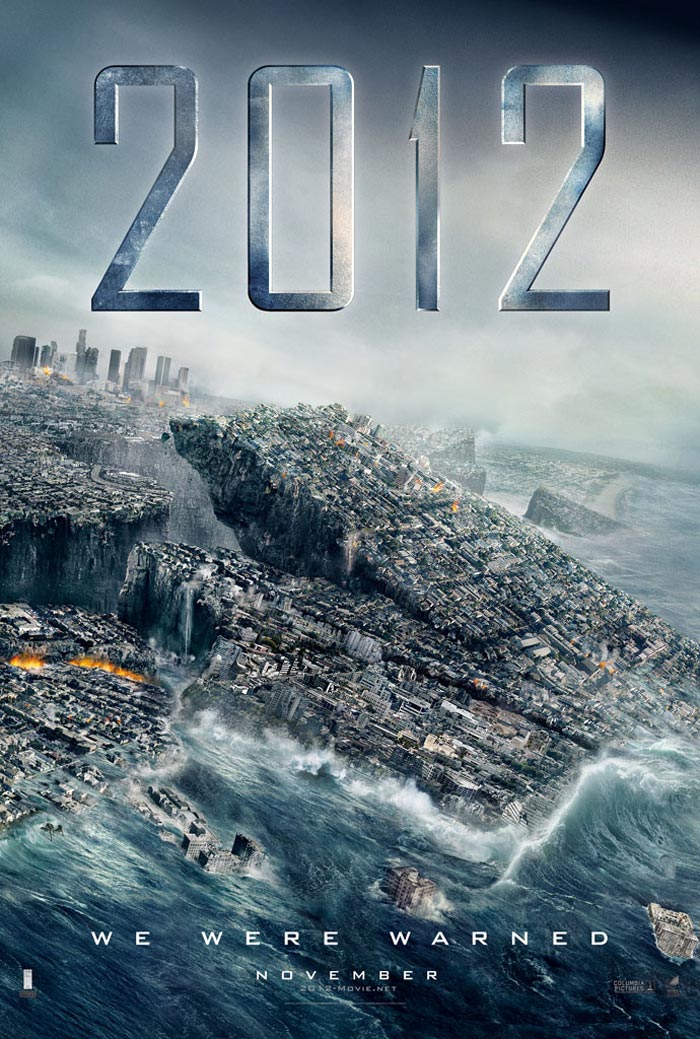
Still from Roland Emmerich's "2012".

At this point, I must mention, the bad science in 2012 did take me out of the film once or twice. Most of it strays just far enough from reality to provide exciting and implausibly narrow escapes for our heroes, but there were a few truly egregious offenses, most of them tsunami-related. Bad science also provided the fuel for a horribly contrived end sequence – I won’t spoil the details, but suffice to say, it goes on far too long and was entirely unnecessary. I would recommend you not think too hard about the ending of this film, but Emmerich’s planned followup TV series, “2013”, may force me to revise that position.

This is the most thoroughly the world has ever been destroyed on film (with the possible exception of Titan A.E.), and the visuals certainly seem to emphasize quantity over quality in a few scenes. Nonetheless, they are mostly brilliant – one scene, depicting the eruption of a supervolcano, featured perfect visuals and near-perfect drama. But for most of its run, 2012 is just a huge, ridiculous ride. It’s more of the same from Emmerich, but if you’ve enjoyed any of his earlier disasters (as I have), it’s well worth a look.

FilmWonk rating: 7 out of 10

*A gimmick the filmmaker is clearly fond of.

Bonus: Check out this amazingly recut trailer for “2012: It’s a Disaster!” from Garrison Dean of io9.com:

Lars von Trier’s “Antichrist” – Horrific in the truest sense

Lars von Trier’s Antichrist boasts some of the most breathtakingly gorgeous cinematography of any film this year, and is easily one of the most disturbing films I’ve ever seen. It tells the tale of an unnamed couple, He (Willem Dafoe) and She (Charlotte Gainsbourg), who hike to their secluded cabin in a pristine wood called Eden to struggle with their grief following the accidental death of their toddler son.

At this year’s Seattle One-Reel Film Festival, I saw a short film called Tara, whose horror I described as “simple, mundane, and rather cryptic“. Like this film, it was boring and ponderous for much of its runtime, but played deeply and effectively on male apprehension about the secrets of women.

Antichrist explores similar territory, but in a more severe, graphic, and haunting manner. He is a trained therapist, treating his wife for her grief and fear, despite the obvious conflict of interest of their marriage and continued sexual relationship. She blames herself for their son’s death, while He seems largely unaffected by it. Meanwhile, they are visited by a series of animal apparitions – Grief, in the form of a doe, Pain, in the form of a fox, and Despair, in the form of a trickster crow. These animals – who come to be known as the Three Beggars – are each profoundly disturbing in some way, and without spoiling too much, I’ll simply say that they effectively encapsulate their associated emotions. It’s unclear if these animals are real, a hallucination, or some combination of the two, but they nonetheless contribute a great deal to the unsettling and episodic nature of the story.

I must also note that von Trier has crafted a film that is unrelentingly misogynistic. Its thesis is spelled out clearly by its female lead, who declares in a singsong voice that “a woman crying is a woman scheming”. This is after She informs us that the bodies of women are ruled by nature rather than reason. Her subsequent actions thoroughly bear out this view of women, whom von Trier seems intent on casting as evil and sadistic by nature.

And yet, the evil and sadistic one may in fact be von Trier himself. The self-styled “best director in the world” sits in his lair thinking, “Ah ha! Watch the foolish, PC, and mostly male film critics leap to the defense of women…playing directly into my hands!” In truth, I can only speculate about von Trier’s motives for making this film, but the most consistent message that I received from it was utter disdain for the audience – male and female.

Antichrist balances precariously between brilliant, independent filmmaking and a “MADtv” parody thereof. The performances (particularly Gainsbourg’s) are fantastic, but bewildering. It features some ravishing cinematography, and yet contains enough gratuitous slow-motion to make even Zack Snyder blush. It also depicts (and fetishizes) graphic sexuality, violence, and combinations of the two, in ways that seem exclusively intended to support the film’s thesis about the evils of women. And what of this thesis? After days of pondering it, I must conclude… Of course women are schemers. People are schemers, and women are people, no matter what Lee Majors might say. And while I doubt von Trier is the world’s best director, he is certainly one of its greatest schemers.

I once said to a friend (amid an argument about Terry Gilliam’s classic dystopian film, Brazil) that anyone can disagree with me about a film, but they must never insult my ability to form a valid opinion about it. With Antichrist, von Trier has succeeded in creating the closest thing to a criticproof film that has ever been hatched.

You’ve done me a grave insult, von Trier, and for this, you get a mere 5.

And another point for unleashing my inner turmoil. Now get out of my sight, you arrogant bastard.

FilmWonk rating: 6 out of 10

Bad Trailer/Good Trailer: “Brothers” and “The Crazies”

I saw F. Gary Gray’s Law Abiding Citizen last night, and saw two incredible trailers, which prompted this aside:

The purpose of an advertisement is to make me want to buy your product, Hollywood. If I don’t see a trailer for your film, I’ll at least feel neutral about it. If I see a compelling, provocative trailer, I may well want to see the film. But if I see a trailer that gives away the whole damn plot (or at least gives me that impression), it will leave me utterly uninterested.

Whether we’re talking about a cheesy, but potentially enjoyable armored car heist or Tom Hanks forging a deep friendship with a volleyball, this has been a problem for a while.

But it’s rare that I’ve seen such an egregious offender as Jim Sheridan’s Brothers:

I don’t need to see this movie. Ever.

Remarkably, in the same evening, I saw an absolutely balls-out-audacious trailer that gave away a TON about its film – Breck Eisner’s “The Crazies” – and yet still left me wanting to see it:

Story structure exists for a reason. You can pitch me a movie without revealing every twist. It’s okay. Really.

Both of these films have their selling points. The acting looks solid in Brothers, and I’m quite pleased to see someone acknowledge the uncanny resemblance between Jake Gyllenhaal and Tobey Maguire. I approve of the The Crazies‘ shameless appropriation of Gary Jules’ “Mad World” (originally written for Donnie Darko), and it looks like potentially fun cheese (although I’ve been burned by that assessment before).

These films may be good or bad, and that’s really not the point. We’re talking about the difference between a book jacket and the Cliff’s Notes.

Tantalize me, Hollywood. Give me a little, and leave me wanting more, and I may just buy a ticket.

*There are two exceptions to this rule:
-Romantic comedies. The quantity of “spoilers” in the trailer had no bearing on my decision not to see Love Happens.
Marley and Me (only obliquely related, and thoroughly spoilerific).

Ruben Fleischer’s “Zombieland” – Better than it has any right to be

Poster for "Zombieland".

Ruben Fleischer’s Zombieland is about four people milling about in a world overrun by zombies. And…that’s about it. My expectations were low for this film. Back in June, when I wrote up the trailer, I referred to it as “the latest entry in an already clogged genre”, and attempted to explain the zombie phenomenon as an societal indulgence of psychopathic fantasies of mass slaughter. And in that grain, it did not disappoint.

These zombies are no slow-moving, Romeroan allegory for a society steeped in consumption and conformity. They’re beasts. They chase down and slaughter humans in grotesque, blood-spattering, gratuitous, slow-motion glory, in an apparent attempt to combine all the cinematic advantages of both fast and slow zombies. And Tallahassee (Woody Harrelson) is the rough-and-tumble zombie-killin’ cowboy who’s happy to put them down. To say that at least one scene ends with him literally standing atop a pile of dead zombies hardly merits a spoiler warning.

In fact, I’m not sure if I could spoil the plot of this movie if I tried. Ruben Fleischer has accomplished something truly remarkable here – he’s created a world that is not only completely devoid of plot, but could not logically include one. America is empty, save for a few aimless, meandering zombies and even fewer aimless, meandering humans. No one has a long-term plan or even a short-term objective, save for the usual rumors – the eastern survivors hear there’s a zombie-free zone out west; the western survivors hear there’s a zombie-free zone back east. As Tallahassee puts it when speaking to his new protégé, Columbus (Jesse Eisenberg), “You’re like a penguin at the North Pole who hears it’s nice at the South Pole this time of year.”

If that’s all this movie had been – an aimless, nihilistic slaughter fantasy – it would’ve been a huge disappointment. And yet, this film contains some truly remarkable character work. The survivors meet under the most random of circumstances, and band together (eventually) because they don’t know what else to do. After a brief Mexican standoff, Columbus catches a ride with Tallahassee, and the two are eventually joined by Wichita (Emma Stone) and her sister, Little Rock (Abigail Breslin).

At first, there is very little sentimentality amongst these four. They refer to each other by their respective cities of origin, so as not to become too attached. They make blithe reference to the demise of each other’s loved ones. They have some pretty serious trust issues.

And yet, amid this loss of identity and hope, they gradually remember what it’s like to be human. For a long second act in which we see almost no zombies, these four actually start to open up to each other. This piecemeal family-amid-disaster could easily descend into maudlin territory, but the film manages to humanize these characters without losing any of the fun and cynicism of the first act. When the inevitable “romantic” subplot occurs between Eisenberg and Stone, it consists of the latter asking the former to join her so she doesn’t have to drink alone, shortly before announcing that she “could hit that”.

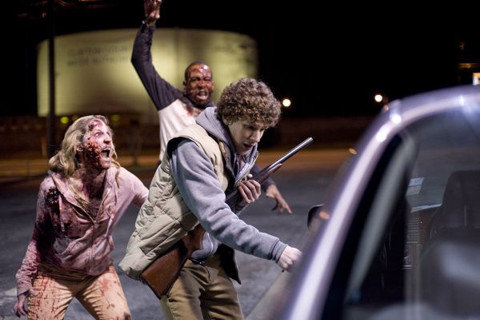
zombieland

Harrelson and Breslin perform admirably in their roles, despite not getting much time to shine in the film’s 88 minutes, and Emma Stone’s performance is adequate, although her character’s motivations become increasingly muddled as the film goes on. But the strongest performance in the film is easily Jesse Eisenberg.

I’ve been a fan of Eisenberg’s since Adventureland, and he continues to demonstrate his prowess as an actor, doing a better job at playing Shia LaBeouf roles than LaBeouf himself. Columbus really is the emotional center of this film, and it is a testament to Eisenberg’s performance that I can refer to any of the characters as such. Columbus has stayed alive by following a self-imposed list of rules – some practical (“Wear seatbelts”), cautionary (“Beware of bathrooms”), or even philosophical (“Don’t be a hero”). They’re eventually supplemented by an entry from Tallahassee – “Enjoy the little things.”

If I had to extract a message from the film, it would be that last rule. It is exemplified by one of the best scenes in the film, in which the characters wreck up a kitschy souvenir shop at an Indian casino just for the hell of it. The amusement park climax of this film is more or less completely forgettable, and yet there are so many brilliant little scenes between these characters that I thoroughly enjoyed the time I spent with them. As a horror flick, creature thriller, or road-trip tale, the film does very little to distinguish itself, and as a zombie film, it’s actually rather boring (and devoid of zombies!). But as a comedy and character piece, it is quite an accomplishment.

FilmWonk rating: 7 out of 10

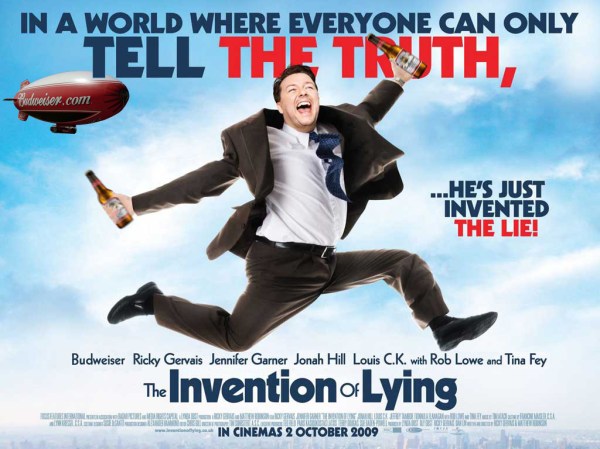
Ricky Gervais’ “The Invention of Lying” – Those jeans make you look fat

Ricky Gervais is a chubby little loser who became semi-famous among a small group of Americans for creating a British TV series called “The Office”. Like most British comedy, the show was very dry, and appealed mostly to those few Americans who appreciate obscure foreign cultural references and being rendered physically uncomfortable. It was eventually adapted by American comics to much greater success, owing largely to its attractive cast and lack of silly accents.

For the record, I adore both versions of “The Office”, and I only refer to Gervais as a “chubby little loser” because he’s quite fond of referring to himself as such. But this is the world of Ricky Gervais and Matthew Robinson’s The Invention of Lying – a world of brutal and unrepentant honesty. Gervais stars as Mark Bellison, an unsuccessful screenwriter who accidentally discovers that he has the ability to lie. Anna (Jennifer Garner) is Mark’s potential love interest, with the minor hitch that she doesn’t find him attractive (and is happy to tell him so), and Brad Kessler (Rob Lowe) is a thoroughly loathsome rival to Anna’s affections. Jonah Hill and Louis C.K. appear as Mark’s friends, joining a host of comedic cameos, including Martin Starr, Jeffrey Tambor, Tina Fey, Jason Bateman, and an almost unrecognizable Ed Norton.

Unsurprisingly, with so many comedic greats on board, the film excels at the humorous exploration of its reality. In a world with no lies, what are movies? What are advertisements? What is dating? All of these questions (and more) are answered, and the resulting world feels a bit like Liar Liar. Characters are forced to tell the absolute truth, and they do so even when they aren’t asked a direct question, making this not so much a world of honesty as a world of too much information. It would be downright alarming if not for the fact that no one reacts to these startling revelations in any visible way. In this sense, they seem childlike – an image that is reinforced as soon as Mark realizes how easy it is to lie to get what he wants. This kind of behavior could easily come off as predatorial, but Mark doesn’t entirely understand his new power, and is mostly well-meaning.

The people of this world start off with a blank slate, and the first half of the film resembles a Lockean state of nature (minus any notion of God) – which makes it all the more fitting when Mark accidentally invents the concepts of God and Heaven at the top of the film’s second half.

At this point, this film might well be retitled “The Invention of Religion”, and becomes perhaps one of the most overtly antireligious films of the year (which might explain its pervasive Budweiser product placement – gotta pay the bills somehow). For his part, Gervais seems quite at home in the ranks of atheist comics – he even delivers a hilarious “Ten Commandments” scene reminiscent of George Carlin. This act feels more or less like an origin story for morality, and is at least moderately fascinating as such. Unfortunately, Mark is not the most well-conceived moral authority. His morality is tenuous, illogical, and largely inconsistent. It seems mostly derived from Gervais’ desire to poke fun at religion, and in that sense its shortcomings may be at least somewhat deliberate. Nonetheless, at this point, Mark ceases to be a real character, and his romance with Anna starts to further strain credulity (despite a worthy effort by Jennifer Garner).

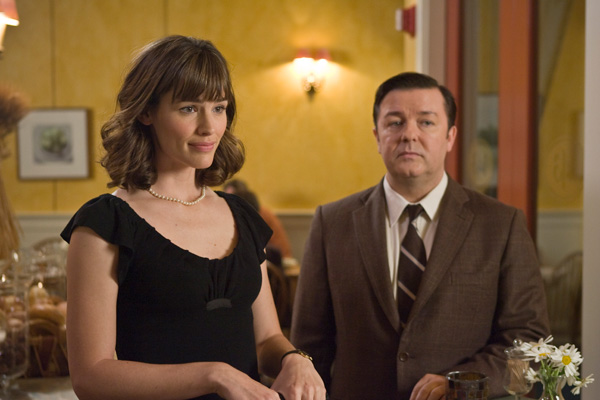
ricky-jennifer-the-invention-of-lying

Anna is a fascinating case study in this world. She likes Mark, maybe even loves him. But she can’t be with him because Brad Kessler is more attractive, successful, and a better match for her genetically. In a world of no lies, the purpose of dating is getting married to make babies. Anna does not have Mark’s ability to lie, but she would have to go against her biological imperative in order to be with him (resulting in “little fat kids with snub noses”). With Anna, the film comes very close to classifying love as a form of self-deception, and this may ultimately be its most provocative theme.

Since “Extras”, Ricky Gervais has shown his aptitude for exploring the ideas of fame and undeserved notoriety, and this film definitely continues in that grain. But The Invention of Lying just feels like a bland entry, dabbling in many complex and fascinating ideas, but spending far too much time undermining them. The resulting allegory may well be enjoyed by some, but is mostly forgettable.

FilmWonk rating: 5 out of 10

Week in Brief: “Whip It”, “Cloudy With a Chance of Meatballs”

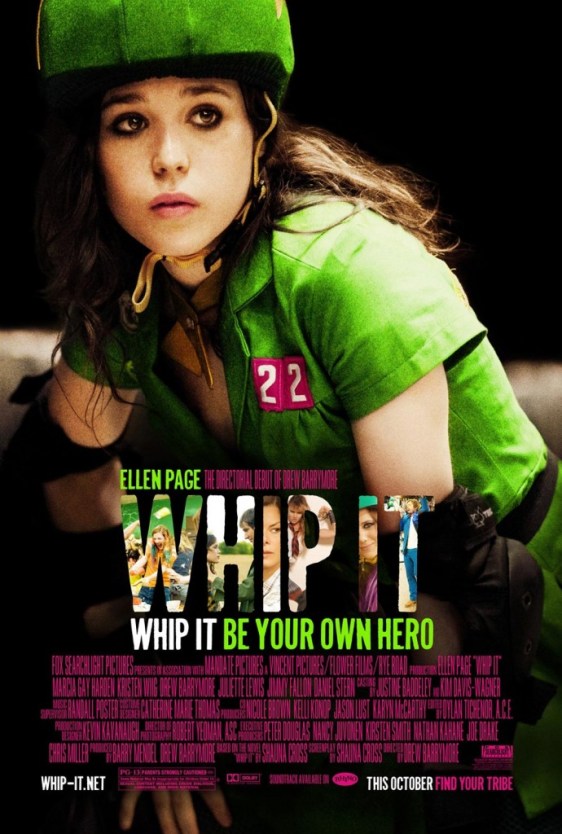
whip-it_poster-690x1024

Drew Barrymore’s directorial debut, Whip It, is the story of Bliss (Ellen Page), a 17-year-old girl who takes a shine to roller derby – the sport in which ladies both lovely and terrifying skate around a banked oval track throwing elbows and attempting to collapse each other’s lungs while passing their opponents’ crumpled bodies to score points. The title refers to a technique whereby one or two skaters act as an anchor to in order to “whip” a teammate past them – a slingshot maneuver designed to greatly increase the teammate’s speed around the track. When I saw this and similar maneuvers put forth in the later matches of the film, I couldn’t help but think of the “Flying V” of The Mighty Ducks. Indeed, Whip It ends up falling somewhere between a Disney sports film and a Texas football tale, and even without the other story trappings, it would be an admirable entry in the sporting genre.

Bliss’ mother Brooke (Marcia Gay Harden) puts constant pressure on her daughter to stay pretty and compete in events that are equal parts beauty pageant and debutante ball, and is naturally appalled to find out what her daughter is doing with her spare time. The parallels to overeager Texas football dads aren’t exactly subtle, but this subplot worked well for me, owing largely to Page and Harden’s performances, as well as that of Daniel Stern as Bliss’ father.

When confessing her secret sporting life to her parents, Bliss proclaims, “I am in love with this!”. This line was in the trailer, and Page delivered it with such earnestness that it was almost solely responsible for my interest in this film. The story of a teenager in love who doesn’t need to wallow in brooding, misunderstood angst was strangely appealing to me, and Page’s performance delivered on every bit of promise from this line.

And yet, Bliss is not an unrealistic or idealized teen. She acts bratty and selfish at times, and is ultimately put in her place a bit for it. She partakes in a romance with a local guitarist, for no clear reason other than because he’s (omg) super-hot. This storyline initially seems pointless, but pays off rather well in the end, and treats us to a bizarre, but entertaining underwater makeout scene.

The supporting cast is solid, with great performances from Alia Shawkat (“Arrested Development”), Zoe Bell (the Kiwi stuntwoman from Death Proof), Andrew Wilson (Idiocracy), and Kristen Wiig (“SNL”) – who proves her acting chops even without her signature comedic deadpan. The great Juliette Lewis is also effective as a rival derby player.

The only real weak link in the acting – with the exception of Jimmy Fallon as an absolutely repellent announcer – is director Drew Barrymore. I was conflicted about her presence as an actress in this film; at times, it seems self-indulgent. Barrymore plays a member of the derby team – basically a non-character, lacking any defining characteristics beyond her nom de guerre (Smashley Simpson). I can’t comment much on her performance, since she doesn’t really do much acting, but she does bring the same convincing physicality to the derby sequences as the ladies above (granted, I have no idea how many of the stunts were actually done by the actresses). There’s seems to be no reason for her to be in this film except to join the fun, but I can’t fault her too much for it.

As a freshman filmmaker, Barrymore’s direction is not mindblowing, but she has done a fine job. Cinematographer Robert Yeoman brings the same sort of semi-grainy look that he’s used in every one of Wes Anderson‘s films, but it works fine here. The camera starts off tight and claustrophobic – focusing on a one or two players at a time, intermixed with POV shots (seemingly from a camera on skates), but as the film goes on, the shots get wider, and we see more and more. The direction kept the action coherent, built the matches’ interest as the film went on, and brought an adequate measure of intimacy and earnestness to the character moments.

The empowering message of “Be Your Own Hero” is ever-present, but not overwrought. If there’s one message the film conveys best, it’s that roller derby looks brutal and immensely fun, and it’s wrapped in enough solid character work to make this a memorable film.

FilmWonk rating: 7.5 out of 10


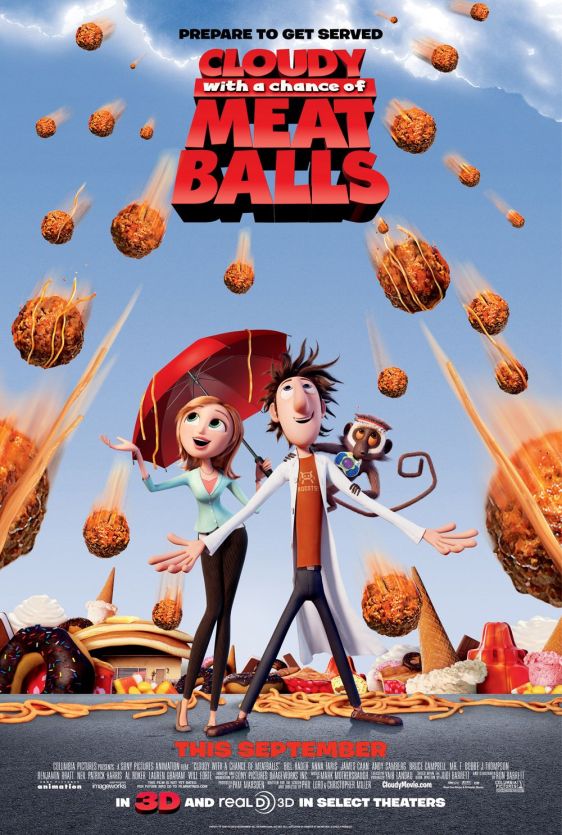
Poster for "Cloudy With a Chance of Meatballs".

Every once in a while, a film comes along that challenges Pixar’s well-earned dominance of the animation market. A film with a solid story, compelling characters, and gorgeous animation. Last year, it was about a panda that wants to learn kung fu. This year, it’s about a scientist who builds a machine that turns rain…into food.

Flint Lockwood (Bill Hader) is a crackpot inventor who has built a myriad of bizarre inventions since childhood, from spray-on shoes to a monkey thought translator. His latest invention is a machine that can “mutate the genetic formula of water to turn it into food”. And that’s about as detailed as the science gets in this film. Lockwood’s lab is designed very much in the Calvin and Hobbes aesthetic, complete with a set of blast doors painted onto a curtain. And just like Calvin, all of the science he develops is immensely fun and borderline magical.

Lockwood lives on a drab island town in the North Atlantic called Swallow Falls, which had previously survived solely on its sardine industry. This industry collapsed when it was discovered – and announced in newspapers the world over – that “Sardines Are Super Gross”. While the town makes an ill-conceived attempt to revitalize through “sardine tourism”, Lockwood’s invention accidentally blasts into the sky (as crackpot inventions are wont to do), and he discovers that it can be programmed remotely to make the skies rain down any food the townspeople want like manna from heaven.

Also in the mix is the power (and food) hungry mayor (Bruce Campbell), a beautiful weather intern (Anna Faris), Lockwood’s disapproving father (James Caan), an aging former sardine mascot (Andy Samberg), and an alarmingly speedy cop (Mr. T). The casting is one of the film’s greatest strengths. Sony appears to have learned a lesson from Dreamworks’ failures. You can’t just pack a film with movie stars and expect them to do well as voice actors. These actors (even Mr. T) feel very much at home in their parts.

As for the character design, it seems quite deliberately cartoonish. Flint Lockwood looks more or less like Jon Arbuckle, with a nose easily half the size of his head. His father’s eyes aren’t even visible under a huge bushy brow and above an equally monstrous mustache, and Mr. T’s cop sports an inverted mohawk (a line shaved down the center). This is in stark contrast to the rest of the animation, which looks gorgeous and practically photorealistic. The film takes place in a sort of heightened reality, and yet the island of Swallow Falls feels every bit like a real place, from its initial shroud of gloomy gray mist to its eventual golden glow amid a shower of falling cheeseburgers. The weather and atmospheric effects are incredible, and the food looks delicious.

The film could have stopped there, but it goes on to showcase some remarkable visual wonders and absurdities. There are depictions of food and food-related wonder and peril that I never could’ve imagined before this film. What does a sunrise look like through the shimmering golden walls of a palace made of jello? How do the children play in a town covered in giant scoops of ice cream? What does it look like when huge animate gummy bears hop onto the wing of a plane and start ripping out wires like a pack of gremlins? I could go on. By the end of this film, you will know all of this, and more.

The film is written for the screen and directed by Phil Lord and Chris Miller, two of the writers of CBS’ brilliantly funny sitcom, “How I Met Your Mother”, and this film has many similarities to that show. In addition to the rapid-fire jokes delivered throughout the film, it also showcases several well-conceived running gags, each of which has a hilarious payoff by the end. It also balances the humor, which is unrelenting and hilarious, with some solid character work. There’s Sam Sparks, the weather girl, afraid to show how smart she really is, and ‘Baby’ Brent, the former sardine mascot, unsure of what to do with his life in adulthood…

There is also a very well-conceived relationship between Flint Lockwood and his father. Tim Lockwood is a simple fisherman, afraid of new technology, who can only communicate meaningfully with his son in the form of fish-related metaphors. As Flint unveils his fantastical machine to the townspeople, this relationship becomes imbued with subtle shades of the creative destruction wrought by new technology on old industry. The relationship keeps these shades while confronting one of the most basic questions between father and son: Is Tim proud or appalled by what Flint has accomplished?

It is largely through this relationship that the film tackles the implications and consequences of a society steeped in overconsumption, but it keeps this to a very basic level. This treatment of the film’s message seemed well-suited for such a lighthearted romp of a film, but it may feel to some like a missed opportunity. To such individuals, I would simply say this: not every film needs to be WALL-E. This film deftly acknowledges the implications of its grand premise, and then leaves its audience to ponder them further if they desire. This, along with the myriad of smart running gags, will ensure that this film rewards repeat viewings. This is a gorgeous, intelligent, and family-friendly piece of animation, sure to be enjoyed by adults and children alike. It respects its audience and will leave them begging for more.

FilmWonk rating: 8.5 out of 10

Special thanks to Devindra Hardawar from the /Filmcast for recommending this film, which I would probably have overlooked otherwise.

Scott Hicks’ “The Boys are Back” – A Portrait of Fatherhood

Kevin Smith’s 2003 film Jersey Girl was an adept depiction of the changing relationship between a father and his child after the tragedy of the mother’s untimely death. It was not a perfect film, but it demonstrated some real progress for Smith as a filmmaker, and contained some noteworthy performances. I mention this for two reasons… First, because Ben Affleck and Jennifer Lopez’s previous collaboration ensured that Smith’s film would not be given a fair shake by audiences or critics when it came out (notwithstanding Lopez’s death 15 minutes into the film), and second, because Shine director Scott Hicks has succeeded in crafting an even better take on the same concept.

Loosely adapted from The Independent writer Simon Carr’s autobiography, The Boys Are Back tells the story of Joe Warr (Clive Owen), a sports writer who lives in Australia with his wife Katie (Laura Fraser) and six-year-old son Artie (played by newcomer Nicholas McAnulty). His teenage son, Harry (George MacKay) lives with his ex-wife in England. Following his wife’s sudden death from late-stage cancer, Joe struggles with his grief, his job, and how to comfort and take care of Artie. They are eventually joined by Harry, who comes from England to see his father, seemingly for the first time since he was Artie’s age.

The film excels in its tone and pacing. It deals with some weighty issues, but the story moves right along when it needs to, and never veers too far into somber territory without coming back to show us something genuinely delightful. This variable emotional curve could easily have come off as jarring, bipolar, and seemingly not serious enough for the film’s subject matter, but it manages to avoid these problems.

Much of the film’s bright tone is owed to the gorgeous scenery of Hicks’ native Adelaide, as photographed by cinematographer Greig Fraser. Fraser, incidentally, was a second unit director of photography on Baz Luhrmann’s 2008 film Australia, whose cinematography relied as much on digital arts as on the natural beauty of the continent. This film sticks almost solely to the latter. From the roads winding through the rolling, windswept hills to the grand, sweeping vistas of the South Australian coast, the scenery feels in every way like a love letter to Hicks’ home. And as a backdrop to such an earnest personal narrative, it sets the tone of the film rather well.

The pacing and backdrop of the film are further complimented by Hal Lindes’ breathtaking score. The cardinal sin of a musical score is to be overbearing, vomiting musical flourishes to lend emotion to a scene that is lacking, or step on the emotion that is already there. This score comes very close to that line once or twice in the film, but never crosses it. I found it impossible to suppress a grin during a scene (some of which is in the trailer below) in which Joe drives his SUV down the beach with Artie draped across the hood and windshield, laughing and screaming happily. If the score had relented in its delight long enough to let me fully think through this scene of patent child endangerment, I may well have sided with the myriad of people on the beach screaming that Joe is a lunatic.

Boys will be boys, and a friend of mine is fond of the theory that this is why the population begins skewed slightly male, but starts to even out early on (skewing female by age 40*). Any of my boyhood jaunts across the monstrous boulders of an oceanside jetty or through the branches of an alarmingly tall tree could have rendered me a similar statistic, but this is what fathers do with their sons, and this is one of the things the film captures so well.

Allan Cubitt’s script and Clive Owen’s performance paint a portrait of a father who is deeply devoted to his children, but is nonetheless quite flawed. He left his elder son when he was six, and prior to his wife’s death, he was absorbed in work. His reward is one grief-stricken son that he barely knows how to comfort and another halfway around the world that he barely knows at all. Once both sons are thrust into his exclusive care, he adopts an almost entirely permissive parenting style of “just say yes”, seemingly the product of wishful thinking and a deep desire to protect his kids from further unhappiness. This style works…with variable success, and the two child actors play their parts quite believably.

While figuring out how to be an effective dad, Joe deals with all the other struggles you might expect – relationships with the boys’ grandparents and his ex-wife, a budding romance with a single mother at Artie’s school, the return to his job as a sports writer… All of these issues were handled deftly by the film, with the exception of his job. In a long third act that was already trying to cover a myriad of topics, most of the job-related scenes fell flat and seemed out of place tonally with the rest of the film.

But none of these scenes detracted too much from the film’s great strength, which was its depiction of relationships – between Joe and each of his sons, between the sons as new half-brothers, and between this newly reunited family and the rest of the world. This film dares to ask what hope this new and semi-functional family has of staying together under the circumstances, and manages to thoroughly earn its sanguine message by the end.

FilmWonk rating: 8 out of 10

Karyn Kusama’s “Jennifer’s Body” – The Devil’s in the Details

Megan Fox has something very much in common with her Transformers co-star, Shia LaBoeuf – they’re both strangely off-putting. LaBoeuf’s awkward reception can likely be attributed to being this generation’s geeky answer to Bruce Willis, but it seems to decrease as his acting prowess is steadily demonstrated. Conversely, Megan Fox has done very little to distinguish herself from any other honeypot on-screen, but from her vast array of tattoos and various attempts at being “edgy” to her public bickering with Michael Bay, she’s has done a fair amount to deserve a chilly reception off-screen.

Amid the scuffle of forced and angry celebrity, we’re presented with Jennifer’s Body, the latest outing from critically-polarizing Juno scribe Diablo Cody and Æon Flux director Karyn Kusama. Megan Fox plays Jennifer, a sultry teenage sexpot-cum-succubus who is working her way through the boys at her high school…killing and eating them in the process. Her friend Needy (Amanda Seyfried) works to uncover the truth and stop any more boys from being killed – including her boyfriend, Chip (Johnny Simmons).

Diablo Cody has once again shown her talent for whimsical character names and gratingly awkward teenage dialogue. Within the first ten minutes, we are treated to the following phrases:

“You’re just jello that you can’t go. Admit it! You’re just green jello!”
“You are so lesbi-gay.”
“Cheese and Fries!” [think “Jesus Christ!”]
“It smells like Thai food in here… Have you guys been f*cking?!”

And yet, as in Juno, if you can overlook the momentary twinges of painful repartee and hipster sensibility (which frankly didn’t bother me much in that film), what shines through is a fairly smart and amusing genre-straddler. The characters, some of which are in the film for the sole purpose of being killed, are much more fleshed out than most horror films would bother with these days. We’re treated to several none-too-elaborate, but nonetheless solid performances from Johnny Simmons (Hotel for Dogs), Kyle Gallner (“Veronica Mars”), Adam Brody (“The O.C.”), and Josh Emerson (I Love You, Beth Cooper). J.K. Simmons probably should’ve stayed home; he and Amy Sedaris are largely wasted in their minor adult roles.

Then there’s Megan Fox… About all I can say about her performance in this film is that it was one-note, but effective. There isn’t much to this character, and yet I can scarcely imagine anyone else playing the part. I suppose I must concede that Fox’s performance was passable, if utterly undemanding, but in spite of what the the posters might say, the real star (and indeed, the most prominent character) of this film is Amanda Seyfried. This is an actress whose work has steadily improved since she first caught her break as the dumbest of the Mean Girls, and went on to give a very effective turn on “Veronica Mars”. In this film, her character subscribes to the usual teen cliche of “hot girl + glasses/uncombed hair = plain girl”, but Seyfried continues to bring all of her signature likeability and earnestness to the role.


-“Our library has an occult section?”
-“It’s very small.”

As Sam Raimi’s Drag Me to Hell and Edgar Wright’s Shaun of the Dead have demonstrated, an effective blend of horror and comedy can make for a groundbreaking and fantastic film. This film may not reach the same levels of brilliance as either of those films, but it mostly succeeds at what it sets out to do.

It plays freely with the conventions of horror, often managing to surprise the audience by playing on the typical direction and storytelling. The film doesn’t overly rely on jump scares, and establishes an effectively frightening ambiance to several scenes. There was one shot in this film in which Megan Fox looked absolutely terrifying, and the camera lingered on it just long enough to make certain that the entire audience was squirming in their seats. Nonetheless, the film’s appeal to the horror genre is unfortunately limited to just a few strokes of directorial aptitude. Once it begins to delve seriously into the rules of its world, the film throws itself firmly back into the realm of teen comedy.

I had to laugh at a scene toward the end in which Megan Fox was hoisted out of a pool by her invisible wires and harness to hang limply in the air, and the following exchange ensues:

Chip: “She can fly?!”
Needy: “She’s only hovering!”
Jennifer: “Do you have to naysay everything I do?”

What ensues is a myriad of nonsensical demonic combat and subpar wire choreography, but it’s all largely immaterial. By this point in the film, if you haven’t erupted in laughter several times, you’re probably not the target audience. This is a film that is unafraid to tackle the connection between painfully generic indie rock and the occult. A film that will gleefully present us with a scene of awkward teenage sexuality (rendered with alarming accuracy), and then cut back and forth to a boy getting brutally murdered. A film in which a scene of abduction and human sacrifice unfolds with all the subtlety of a “MadTV” sketch, but is nonetheless played for ample hilarity.

This was a fun film – just as laughable as the majority of the franchise horror films that will appear over the next few weeks, but not nearly as insulting to the audience’s intelligence.

FilmWonk rating: 7 out of 10

Or check out the red-band trailer at Shock Til You Drop (NSFW).