Yôjirô Takita’s “Departures” – The ritual of mortality

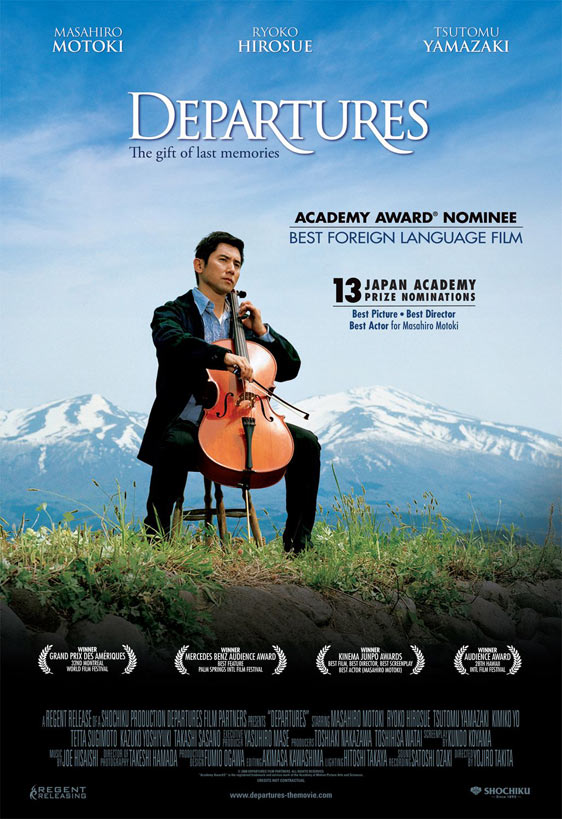
Poster for "Departures".

Last week, I had a chance to catch up with the 2009 Academy Award winner for Best Foreign Film, Yôjirô Takita’s Departures. The film stars Masahiro Motoki as Daigo, a Tokyo cellist who finds himself out of a job after his orchestra is disbanded, and is forced to move back to his hometown with his wife Mika (Ryoko Hirosue). He reluctantly takes a job as an encoffiner, performing a series of delicate ceremonies to prepare a recently deceased body and place it in a coffin before the family. He initially acts as an assistant, gradually learning the trade from his boss, Ikuei (Tsutomu Yamazaki).

The film initially seems to rely on a knowledge of Japanese culture, attitudes, and rituals surrounding death, and it quickly becomes evident that Daigo’s employment, while financially lucrative, is not considered remotely respectable in society. He keeps the job a secret from his wife, and is subject to constant shame by the townspeople. In the first act, the film strangely takes on the air of a quaint little after-school special. As I took stock of this seemingly contrived intolerance from my cynical American perspective, my reaction was pretty dismissive: Wow, those Japanese sure are uptight about death.

If that’s all Departures had been, my [borderline offensive] reaction would have likely remained unchanged, and I may have found the film to be a waste of time. In fact, this film – with its 131-minute runtime, ponderous themes of life and death, and frankly masturbatory poster shot (above) – seems to fit the exact formula for a film that’s likely to be seen by no one. But in spite of my initial reaction, I found myself completely drawn in by it. As the film goes on, it proves itself an adept and thoughtful exploration of the ritual of mortality, driven by some very strong performances.
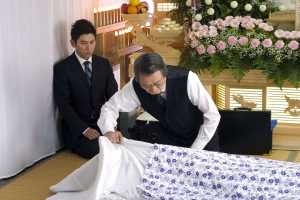
We see many “prepping the dead” scenes performed in front of the families of the deceased – each one almost plays out like a short film, and the first has several unexpected comedic beats that aptly set up the tone of the film. For a film about death and mortality, Departures turns out to be surprisingly light viewing. And while showing the entirety of each death ritual for several minutes at a time may have dragged out the film, I found it to be a brave and surprisingly effective choice. Joe Hisaishi’s score is particularly striking throughout the film (and in these scenes in particular). There are a number of sequences in which the film cuts back and forth between Daigo prepping a body and playing his cello – even prodding the fourth wall a bit as the score syncs up to accompany him. It’s a shameless and slightly jarring trick, but the illusion never quite breaks, and the film’s none-too-subtle parallels between playing the cello and prepping a dead body are aptly conveyed.

It certainly helps that Takeshi Hamada’s cinematography is absolutely gorgeous. We get the sense that Daigo’s hometown of Sakata is meant to be a bit of a dive, but you wouldn’t know it from the scenery. As Daigo preposterously plays his cello outdoors in the winter cold (a feat that would probably crack it down the middle in real life), I just couldn’t stop marveling at the wondrous backdrops and taking in the rich, flowing orchestral beats.

But as the film went on, I was struck the most by the beauty and dignity of the death rituals, and chastised myself a bit for the “after-school special” vibe with which I cast the film initially. Are the Japanese uptight about death? Certainly. But we all are, even if American culture handles it with slightly different ritualistic trappings. Daigo and Ikuei may not be well-respected, but the film effectively conveys the nobility of their profession.

FilmWonk rating: 7 out of 10

Mild spoilers will follow.
I wish I could end my review here, but the fact is, Departures takes a 15-minute detour at the end that I found completely jarring and unnecessary. Much of the film’s conflict stems from Mika’s disapproval of Daigo’s profession, and it’s not much of a spoiler to say that she eventually changes this opinion. While the character transformation is fairly standard, it is Ryoko Hirosue’s performance that made me completely buy it. She starts off as a devoted and loving wife – visibly bothered by their new living situation, but staying supportive. As the film goes on, the character could easily have turned shrewy, but Hirosue keeps her completely sympathetic, and her chemistry with Motoki is impressive. And then, not two minutes after that conflict is entirely and satisfactorily resolved (in front of another needlessly gorgeous outdoor backdrop)…

Someone else dies. And no, it’s not who you think, because this fresh corpse has not been around for any part of the film. We’re treated to a shocking revelation about a secondary character that comes completely out of left field, and the ensuing plotline completely abandons and undermines the well-established surrogate father/son relationship between Daigo and Ikuei (and aided by their masterful performances). The first two hours of this film felt like a complete story, but this denouement sent it completely off the rails. Much like this review, Departures would have been better off ending just a little sooner.
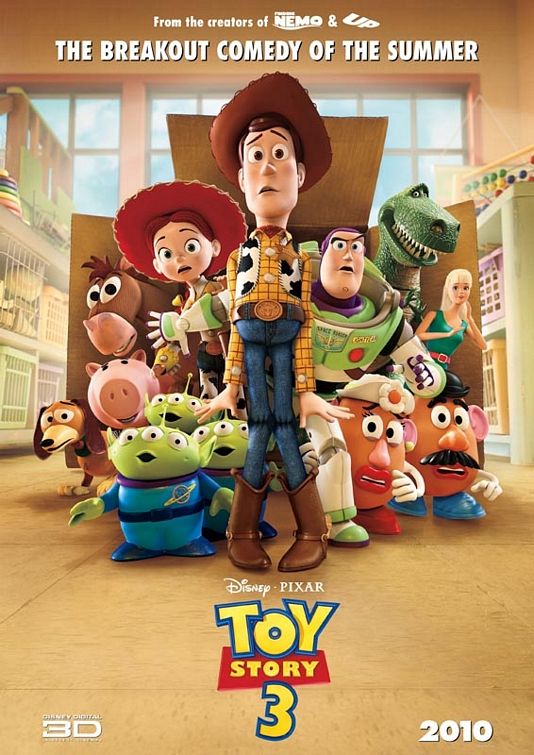
Disney/Pixar’s “Toy Story 3” – There’s a snake in my boot!

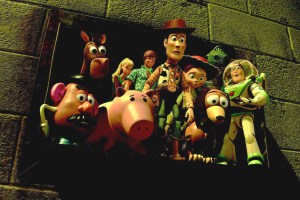
Poster for "Toy Story 3"

This review will contain moderate spoilers.

My favorite toy as a kid was the Red Dragon Thunderzord, an eight-inch robot that could transform, through a series of clever twists, into a brilliantly articulated dragon that could fly around the room (with my assistance), demolish a Lego castle, eviscerate Stretch Armstrong, and wipe out his plastic army men without breaking a sweat. As of this writing, the zord is standing on my shelf…a nostalgic replacement I purchased from eBay a few years ago. The original has long since been lost…boxed up, thrown away, or donated. Who knows.

Over the past week, I’ve had the pleasure of rewatching Disney/Pixar’s Toy Story films, and I was struck by the realistically bittersweet ending of the last entry, in which Woody and the gang decide to stick with Andy, rationalizing that it’ll be fun while it lasts. And as we must expect, at the outset of the third installment, most of Andy’s toys have already disappeared – sold at yard sales, donated, or lost to the years – the sad and logical extension of all the perils built into the first two films. But a few favorites (of both ours and Andy’s) remain – cowboy Woody (Tom Hanks), cowgirl Jessie (Joan Cusack), spaceman Buzz Lightyear (Tim Allen), Mr. and Mrs. Potato Head (Don Rickles and Estelle Harris), dinosaur Rex (Wallace Shawn), piggy bank Hamm (John Ratzenberger), and the Slinky Dog (Blake Clark). But Andy is 17 now and hasn’t played with them in years; he’s about to leave for college, and his mom insists that he box up his toys for donation, attic storage, or the trash.

Through a series of mishaps and miscommunications, the toys are donated to a local daycare center. They meet the leader of their new community, Lotso (Ned Beatty), a plush, warm-sounding, purple “huggin’ bear” who tells them that being donated is the best thing that’s ever happened to them. He limps onward with a cane, giving them a glorious tour of their new home, and for a brief moment, it looks like Sunnyside Daycare might be a wondrous retirement for these toys. But Woody – steadfast Woody – won’t have it. He wants nothing more than to get home to Andy, even if there’s nothing his owner would rather do than box him up in the attic. While this may have just been his prejudice talking, it quickly becomes apparent that he’s right. The daycare center turns out to be a dystopian nightmare, with new toys thrown into the toddlers’ room to be smashed and mutilated by hands too young to play with them properly. Only the chosen few get a chance with the older kids, whose playtime might be a bit more stimulating than being shoved into a gaping nostril. Lotso is effectively a Stalinist overlord, ruling the daycare center with an iron fist (and a kindly silver tongue), even enforcing his very own Berlin Wall (a children’s bathroom) patrolled by a huge, lazy-eyed baby doll (which is somehow much more creepy walking around on two legs than on all fours). The toys are locked in cages and guarded by night, and any misbehavior is rewarded with a trip to “the box” (you don’t wanna know). And it’s at this point that Toy Story 3 becomes one of the best prison escape films I’ve ever seen.

The plan is intricate, and utilizes all of the toys to great effect (did you know Mrs. Potato Head can use her missing eyeball for remote viewing?). It has all the slickness of a joyful heist film, but is peppered with many downright harrowing character moments (a scene in which Buzz is held down and has his battery compartment forced open made me physically uncomfortable).

Still from "Toy Story 3"

Lotso is a remarkable villain. He is a merciless and brilliantly developed tyrant, and his past is not that dissimilar from Jessie’s. Like that poor cowgirl, he was abandoned by the girl that he cared for deeply, but unlike Jessie, it completely destroyed him. When Lotso faces off with Woody over a precarious trash dumpster, he furiously screams, “You are a toy! A piece of plastic!”. This moment eerily echoes the speech made by Woody to Buzz in the first Toy Story, but when Woody said this, he was just trying to knock some sense into a deluded space cadet. He was defining his life and the purpose of his existence. The tragedy of Lotso is expressed brilliantly as he screams the purpose of his existence: “We’re all just trash! Waiting to be thrown away! That’s all a toy is!”

Ned Beatty’s vocal performance completely sold me on this theme (mature and nihilistic though it was for a G-rated film), and it is followed by one of the most viscerally terrifying scenes I’ve ever experienced on film. I wouldn’t dream of spoiling it, but director Lee Unkrich crafts an intense, fast-paced, and visually brilliant sequence, and manages to hit every believable and jarring emotional beat that the situation demands. The scene is also punctuated brilliantly by Randy Newman’s score (which shines throughout the film).

In the 15 years since the first Toy Story, Pixar’s animation has progressed immeasurably, but time and again, they have proven that their greatest strength is their understanding of character and story*. Pixar has crafted an absolutely gorgeous film here, but it is not about plastic toys – the soulless, lifeless, disposable pleasures of youth. It is a film about life, love, friendship, and loss; hope, despair, and finding one’s purpose. It is funny, exciting, surprisingly poignant, and easily Pixar’s finest film**. I’m a little wary of giving this film a perfect score, since I may well have handicapped myself by revisiting the first two films immediately beforehand. This might better be considered a rating for the entire trilogy, and not just its brilliant send-off – but I can’t help it. I’ve seen this movie twice and I wouldn’t change a thing.

FilmWonk rating: 10 out of 10

*This is one area in which Pixar has consistently beaten Dreamworks, and I was given a stark reminder of this during the end credits (minor spoiler), in which Buzz and Jessie dance to a Spanish-language version of “You’ve Got a Friend in Me”. It could just be a throwaway gag, but it’s not. It builds on what’s come before. It’s a character moment with some surprising weight to it. And no amount of Shrek and Donkey dancing over Smash Mouth can touch moments like these. Well done, Pixar.
**Narrowly edging out The Incredibles for me.

Uwe Boll’s “Rampage” – I never thought I’d review this

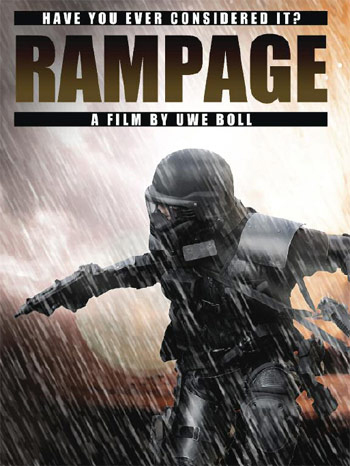
Poster for "Rampage"

The film: Postal.
The scene: A large public square.
A small-town crowd gathers before a dais holding several local celebrities and media. The film’s director, Uwe Boll, is interviewed on camera about the rumors that his films are funded by Nazi gold (which he happily confirms). Verne Troyer (best known as Mini-Me from Austin Powers) sits in a wooden high-chair and introduces the town’s latest toy sensation, the Krotchy doll. A mascot-sized version of this doll – basically a huge, anthropomorphic dick – stands proudly on the stage nearby. A paunchy man dressed as Hitler barks into a microphone that terrorists are coming. A fight breaks out between the dick-man and Boll. Several Arab stereotypes rappel down the side of an adjacent building and start firing indiscriminately into the crowd. The cops, terrorists, Nazis, dick-man, Boll, and a nearby barista all pull out guns and start shooting each other. A man in a motorized wheelchair is graphically wounded and starts rotating uncontrollably. Boll personally shoots three small children (including a happy boy holding a lollipop), and we see several lingering shots of their slow-motion blood-splatter. The director catches a bullet to the crotch, and manages to squeak out one last line before collapsing: “I hate video games…”

Thus spake Uwe Boll, that prolific and panned writer/director of an untold number of video game adaptations. I can assure you, dear reader, the scene above is not an aberration – of the three Boll films I’ve seen, not a single moment strayed from the nonsensical, immature, and patently offensive formula you see above.

Until now.

His latest outing, Rampage, is not an adaptation of a video game, but rather a story of a young man (Brendan Fletcher) who becomes dissatisfied with his life and the society he lives in, and decides to go on a killing spree. Now, please brace yourself, because my shocking admission is this – the first act of Rampage reminded me rather favorably of Gus Van Sant’s Elephant. Like that film (which was a loose dramatization of the Columbine shootings), Boll prefaces his explosive finale with an impressive degree of character development. While he proceeds with a fraction of Van Sant’s subtlety or narrative coherence, he still manages to effectively convey the important points about the young, disturbed man who is Bill Williamson. He hates his life. He hates his parents. He hates America, global warming, and the Iraq War. He hates the barista who made him a piss-poor macchiato. These scenes are intercut with Williamson’s video manifesto, in which explains his various beefs with America (using the same half-dozen lines of nihilistic claptrap repeated over and over). Fletcher’s performance isn’t demanding or spectacular, but it’s effectively chilling, and gives some surprising depth to the character. While this act could have used some improved editing, I can’t argue with its effectiveness, and it showed some remarkable restraint on the part of the writer/director.

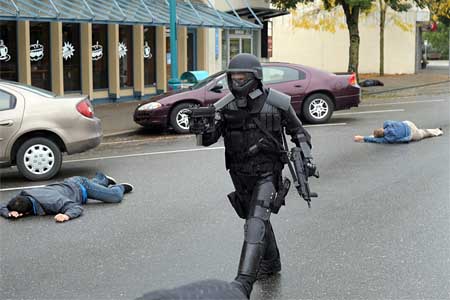
Still from "Rampage"

And then the “fun” begins. Bill drives a remote-controlled van into a police station and detonates a massive bomb (which conveniently displays “GAME OVER” to the approaching cops before vaporizing them). The ensuing CGI explosion looks like something out of Independence Day, complete with the classic rear-view mirror shot as Bill peels out to avoid the massive, car-tossing fireball. He dons a glorious suit of Kevlar, pulls a pair of never-ending submachine guns, and proceeds with an epic and sadistic killing spree. Bill Williamson is the man with the plan, demonstrating ingenuity and invulnerability worthy of Jack Bauer, but for no grand purpose apart from mass murder. Perhaps it’s my massive exposure to cinematic violence speaking, but Boll actually manages to make this heinous assault on innocent life seem…cool.

And that’s how uncomfortable Rampage is. The film glamorizes violence in a way that’s really no worse than stylistic bloodbaths like Bad Boys 2, but proceeds with a disturbing level of sadism and nihilistic fervor. The film applies the logic of the “torture porn” genre to a gleeful shooting spree, rendering the audience partially complicit in the horrors to which they’re choosing to subject themselves. The juxtaposition of these themes with Boll’s over-the-top action direction is surprisingly effective. And in a sequence that could just be nonstop, mindless shooting, Boll manages to craft some remarkable moments of tension (a scene in which Bill quietly enters a crowded bingo hall was far more terrifying than any of the moments in which he just stormed into a building shooting).

The film’s ending is laughable and thematically dubious, and much of the acting and improvised dialogue was downright awful. But this was a tense and riveting film – I couldn’t take my eyes off of it, despite wanting to at several points. Is it a good film? Very nearly. And it’s easily the best thing I’ve seen from Boll.

FilmWonk rating: 6.5 out of 10

Vincenzo Natali’s “Splice” – What hath man wrought?

“Tonight I ask you to pass legislation to prohibit the most egregious abuses of medical research: human cloning in all its forms; creating or implanting embryos for experiments; creating human-animal hybrids; and buying, selling or patenting human embryos.”

-George W. Bush

We all heard it, or at least heard about it – the moment when the President of the United States, perhaps after watching Mansquito on the Sci-Fi Channel, stood before Congress for a Constitutionally-mandated State of the Union and demanded that they ban the creation of human-animal hybrids. We laughed, or at least chuckled a bit. Most of us knew about Dolly, the cloned sheep. A few of us might’ve seen the mouse with a mock human ear on its back. But human-animal hybrids? Did the President honestly expect us to believe that there’s a lab somewhere diligently toiling to build its very own centaur?

From Cube director Vincenzo Natali comes Splice, a provocative and disturbing drama that explores that very possibility. The film stars Adrian Brody and Sarah Polley as Clive and Elsa, a pair of rockstar geneticists working to synthesize a miraculous, disease-fighting protein by splicing together DNA from a variety of different animals. The lab’s aesthetic is very pop-sci… Think “CSI” with snazzier wardrobe – I daresay Adrian Brody sports a different novelty geek tee in every scene. The two scientists are also romantically involved, which makes their almost giddy pursuit of new life that much more poignant. Their first several creations are failures, pickling grotesquely in jars next to celebratory champagne bottles with the name of each prospective bioengineered couple – “Adam and Eve”, “Sid and Nancy”, and the latest – the still-living “Fred and Ginger”. Appropriately, these two look like a pair of huge, malformed guinea pigs. With no faces and third-degree burns. They’re monstrous to behold, and serve quite effectively to remind the viewer that it took millions of years of evolution to make us look as sexy as we do now, and a bit of random DNA splicing is likely to end up lacking in the aesthetic department.

'How do you know what she'll do?'
'I just know, okay?!'

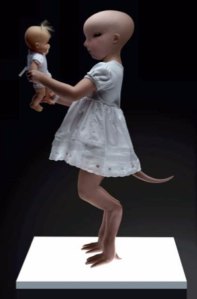
With this in mind, it makes sense that Clive and Elsa would go behind the backs of their bosses to incorporate human DNA into the mix, but it’s still a bit of a cinematic conceit that the resulting creature looks much less horrifying than Fred and Ginger. Dren, as she comes to be called [Nerd spelled backwards], looks more or less human from the torso up, but sports double-jointed legs, feet that are equal parts monkey and kangaroo, and a rather ominous looking tail (Didn’t Chekhov say something about a huge, venomous spike in the first act?).

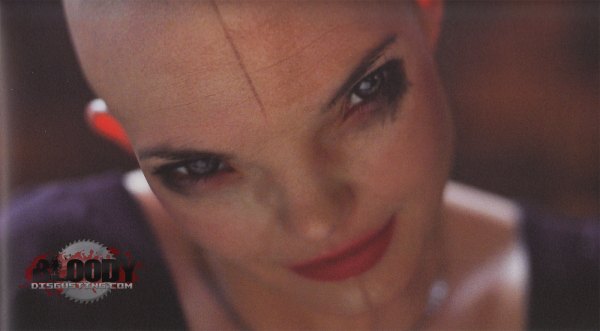
The creature design and visual effects are just superb. Much like the creatures of Will Wright’s “Spore”, Dren was is clearly designed to be viewed in stages; to this end, we have cinematic conceit #2… Her aging is rapidly accelerated. After a series of CG quasi-fetuses, Dren is played by a human child with various practical and CG tweaks. As an adult, she is played to great effect by French actress/model Delphine Chanéac. For a performance in which she never utters human speech, Chanéac makes Dren into at least a somewhat legitimate “character”. But she’s also bald, she never blinks, her head darts around like a bird, and she moves with an animalistic fluidity and speed. Like the residents of the uncanny valley, Dren seems irrevocably human, and yet even when her animal parts aren’t visible, she just seems…wrong.

Consequently, Elsa’s interaction with Dren is pretty jarring at first. She seems to forms a maternal bond almost immediately, to Clive’s chagrin. But while her relationship with Dren developed mostly organically, Elsa didn’t completely work for me as a character… She starts off as the moral “Eve” of the situation, acting as the impetus behind the creation of the beast and then dragging Clive along for the ride, but as the film goes on, her history and motivations get a bit muddled (particularly by the rushed introduction of the character’s less than healthy upbringing). In spite of these minor difficulties, Polley gives a fantastic performance, the chemistry between her and Brody is undeniable. They are completely believable together as both a romantic couple and quasi-parents (although this may be the most striking example yet of why a couple shouldn’t work together!).

At first, Elsa and Clive seem almost high on life (which seems plausible enough for cutting edge geneticists), but their boldness and arrogance is thoroughly smacked down as the film goes on. We are run through a myriad of moral and ethical questions regarding the creation and upbringing of a human-animal hybrid. There were the ones I expected – Do you treat it like a human or an animal? Like a pet or a research subject? – and a few others I frankly never would’ve imagined*. There was one question that I would have liked to see more of – what do you teach a creature with near-human intelligence? We see a bit of this when Dren is a child, but due to her rapid aging and character changes, this question is too hastily abandoned. Nonetheless, Splice is quite impressive as a bioethical thought experiment, perhaps joining the ranks alongside (but not quite eclipsing) Andrew Niccol’s Gattaca. And like that film, it tackles material that will probably no longer be science fiction in a decade or two.

'None of her animal components have predatory characteristics.'
'There is the human element...'

Splice also reminded me of Jurassic Park, reiterating that film’s ethos of “life will find a way”. The only problem with the film’s portrayal is that in the case of a designer organism, it’s not entirely clear – either to us or the organism itself – what exactly it’s finding a way to do. It doesn’t fit in with the natural order, and its behavior (and relationship with other creatures) is governed largely by overlapping and often contradictory tidbits of chemical instinct. I may be giving Splice too much credit, but this naturalistic chaos may well be the point the film is trying to make. And like Jurassic Park before it, the characters certainly pay a believable price for their hubris.

In its marketing, Splice looks more or less like a typical monster flick, although only about 10% of it is what I would really call creature-horror. Nonetheless, Vincenzo Natali’s direction throughout the film ably plays on monster movie conventions to add additional stakes (and a few brilliant moments of dark comedy) to what might otherwise be an overwrought morality play. Splice may well be one of my favorite films of this year, but it is also one of the most visceral and shocking things I’ve ever seen, and it’s definitely not for everyone. But Natali has once again proven himself a thoughtful and provocative sci-fi writer/director. Splice may not explore every possibility of its audacious premise, but it is still a brilliant and haunting achievement.

FilmWonk rating: 8 out of 10

*Ah, the fevered dream of every sci-fi explorer from James Kirk to Jason Mewes. Was I surprised? Certainly. Disturbed? Not really**.
**(the first time, at least)

Debra Granik’s “Winter’s Bone” – A masterful dose of guns, guts, and gloom

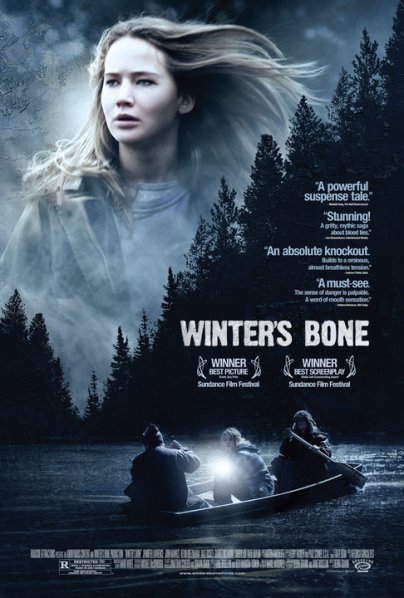
Winter’s Bone is the tale of Ree (Jennifer Lawrence), a tough-as-nails 17-year-old girl who must track down her meth-cooking, bail-jumping father in the Missouri Ozarks before he misses his court date and forfeits his bail – the family home she shares with her two younger siblings. Out of that simple, high-stakes premise comes one of the most bleak and memorable thrillers I’ve seen since Gone Baby Gone. Director Debra Granik and cinematographer Michael McDonough shoot the film with an utterly drab color palette, the Missouri gloom cloaking every frame in a desaturated blue-gray haze. The film’s atmosphere is one of utter hopelessness and yet through it all, Ree remains, frankly, a tough bitch. Relative newcomer Jennifer Lawrence (who bears quite a resemblance to Renee Zellweger) turns in a powerful and unflinching performance. As Ree interrogates one uncooperative subject after another amid social obstacles and resistance from even her own family, Lawrence delivers every line of back-country Missoura slang with remarkable authenticity.

“You’ve always scared me,” says Ree.

“That’s because you’re smart,” gruffs John Hawkes, who plays Ree’s uncle, the inexplicably-named Teardrop. Hawkes, an actor who I’d only previously seen playing wiry, semi-geeky characters, was easily the biggest surprise in this film, completely matching Lawrence’s intensity. His physique was more or less unchanged (except for a slightly graying beard), but his demeanor was something new and thoroughly intimidating. Every word Teardrop says seems to carry a simmering threat of violence, and although the character actually perpetrates very little, Hawkes brings a fiery intensity that makes him downright terrifying to watch.

Winter's Bone still

Also intimidating is Merab (Dale Dickey), one of the first characters Ree questions, who offers her tea and then advises with precipitous hostility to “Go home, child.” The stakes of this scene were driven higher by their ambiguous blood relation, and indeed, the film presents the conflicting familial and social allegiances amongst these characters as central to Missouri culture. They were also utterly unintimidated by guns or guts, which were ubiquitous throughout the film. As an ignorant, lazy, metrosexual coastal-dweller, I can’t speak to how accurate this depiction may be, but the characters and culture felt completely authentic. Also central to the film is “meth culture”, of which we’ve already seen a gritty, stylized version in AMC’s “Breaking Bad”; but while the medium of television grants that show the freedom of rich world-building over a long period, the greatest strength of Winter’s Bone is just how rich, believable, and utterly bleak a world it manages to craft within its runtime. And while the trailer-park drug production and rampant availability of methamphetamine are merely a backdrop to the overall mystery of this film, they manage to add yet another layer of bleakness and tension.

This indie thriller kept me fearing for its characters at every turn. The screenplay, adapted from a Daniel Woodrell novel by director Debra Granik and co-writer Anne Rosellini, is immensely taut with its dialogue. The characters say everything they need to say, and not a single word more. The direction and pace is fantastic, evoking shades of the Coen Brothers (it reminded me at times of both Fargo and No Country).

“You’ve paid for this in blood,” a character tells Ree toward the end. And indeed, if this film has a central theme, it is blood. How it binds or separates us, how easily it is disregarded, and what we might do to protect it. Lawrence and Hawkes’ intense performances guide the audience masterfully through this simple, effective thriller, and make it well worth the price of admission.

FilmWonk rating: 7.5 out of 10

Atom Egoyan’s “Chloe” – An odd bit of erotica

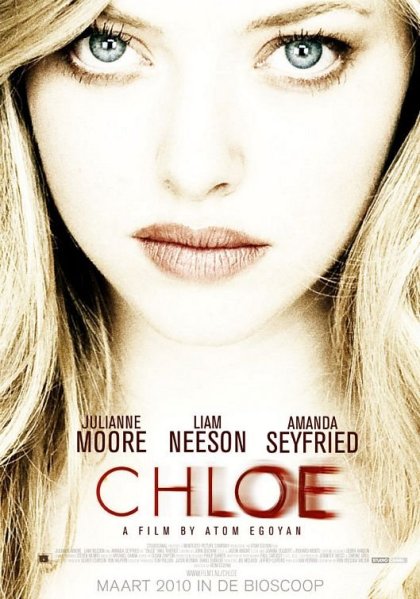
Two seconds. That’s how long it takes for Amanda Seyfried’s breasts to appear in this film, and as she begins a wistful voiceover about what it means to be a prostitute, it is with this first artfully lit shot that Atom Egoyan’s Chloe (a remake of a 2003 French film) presents itself with decidedly European sensibilities. But while the Europeans might decry my American puritanical sexualization of the female breast, I must confess that this shot (and many similar ones that followed) put me somewhat on guard. There are few things that take me out of a film faster than the feeling that I’m being manipulated by the screen. If this were a film about gargantuan fighting robots, I could certainly ignore the feeling, but Chloe strives for a good deal more. As it went on, I was forced to decide whether I was watching a thoughtful and emotionally complex exploration of sexual obsession and jealousy or being titillated just for the sake of it.

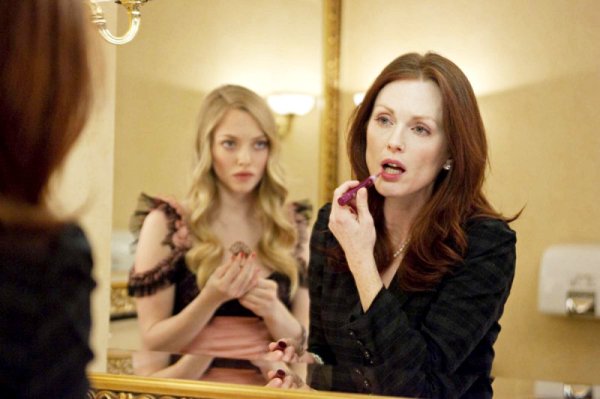
The premise is certainly a provocative one. The Stewarts are a pair of well-off professionals whose marriage is gradually drifting apart – David (Liam Neeson), a college professor, is friendly and semi-flirtatious with every woman he meets, and his wife Catherine (Julianne Moore), a doctor, is becoming increasingly insecure and jealous. From the outset, we are as much in the dark as Catherine about her husband, as she becomes more and more suspicious that he’s cheating on her. She finds a friend and confidante in an escort named Chloe (Amanda Seyfried), whom she hires to try and seduce David.

“I usually meet the client directly,” starts Chloe.

“I’M the client” declares Catherine.

And indeed, nearly all we see from this point on is through the interactions between these two women. As Chloe recounts her various encounters with David, Catherine insists she spare no detail. These graphic recollections are nothing new in cinema (they reminded me a great deal of Mike Nichols’ 2004 film Closer), but they still rang true for me. They spoke to the secret shame shared by private detectives and their cuckholded clients alike – when you’ve been betrayed by someone you love, you want to know every last disgusting detail.

It is this obsession that the film and its actors convey so effectively. The plot takes a number of rather predictable twists, but I really can’t fault it for this. As Catherine watches the destruction of her marriage, she gradually realizes that it may be her own mistrust and jealousy that precipitated its end. By the final act, the film only seems predictable in the sense of people being reliably self-destructive, and Julianne Moore proves to be the tragic heart of this film, turning in a performance that is both fearless and believable.

But what an enigma is Amanda Seyfried… This is an actress whose work I’ve nearly always enjoyed, who often elevates lesser films with her performances. But for the first half of this film, her line delivery is nearly as flat and devoid of character as porn star Sasha Grey in Soderbergh’s The Girlfriend Experience. As she recounted the vagaries of life as a high-class call-girl, I just didn’t buy it. And while her performance certainly improves in the second half, it’s balanced out by some rather preposterous character twists (for which I place equal blame on the screenwriter).

This is certainly an ambitious film, and its successes manage to stay a bit more interesting than its failures. The film looks great, featuring some gorgeous cinematography from DP Paul Sarossy. It delivers a fantastic performance from Moore and solid supporting work from Neeson. And perhaps most importantly, despite the absurd lengths the film goes to in order to destroy its characters, it delivers a few remarkable relationship insights. I have to think that if only something had elevated the character of Chloe, I wouldn’t have been left to ponder whether this film is exploitative or gratuitous. The film strives for something like Closer but becomes something more akin to Heartbreakers. The result is something worse than one, but better than the other, and fascinating nonetheless.

FilmWonk rating: 6 out of 10

Breck Eisner’s “The Crazies” – Another horror remake? And it’s GOOD?!

Breck Eisner’s The Crazies is the tale of Ogden Marsh, an idyllic Iowa farming community exposed to a biological agent that turns the townspeople turn uncontrollably violent. And I won’t bury the lead on this… It’s one hell of a ride. A deliberate pace, ratcheting sense of doom, and awesome use of setpieces make this an extremely effective horror film. In fact, the last time I had this much fun with a horror remake was with Zack Snyder’s Dawn of the Dead, and from the outset, this film has some stark similarities. It’s another remake of a 70s Romero film featuring another dark Johnny Cash song (in an amusing nod to Dr. Strangelove), and two of the main characters are a cop and a doctor. We get the briefest glimpse at their normal lives, and then all hell breaks loose.

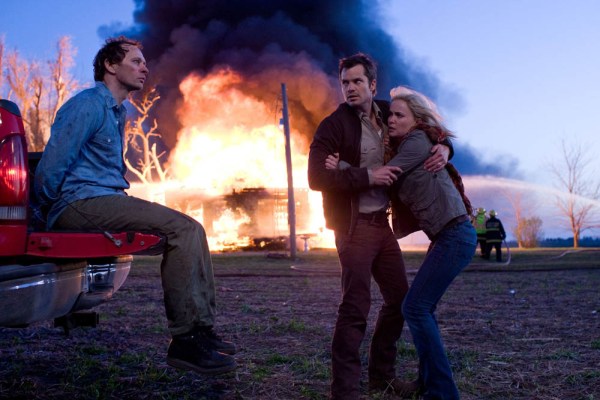
The formula is familiar, but The Crazies does plenty to distinguish itself. Unlike typical zombies, these creatures retain varying degrees of their human intelligence, running the gamut from free-running, flesh-eating monsters to what can only be described as “super-rednecks”. While this makes them only marginally more interesting as characters, it’s still impressive to see zombies put to more substantial use than the nihilistic slaughter fantasy they usually amount to. What’s more, the film takes just enough time to establish an authentic setting and some sympathetic characters with very real stakes. From the outset, Ogden Marsh feels every bit like a real small town, with everyone on a first-name basis with town sheriff David (Timothy Olyphant), his deputy Russell (Joe Anderson), and his wife Judy (Radha Mitchell) – also the town’s doctor. When the military moves in to quell the infection, the plot becomes more like 1995’s Outbreak, but told from the perspective of the townspeople. From the moment the hubristic mayor dismisses the impending threat from what might be the only cornfield swimming pool in Iowa, the film barrels forward and never lets up. The result is a very well-paced chase thriller, told through the eyes of these characters by way of some brilliant but simple setpieces (there’s a sequence in the third act involving a drive-through carwash that I can only describe as pure joy).

As I think back, the tone of this film seems remarkably well balanced. There are many genuinely terrifying moments, and it adequately conveys the senseless human tragedy of it all while never shying away from a healthy dose of pitch-black humor. As it went on, I found myself genuinely afraid for the lives of the remaining characters, but could still chuckle as Timothy Olyphant took a sprawling tumble onto the floor of a funeral home and narrowly escaped getting his scrotum sliced open by a runaway electric bone saw. Indeed, Eisner’s direction makes a number of admirable choices, seemingly utilizing jump scares for the sole purpose of screwing with the audience, and then jarring them out of their seats as they slowly realize there’s an out-of-focus super-zombie still and salivating in the corner of the room.

The performances are quite adept, establishing a tense and believable dynamic between the three characters. Olyphant has long since proven that he can do no wrong as a small-town sheriff, and he and Mitchell make a convincing married couple, their performances helped along by many effective little moments of dialogue (“Don’t ask me why I can’t leave without my wife, and I won’t ask you why you can leave without yours”). Additionally, the shifting relationship between sheriff and deputy is one of the most fascinating aspects to the film. Between Anderson’s adept performance and the character’s well-written arc, the deputy’s plot stirs a sense of imminent danger and infection paranoia unparalleled since John Carpenter’s The Thing.

As soon as the credits rolled, I typed a single line for this review, demanding that Breck Eisner come down to my theater immediately and pry me loose from the edge of my seat. When I wrote up the film’s balls-out-audacious trailer back in October, I expected this film to be a good bit of cheese – a solid, shlocky B-horror film. What I finally saw was that and much more. Eisner’s direction balances the tone of the film perfectly, injecting just the right mix of horror, comedy, and drama. The allegorical elements are none-too-subtle, from the concentration camps to the good soldier who “didn’t sign up for this,” but they still imbue the film with some welcome depth. The Crazies takes the relatively straightforward premise of “zombies that can think” and turns it into a menacing and memorable piece of horror.

FilmWonk rating: 7.5 out of 10

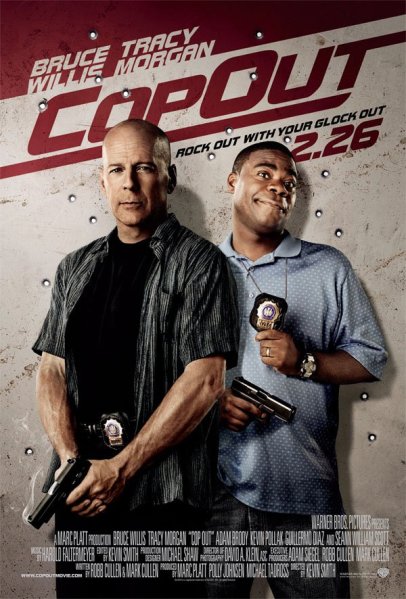
Kevin Smith’s “Cop Out” – Painful and forgettable.

Poster for "Cop Out"

I have an abiding respect for Kevin Smith. Between college Q&As, prolific tweeting, and a hilarious podcast with his longtime producer and friend Scott Mosier, here is a man who wears his entire life on his sleeve. A man as likely to talk about his first sexual experience as the time he accidentally pooped in the shower. A man who constantly admits the breadth of his ignorance, never stops calling himself a fat bastard, and freely admits that his writing is terrible and that he has no directorial style. But despite his posturing, he has proven himself a reliably effective screenwriter and an occasionally brilliant director. He’s carved out a well-fitting niche of self-promotion through self-deprecation, and on those rare occasions when he isn’t funny, he’s nearly always endearing.

And then he goes and does something like this.

Cop Out (originally called A Couple of Dicks) is the story of Jimmy (Bruce Willis) and Paul (Tracy Morgan), a pair of no-nonsense cops who play by their own rules. Naturally, “their own rules” amount to a level of brutality and incompetence seldom seen outside of airport security, and they’re immediately suspended. And do they have to give up their badges and guns? Of course. And is Tracy Morgan still dressed up like a giant foam-rubber cell phone as the captain bawls them out? You betcha.

After their suspension, they keep right on acting as cops, trying to retrieve a priceless stolen baseball card from a ruthless drug kingpin, Poh Boy (Guillermo Diaz), who wants to take over the entire east coast drug trade by way of a magical USB thumbdrive. They join forces with Dave (Seann William Scott), an incompetent parkouring thief who spends nearly every moment verbally abusing them. Or repeating whatever they say. Oh, and there’s a kidnapped drug moll…or possibly a nun (Ana de la Reguera), whose sole language is “fuckin’ Spanish”. Nearly every one of her lines will call you out for the hijo de puta you are, and she serves almost no purpose in the film except as a comely MacGuffin.

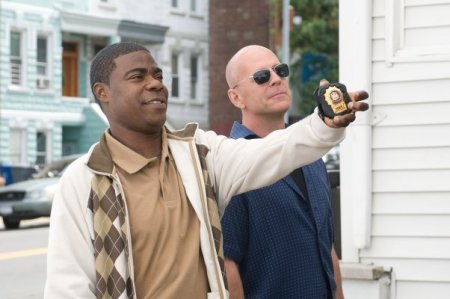
Still from "Cop Out"

The first act is frankly painful to sit through… At several points, the characters stop just short of winking at the camera as they announce that all of their tactics and dialogue are stolen from better movies (“It’s called an homage!”). But even as Tracy Morgan gradually started to amuse me, Bruce Willis seemed completely unsure of what movie he was in. And before too long, his confusion spread to the audience, as the plot took one bizarre turn after another. Seann William Scott is amusing, but this character is nothing new for him, and it’s never entirely clear why these two cops would involve themselves with him. Guillermo Diaz is almost completely wasted in this film, losing most of the charm and dark humor he showed on Weeds in favor of playing a generic, humorless dick. And the less said about Rashida Jones’ vacuous subplot, the better.

I don’t want to spend much more time on the plot of this film because frankly, it doesn’t seem like writers Robb and Mark Cullen did either. The film strives to be a buddy cop flick in the tradition of Beverly Hills Cop, but ends up being something more akin to Showtime or Hollywood Homicide. And I can’t elaborate on that comparison any further, because like those films, Cop Out is almost completely forgettable.

It is only because I’ve liked Smith’s other films that I even feel like talking about this one. He didn’t write it himself, opting instead to work with the pair that wrote an abyssmal Showtime pilot called Manchild for Smith and several others (his subplot is just about the only funny part of it). The action direction is definitely something new for the filmmaker, but it’s nothing terribly complex, given the limited demands of this genre. Dave Klein’s cinematography is striking at times (this is the guy who shot Clerks?!), but the look of the film is wildly uneven, with some scenes seemingly taken out of completely different films.

The film inexplicably gets fun at around the second hour, but I certainly can’t call it good… At the end of the day, Cop Out seems little more than a bewildering evolution for its filmmaker. And like the Neanderthal before it, I can’t help but hope it will wander off into some corner of Eastern Europe to die.

Sorry, Kev. I hope you get writing again soon. If your next film really is as good as Chasing Amy, I’ll happily give this one a pass.

FilmWonk rating: 3 out of 10

Jerome Bixby’s “The Man From Earth” – A brilliant and audacious journey

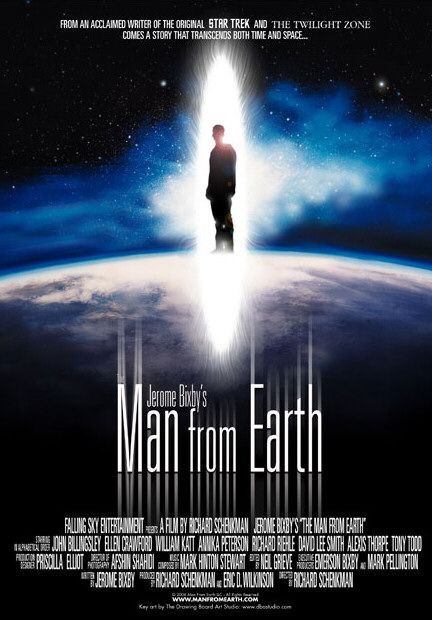
Poster for "The Man From Earth"

Produced in 2007 from a screenplay finished on the writer’s deathbed, Jerome Bixby’s sci-fi opus The Man From Earth feels more like a play than a film. Professor John Oldman (David Lee Smith) announces to his colleagues and friends that he’ll be moving on, but makes a surprise confession – he is immortal, and has lived for the past 14,000 years. The rest of the film takes place almost entirely in a single room, following the threads of the group’s conversation. And in a very theatrical touch, the assembled group of academics are perfectly suited to test his story. There’s Harry – a biologist (John Billingsley), Dan – an anthropologist (Tony Todd), Sandy – a historian (Annika Peterson), Art – an archaeologist (William Katt), and Edith (Ellen Crawford), a devout Christian with an unnamed specialty. As John’s story goes on, they are joined (quite expectedly) by Dr. Will Gruber (Richard Riehle), a psychologist.

I mention the character names, but these aren’t really characters anyway. They’re just filters through which the audience can analyze this man’s fantastical tale. There is even a student (Alexis Thorpe) present to ask a few simplistic questions so the professors can explain details that the group would already know. And even when the story strives for more dramatic and theatrical character moments (a confession of love, a surprise death threat, and so on), the situation never quite feels plausible, as these moments only serve to provoke new dimensions to John’s story.

But as I mention these character and narrative shortcomings, I must also say this – not a single one of them detracts from the film. David Lee Smith gives a remarkably subdued performance as John Oldman (one of many pun names he claims to have chosen over the years), the wise, humble, and pragmatic old soul. He reminded me somewhat of Doctor Who, but he feels far more authentic and human, because the film so excels at depicting the limitations of his purportedly vast knowledge and experience.

As they quiz him for every detail of the last 14,000 years, he points out that he doesn’t remember every detail any more than we can remember every moment of our childhoods. As he produces details of history, anthropology, and social and scientific advancement, they rightfully point out that he could have gleaned any of them from a textbook. But as one professor admits, it is no more possible for John to prove his story than it is for any of them to disprove it. And so the conversation goes on. He talks of love, friendship, life, and death – the one subject of which he has no more knowledge than anyone else. The film goes on to raise some startling religious themes, to the chagrin of Edith, the devout Christian… The ensuing theological discussion is easily the most provocative aspect of this film, and is quite well realized.

I don’t have much to say about the other performances, since there weren’t any other particularly strong characters. But even as a collection of variable filters for John’s conversation, the acting was solid overall. Todd, Crawford, and Riehle were superb, and Billingsley was enjoyable, albeit playing to familiar quirky territory. Annika Peterson does the best she can with some of the more contrived character moments, although her unlikely conversation with John about the nature of love is a surprisingly effective addition to the film. Katt and Thorpe don’t contribute much as skeptic and simpleton respectively, but I don’t really fault their performances, as they aren’t given much to do in the film (except make the audience wonder why a fifty-something doppelganger of James Cameron is permitted to date one of his students).

Jerome Bixby was a writer for the original “Star Trek” series, and it definitely shows here. The film’s end features Tony Todd announcing he’ll go home and “watch some ‘Star Trek’ for a little sanity”, and while it was a mildly self-indulgent reference, it does bring to mind a key difference between the two works. “Star Trek”, with its niche audience, was quite free to explore the big sci-fi ideas via alien allegory, since no one was too worried about offending the delicate sensibilities of the Tholian Empire. The Man From Earth takes on a far more daunting task – to deconstruct human history, values, and beliefs in a manner as shocking as it is insightful, and keep the audience adequately engaged to stop them squirming in their seats and fleeing the room. And it completely succeeds.

FilmWonk rating: 8 out of 10