Martin McDonagh’s “Seven Psychopaths” – Cute and hilarious.

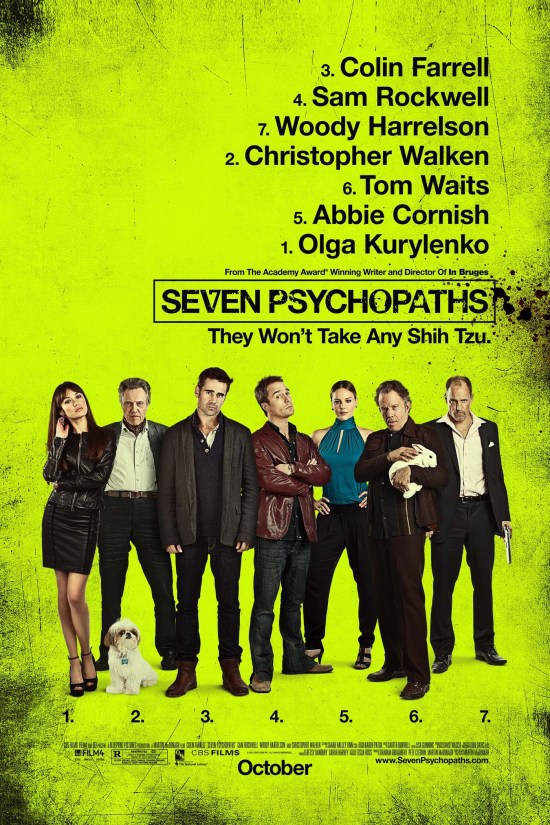
Poster for "Seven Psychopaths"

I know what you’re thinking. This film is about a culturally satisfying number of psychopaths. It’s from Martin McDonagh, the bloody-minded, utterly un-PC writer/director of In Bruges (as well as The Lieutenant of Inishmore, which is, to this day, the most disturbing thing I’ve ever seen on a stage). How can it possibly be “cute”? Well I’ll tell you, dear reader. The main character is a drunken Irish screenwriter named Martin (Colin Farrell), who is attempting to write a screenplay for a film called Seven Psychopaths. The very same film we’re presently watching, in fact. The film cuts back and forth between his beautifully imaginative psychopathic origin vignettes and the “real world”, along with occasional revelations that some of his psychopaths are in the actual story of the film we’re watching. Maybe. It’s wonderfully unclear.

Seven Psychopaths seizes on the fundamental truth of storytelling that no idea is completely original. You may think it came from a serendipitous muse that squirted it into your brain from the collective unconscious, but we are the inexorable products of our surroundings, our culture, and most importantly, our stories. Stories we’ve been told, stories we’ve forgotten, and stories we’ve subsequently retold and passed off as our own work. This is a bloody-minded Adaptation. Hugo without the whimsy. It is sickeningly self-aware, and could have felt like a lesser parody of either of those films if not for such a perfect ensemble cast.

Sam Rockwell plays Billy Bickle, professional dognapper. When Bickle’s partner, Hans (Christopher Walken), accidentally steals a Shih Tzu owned by mobster Charlie Costello (Woody Harrelson), the two are forced to scramble to stay alive as Costello ruthlessly seeks out his purloined puppy. While Walken and Harrelson are perfectly cast, the absolute standout is Sam Rockwell, who plays the rather obviously-named Bickle as a relentlessly delightful sociopath. His every interaction with Farrell is pitch-perfect, even as he interrupts each fresh outrage to question whether his screenwriting friend might have a drinking problem. The film also features a solid supporting ensemble, including Zeljko Ivanek and Kevin Corrigan, as well as an outstanding turn by Tom Waits, who manages to turn the simple act of petting a bunny into something wondrously terrifying.

You might notice I haven’t mentioned any ladies yet, and there are several in the film. Abbie Cornish, Olga Kurylenko, and Gabourey Sidibe each have small parts, and they do decent work with what little they’re given. Newcomer Linda Bright Clay is especially strong as Hans’ wife. But this is where the film’s veneer of self-awareness starts to crack a bit. Can a screenplay that’s chock full of crappy, one-note, brutally treated female characters redeem itself by having one of its myriad gentlemen point it out in the third act? My general response would be ‘no’, but Farrell’s hilariously weak defense that “it’s a tough world for women”, and Walken’s wry retort that despite that, most of the ladies he knows “can string a fucking sentence together” completely saved it.
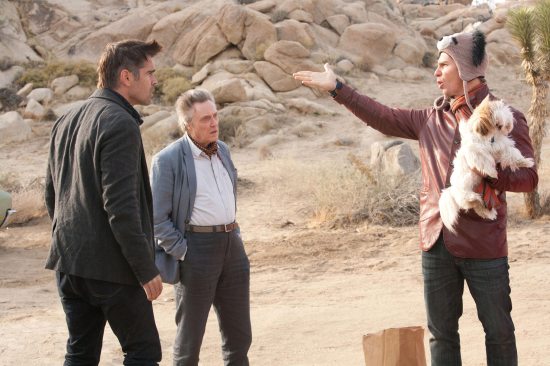
Still from "Seven Psychopaths"

In fact, when the last act of the film drops any pretense of real-world story and has the entire ensemble vigorously debating how the movie should end, it somehow manages to hit every note perfectly. Its self-awareness becomes incredibly endearing, even as it debates precisely what kind of shootout should bookend the story. The film’s most honest moments emerge from this sequence, as Marty questions whether he even wants to write this kind of story anymore. Psychopaths might be a fun idea with which to frame a story, but they do get a bit fucking tiresome when you have to write so many of them.

But whether he wants to keep writing this kind of story or not, McDonagh still seems to be having a great deal of fun with the material. His Irish characters still border on caricature, his racist humor reaches Tarantinoan levels of superfluousness, and his odd fascination with the Vietnamese continues. His creations are born in a world of cartoonish excess, and die with as much frenetic and hilarious bloodlust as the script can muster – unless of course he changes his mind before the film ends. But in a film like Seven Psychopaths, mind-changing is an integral part of the narrative. The film conceives of a great many brilliant characters, then dispenses with any necessity to actually put them into the story. Some might regard this as a cheat, but I simply saw it as a laundry list of possibilities. When Martin McDonagh plays in his sandbox, this is the unholy ensemble that emerges. And as hilariously overdone as it might be, it still felt as fresh and effective as ever.

FilmWonk rating: 8 out of 10
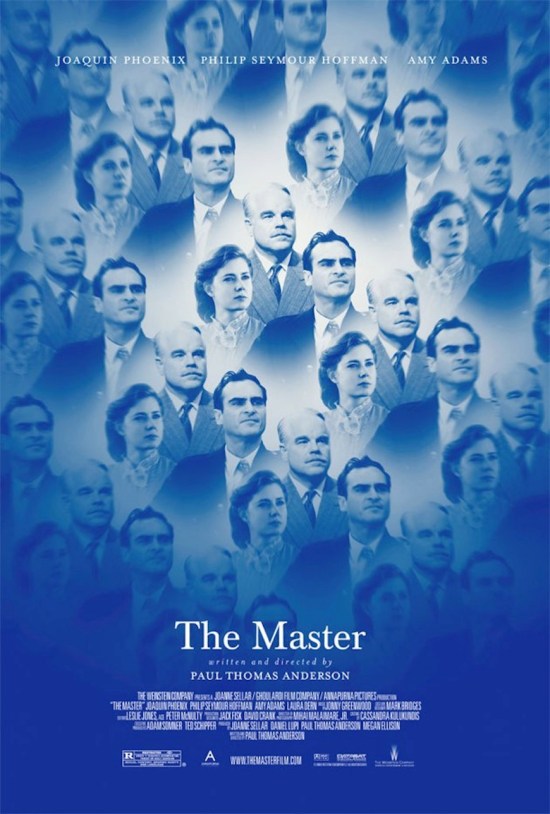
FilmWonk Podcast – Episode #26 – “The Master” (dir. Paul Thomas Anderson)

Poster for "The Master"

This week on the podcast, Glenn and Daniel purge their inner demons reviewing Paul Thomas Anderson’s new film, The Master, starring Joaquin Phoenix, Philip Seymour Hoffman, Amy Adams, and Laura Dern (25:33).

May contain some NSFW language.

FilmWonk rating: 6/10

Show notes:

  • Music for this episode is Ella Fitzgerald singing “Get Thee Behind Me Satan“, from the soundtrack to The Master.
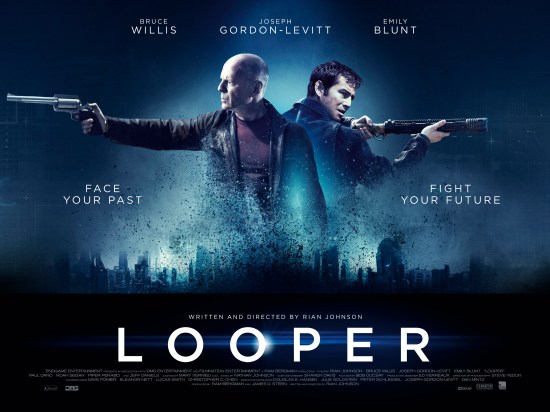
  • Check out my review of Rian Johnson’s Looper here.

Listen above, or download: The Master (right-click, save as, or click/tap to play on a non-flash browser).

Rian Johnson’s “Looper” – An audacious temporal thriller

Rian Johnson’s Looper may be the closest thing to a perfect time travel paradox since the Terminator franchise. Once again, meddlers from the future are changing the past, using their perfect foreknowledge to make things better for themselves. If they want to make someone disappear, they don’t just murder them and destroy the body- they zap the target back in time to be killed by assassins in the present day (in this case, 2044), called loopers. The problem arises when looper Joe (Joseph Gordon-Levitt) is presented with having to murder his own future self (Bruce Willis). Joe the Elder escapes from his younger self and strikes out on a mission of his own, to preserve his life in the future.

This outlandish premise works for two reasons. First, the world-building for both time periods is extremely effective. 2044 is a grim, dark, crime-ridden place, and 2074 seems perhaps even more so, just a bit cleaner (especially if you go to China, which is obviously an economic powerhouse). Both periods feel very lived-in despite their obvious budgetary constraints.

Second, the film sets up a clever time travel mechanic wherein Future Joe – whose mere presence is altering his own timeline – doesn’t know the outcome of every situation involving his younger self, but he does remember it once it happens. It’s an action-oriented version of Marty McFly fading away from a photograph, and the film explains it with just the right amount of technobabble and disturbing imagery, punctuated by Willis telling his younger self (and perhaps the logic centers of the audience’s brains) to kindly shut the fuck up and stop wasting time slogging through the murky waters of time travel.

This bit of hand waving makes for an extremely haunting and effective ending, as we’re left to consider the full and lasting impact of Future Joe’s presence in this timeline. Looper dares to present us with high personal stakes for both versions of its protagonist, set them in opposition to each other, then force us to consider whether the future of this despicable person should be saved. It’s a theme that has been touched upon before (Doctor Who’s The Girl Who Waited comes to mind), but never with such a thoroughly unsympathetic protagonist. It’s a bold choice, and it definitely pays off.

Gordon-Levitt’s performance is unsettling, to say the least. His face is nearly unrecognizable in its attempt to resemble Willis- so much so that I suspected some kind of digital alteration, but after watching the film, the illusion is surprisingly convincing. When Gordon-Levitt is telling his older self to “do what old men do and die”, I could almost shut my eyes and imagine Willis delivering the line. Much of this is due to Gordon-Levitt’s physicality and voice work. But the physical alterations (whether digital or cosmetic) went from being a slight and deliberate distraction to an effective filter for the audience to forget at least one famous face and think of these two men as one and the same. And for the record, I never would have guessed this from the trailer.

Along the way we meet Sara (Emily Blunt) and her possibly-adoptive son Cid (Pierce Gagnon), whose farm becomes the central setpiece for the film’s final act. The film takes a bit of a turn with the introduction of this odd little family. Cid is an alarmingly precocious child, and not in a grating, Short-Round sort of way. In fact, Cid’s intelligence and command of the situation is intimidating to characters and audience alike. To put it mildly, there’s something off about this boy. While it would spoil much of the film’s climax to reveal his precise role, it’s safe to say that his effectiveness hinges on a brilliant performance from this child actor.

The only weak link is Blunt’s character. Much of the film’s ending hinges on her intrinsic good nature, and we get very little evidence of it apart from her own word on what a good mom she is. The best explanation I could muster for the obligatory love scene was “Why not?” Sara’s baffling seduction of Joe could be readily explained by the loneliness of a rural, single mom, but it seems a bit far-fetched given his status as a murderous drifter – which she seems fully aware of from the moment they meet.

Despite this issue, Rian Johnson has crafted a smart and effective thriller with well-drawn characters and a novel take on time travel. During his grand hiatus of TV directing since The Brothers Bloom, I’ve had time to forget just how effective his dialogue can be. Every exchange in this film is multifaceted enough that it will surely benefit from repeat viewings. The relationship between mob boss Abe (Jeff Daniels) and young buck Kid Blue (Noah Segan) – who may in fact be the same person – is certainly worth another look.

FilmWonk rating: 8/10

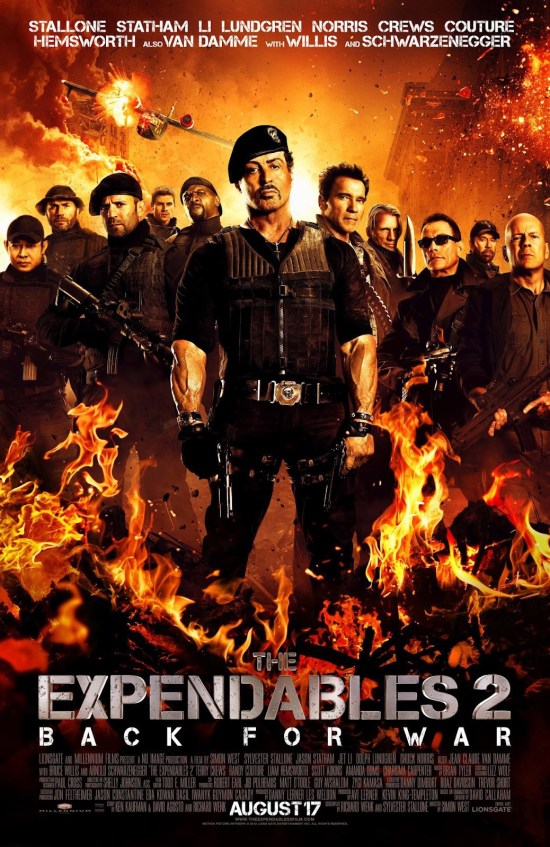
FilmWonk Podcast – Episode #25 – “The Expendables 2” (dir. Simon West)

Poster for "The Expendables 2"

On our two-year anniversary show, we go back to the well and review the sequel to our very first podcast subject, The Expendables 2! Can the acting stylings of Arnold Schwarzenegger and Randy Couture impress us a second time? Find out below! (31:33)

May contain some NSFW language.

FilmWonk rating: 6.5/10

Show notes:

  • Music for this episode comes from the score to the The Expendables by Brian Tyler.
  • The director of photography for this film is Shelly Johnson.
  • We referred to this rumor from back in January, which stated that the film had been edited down to be PG-13 in order to secure the participation of Chuck Norris. According to director Simon West last week, that rumor was never true.
  • Nope, it appears Jean-Claude Van Damme has never ripped anyone’s heart out on film. But he has done this
  • If you absolutely must see a heart-rip, here’s the dude from Temple of Doom. Or here’s Jim Carrey.
  • Correction: Our first podcast was in August 2010, making this our two-year anniversary show!

Listen above, or download: The Expendables 2 (right-click, save as, or click/tap to play on a non-flash browser).

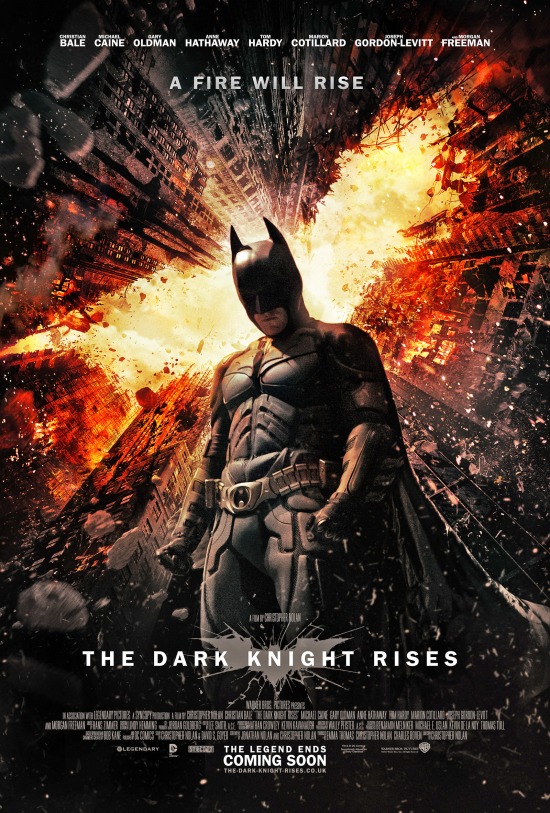
FilmWonk Podcast – Episode #24 – “The Dark Knight Rises” (dir. Christopher Nolan)

Poster for "The Dark Knight Rises"

This week, Glenn, Daniel, and special guest James Quinn discuss the epic final chapter of Christopher Nolan‘s Batman trilogy, The Dark Knight Rises (54:32).

May contain some NSFW language.

FilmWonk rating: 7/10 (Glenn/Daniel), 6/10 (James)

Show notes:

  • Spoilers begin after the warning (15:52).
  • Music for this episode comes from Hans Zimmer‘s original score to The Dark Knight Rises, including the tracks “Despair” and “Rise”.
  • Special thanks to James for contributing to this episode! Find out about his new sci-fi web series (in which Glenn plays a bear-alien named Uzor) at MasterOfOrionSeries.com.
  • I resisted the temptation to read this before we recorded, but here’s an excellent rundown from the folks at /Film of everything that bothered them about the film. We touched on several of these points, but there are a couple that I flat-out disagree with (most notably a major scene between Bruce and Alfred, which I thought was brilliantly written and acted). But if there’s one thing this film valuably inspires, it’s diversity of opinion, at least in terms of which storytelling issues people hate the most, so it’s well worth reading.
  • Also worth reading: Christopher Nolan’s eloquent farewell to the Batman franchise.
  • CORRECTION: I incorrectly stated that Guillermo Del Toro’s upcoming film, Pacific Rim, is “an adaptation of something” – it is an original work (albeit an obvious homage to Japanese monster films). Either way, we’re stoked.

Listen above, or download: The Dark Knight Rises (right-click, save as, or click/tap to play on a non-flash browser).

SIFF Review: Wes Anderson’s “Moonrise Kingdom” – A triumphant, romantic caper

Poster for "Moonrise Kingdom"

If I were to categorize Wes Anderson, I would place him in a similar camp to Tim Burton. They both have a distinct and instantly recognizable vision for the bizarre worlds in which their films take place, and they both tend to work with an abundance of the same actors. But while Burton’s recent contributions have been marked by a nearly linear decline in quality and coherence, Anderson’s films have taken a far more regrettable route… They have become utterly forgettable. While I have seen [and modestly enjoyed] every one of Wes Anderson’s films since Rushmore, I can scarcely recall a single moment from any of them since 2001’s The Royal Tenenbaums. While Anderson’s quirk and theatricality has remained as distinctive as ever, his overall vision has somehow become completely unremarkable.

Until now.

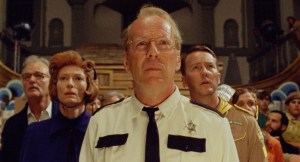
Moonrise Kingdom is a triumphant return to form for Anderson (along with co-writer Roman Coppola), meticulously crafting a rich and memorable world in the fictitious island of New Penzance off the Atlantic Coast. The story kicks right into gear as a young Khaki Scout, Sam Shakusky (Jared Gilman) leaves a hand-scrawled letter of resignation in his jamboree tent and strikes off into the wilderness in a purloined canoe. At the very same moment, his preteen sweetheart Suzy Bishop (Kara Hayward) runs away from home on the other end of the island, leaving her parents, Walt (Bill Murray) and Laura (Frances McDormand), at a loss to explain her disappearance. An immediate search begins as both the local police Captain Sharp (Bruce Willis) and Khaki Scout Master Randy Ward (Edward Norton) both rally their respective posses to search for the wayward couple.

The film takes a bit of time to find its footing, owing to the bizarrely precocious dialogue of its young, first-time leads. Their initial line readings have an almost wooden theatricality, with drawn-out banter so improbably delivered that it seems like Shakespeare in the Park as read from a teleprompter. But as their chaste and cordial romp gets into full swing, the two actors somehow find an accord. They become a fascinating romantic screen presence, even as the overall plot starts to take on a flavor none-too-dissimilar from the first Rambo film. An early “showdown” ensues between the young couple atop a hillside and some unrelenting Scouts who have happened upon them. Without grownup supervision, the Scouts are tenacious in their pursuit, armed with absurdly dangerous homemade melee weapons, an archery kit, and a lead Scout primed to charge the young lovers on his dirt bike. It’s all a great deal of fun, but the romance starts to make a bit more sense when viewed through this adversarial lens. These kids are determined to skip ahead to grownup life, bidding farewell to their erstwhile families and making a life for themselves in the wilderness. They are the embodiment of “us against the world”, even if their oppressive world is like something from the mind of Roald Dahl or J.K. Rowling.

Still from "Moonrise Kingdom"

In fact, the entire cast plays the film remarkably straight, even as the stakes continue to ramp absurdly upward. An on-screen narrator (Bob Balaban) informs us that a hurricane will strike in three days’ time. In fact, he tells us that this has already happened. By playing the entire film as a historical document, the various perils that befall the characters take on a tense fatalism. As the film goes on, any time a character steps onto a boat or seaplane feels like it might be the last time they’ll ever been seen alive. In this way, Moonrise evokes another much more adult film – Shutter Island. While Suzy will simply be returned to her parents if caught, Sam faces potentially greater peril, as it is revealed early on that he lives in a foster home that will not be welcoming him back, due to his unspecified “emotional problems”. The specter of Social Services (embodied by a hilariously dry Tilda Swinton) hangs over the proceedings at all times, along with all the potential horror of 1960s psychiatric practices. If Sam manages to survive his adventure, his life will get irrevocably worse.

Slightly less interesting are the marital problems of Suzy’s parents. Murray and McDormand are amusing together – a pair of attorneys who sleep in separate beds and speak of little else but their cases – but Murray and Willis, both rivals for the lady’s affections, are the real standouts. They each give their best comedic performances in years, engaging in a relentless duel of nonchalance and quiet resignation. Edward Norton is also brilliantly straight-laced, although the film seems to run out of practical use for him by the final act (not counting a bizarre stunt with Harvey Keitel). Given that Willis’ arc is probably the most underdeveloped in the film, it almost seems like the ending of Norton’s storyline was chopped and given to Willis instead. It was an odd choice, but it did feel just barely earned, as the film gives each character just enough setup to justify their final choices. Except, perhaps, for Jason Schwartzmann, who shows up just long enough to be awesome and underused as Cousin Ben, the obligatory helpful rogue. As an Anderson vet, Schwartzmann is so well-equipped to handle this material that I couldn’t help but want a bit more of him.

This would seem to be as far down the quirky path as Wes Anderson can delve without diminishing returns. Not everything in this film worked – as much as I was enjoying the meticulous opening cinematography of the Bishop home, I found myself rolling my eyes at its more superfluous elements, including Frances McDormand’s rather grating use of a megaphone to call for her children. But once the story got started, I was completely swept up in it. There is so much in this film that I’ll fondly recall, from the ridiculously tall treehouse to the Terabithian splendor of the titular Kingdom. This film is a sweet and nostalgic chronicle of the wondrous worlds that we create in childhood, and even manages to delve into the dire consequences of growing up, without ever losing a bit of its charm.

FilmWonk rating: 8 out of 10
SIFF Review: “Earthbound” – A schizophrenic mess of alien romance

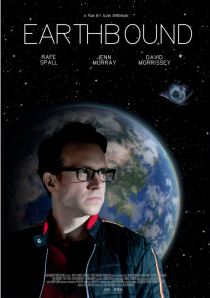
Poster for "Earthbound"

Earthbound is a mess, plain and simple, which is doubly disappointing given all the awesomely schlocky B-movie promise of the pre-credits sequence. We learn the tale of Mathius and Jace, the sole refugees of a distant planet called Zalaxon, which has been torn apart in a civil war. Mathius fled the planet with his son, who was due to be sacrificed by the enemy in order to win the war…somehow. Jace lives on as the “Last Son of Zalaxon” in exile. Presumably this is also a symbolic title, as his warring planet is still awaiting his return by way of a signal beacon visible through a wormhole that opens every few years between Zalaxon and Earth.

And you know what? All of that is just fine. This film takes an absurd space opera and spells it out via a dazzling series of colorful comic book panels, leaving the audience begging for more. But all of the delight and incoherence of this premise could have only succeeeded if this film had the slightest idea of what tone it was going for. If I’m to judge by Liam Bates’ oppressively cloying musical score, the film is trying to be a grown-up version of E.T., replacing the earnest and childlike alien relationship with that of a pair of desperately lovestruck adults. Joe, the 10-year-old boy formerly known as Jace, loses his father Bill (né Mathius) (David Morrissey) at the age of 10. Before dying [of unspecified causes], Bill lets his son in on his extraterrestrial origins, leaving behind a collection of retro-futuristic children’s toys and otherwise human-looking objects as evidence. But more on this collection later.

Fifteen years later, Joe (Rafe Spall), now working as a clerk in a comic shop, instantly falls for fellow sci-fi fan Maria (Jenn Murray) by way of an electronic wristband that instantly informs him of their 93% genetic compatibility (well past the 85% that he needs in order to knock up one of those easy Earth girls). While “you’re the only hope for my people” might have actually had some success as a pickup line, Joe wisely conceals his true identity when asking Maria out. But what we get instead are some of the most insipid attempts at romantic dialogue this side of Attack of the Clones, made even more obnoxious by the score’s various attempts to make me think I’d felt something for these star-crossed lovers. The two performances are individually decent, but weren’t remotely believable as romantic partners, with Murray’s earnest sadness and Spall’s unrelenting quirk making an incredibly poor match when sharing the screen.

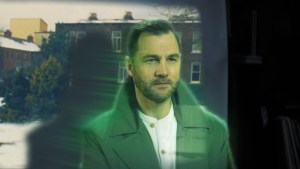
Still from "Earthbound"

This film had all the elements of a successful piece of sci-fi, but no earthly idea how to fit them all together. Among Joe’s gadgets was a holographic projection of his father – a device that served virtually no purpose beyond exposition and plot contrivance. This is neither Jor-El nor Obi-Wan. While there’s a chance of poignancy in the idea of Joe conversing endlessly with an affectless husk of his dead father, the various attempted emotional beats in this “relationship” utterly fail to land. When Joe is potentially forced to give up on seeing his projected father ever again, the dilemma inspired nothing more than a tepid yawn, and was over just as quickly. If Joe doesn’t care, why should I? And his choices don’t seem to matter much anyway. Each of Joe’s mundane-looking alien devices had to stop working at just the right moment to prevent anyone from believing his story, and start working again just in time to be useful or muddy the waters further. The film tries to delve into psychological thriller territory by forcing Joe to doubt the veracity of his tale, but given the clunkiness with which his doubts are established, it doesn’t remotely succeed. Apart from a hilariously dark performance by Stephen Hogan as the world’s worst psychiatrist, there is very little to redeem this act, and it attempts so many unsuccessful twists and reversals that it all becomes downright tedious.

But the final sequence very nearly saved it. Some vague spoilers will follow. By the time we reached the third villainous monologue, in which the baddie just can’t kill the hero without first talking his ear off about how thoroughly he has been beaten, I thought perhaps the film had found its footing again. The final sequence would feel right at home in a 50s sci-fi romp, and it was this loving and old-fashioned treatment of the genre that made me lament just how much of a missed opportunity this is. Earthbound is actually quite well made, and everything – from the production design and effects to the majority of the performances – seemed just adept enough that it all should have coalesced into something just a bit more watchable. But for a film that only has enough plot to fill perhaps a single decent episode of Doctor Who, the rest just feels like the disorganized cutting-room bits of a different project.

FilmWonk rating: 4 out of 10

FilmWonk Podcast – Episode #23 – “Liberal Arts” (dir. Josh Radnor) (SIFF)

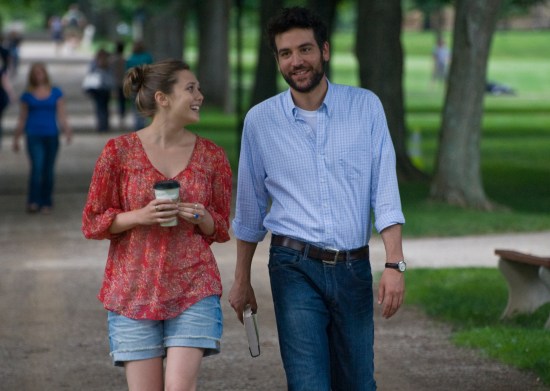
Still from "Liberal Arts"

Back at SIFF and back to school! Glenn and Daniel hit the books with college nostalgia as they review Liberal Arts, the latest film from How I Met Your Mother star Josh Radnor. Take in their worthless intellectual blather while you can! They’ve both got work in the morning that is utterly unrelated to their majors.

May contain some NSFW language.

FilmWonk rating: 6.5/10

Show notes:

  • Music for this episode is a pair of classical pieces that appear in the film. The first is Beethoven‘s Symphony No. 6 Pastorale as performed by Istanbul’s National Conservatory Orchestra (free download in link). The second is Soave sia il vento, from Mozart‘s opera Così fan tutte, which I’ve included in its entirety at the end of the podcast. Listen to it while walking down the street and watch as everyone becomes more attractive.
  • Regarding the age question that both we and the movie raise – Elizabeth Olsen was around 22 when this film was shot. Josh Radnor was 37, and Allison Janney was 52.
  • The book shop owner is played by Elizabeth Reaser of Twilight fame. And it all comes full circle.

Listen above, or download: Liberal Arts (right-click, save as, or click/tap to play on a non-flash browser).

SIFF Roundup: “Extraterrestrial”, “John Dies at the End”

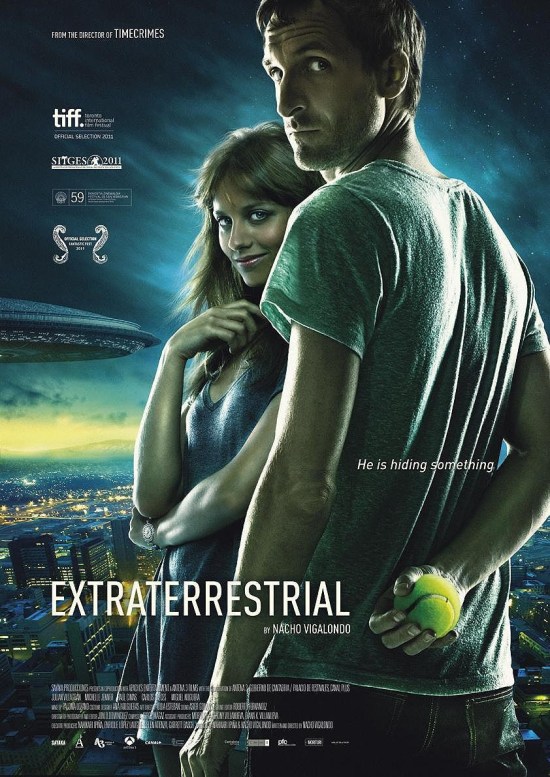
Poster for "Extraterrestrial"
It appears I can cross “alien invasion sex comedy” off my dwindling list of unseen genre mashups. This is the latest small-budget feature from Nacho Vigalondo, the Spanish writer/director behind the tense and violent 2007 sci-fi thriller Timecrimes – another brilliant film that otherwise has so little in common with the director’s sophomore effort that the connection seems scarcely worth mentioning. While Los Cronocrimenes was driven by a taut and carefully scripted sci-fi plotline, Extraterrestre merely uses the backdrop of an alien invasion to frame a sexy rom-com.

Julio (Julián Villagrán) wakes up in the apartment and bed of Julia (Michelle Jenner), following an awkward one-night stand only made more so by the fact that neither of the two can remember anything about the night before – including, indeed, whether or not they even had sex. This question becomes a bit more important when a pair of interested parties arrive – Ángel (Carlos Areces), a nosy neighbor with a serious crush on Julia, and Carlos (Raúl Cimas), her long-distance boyfriend. With the streets of Madrid empty and the downtown core beneath a mile-wide alien spaceship, this essentially becomes a locked-room romantic comedy. Julio and Julia explore their newfound, philandering chemistry, Ángel deftly demonstrates why he can’t get the girl, and Carlos, a steadfast survivalist, obliviously plans the group’s next move.

Don’t get me wrong, these characters sound a bit cookie-cutter, but the entire first act of this film is brilliantly written. The film fits right into that nice Zombieland niche in which ordinary characters are tossed together amusingly amid extraordinary circumstances. Sure, the world might be coming to an end, but can’t we still engage in petty bickering over who f’d whom? All of the cuckolding drama is a bit celebratory of bad behavior, but the plot maintains just the right tone of naughty fun to avoid feeling too mean-spirited. Even with a merciless love-quadrangle, the film has an impressive amount of heart, and makes you genuinely care about each of the four characters at least some of the time.

The problem is, these characters get kicked out of the film one by one. We definitely needed time for the core romance – if that is what it is – to grow, but at least one of the rival characters had to get short shrift, and it really wasn’t the one I expected. One of them veers just a bit too much off the rails in the third act, and it isn’t the guy with the tennis ball launcher. While this bit of screwball comedy was still entertaining, it does feel just a bit like the film is turning on its characters as they begin to strain likeability even further.

Fortunately, Extraterrestrial manages to stick the landing. The ending is sweet and seems tonally appropriate, concluding with a gorgeous sunset shot that just about perfectly sums up the film. Save the interstellar warfare for the Americans…we’re just here to hang out in Madrid.

FilmWonk rating: 7.5/10
Extraterrestrial will be playing a couple more times at SIFF, and staying for at least a weeklong Seattle run at SIFF Cinema when the festival concludes. If you’re interested in seeing the film in your town, you can also “demand it” by visiting this link.

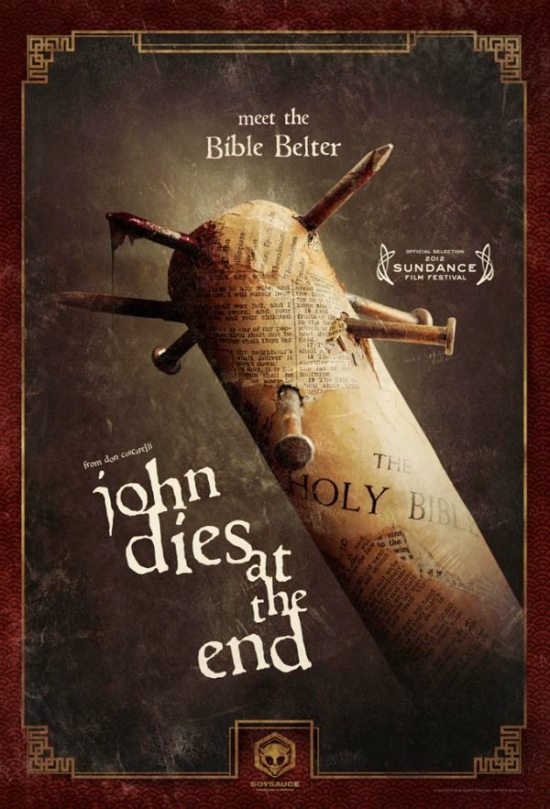
Poster for "John Dies At the End"

John Dies at the End is pure, unadulterated insanity. I saw it at midnight under the influence of 9 hours of road-trip driving, a shot of Jägermeister, a glass of hefeweizen, and a 12-oz can of Red Bull (in that order), which might just comprise an ideal viewing experience. The film features the bizarre, drug-fueled, stream-of-consciousness journey of David Wong (Chase Williamson) and John Cheese (Rob Mayes), a pair of bros who dabble in paranormal investigation. Their recent discovery is a drug called “soy sauce”, which, when injected, enables the user to see into other places, times, dimensions, etc.

The drug is basically whatever the plot needs it to be from moment to moment, operating variably as a means of clairvoyance, precognition, telekinesis, and so on. But really, that’s fine. The drug is no different in principle than demonic possession, alien invasion, or any number of other paranormal plot devices. What keeps this movie stampeding along is not plot convention but an immense sense of kinetic fun and a commitment to remain at least semi-coherent. Don Coscarelli‘s strong low-budget visuals (which he previously demonstrated in Bubba Ho-Tep) are out in full force here. Even the most ridiculous practical effects and creatures manage to strike a nice balance between laughable and menacing. The film felt almost like an R-rated take on Ghostbusters, with the main duo seemingly quite knowledgeable about all things paranormal, despite the insane, bumbling adventure on which they must embark.

The film utilizes a number of clever devices, including phone calls displaced in time, demons who appear as different people depending on who’s looking, and even a clever reference to the Grandfather’s Axe paradox. There was seemingly a great deal of care and intelligence that went into this psychotic romp. It feels like a meticulously constructed doll, woven by a maniac into a tattered conglomeration of twigs and human hair, which he brushes lovingly every night before he goes to bed. Perhaps he calls it Sheila. Or Brutus. And then one night, he decides to use it as a quill with which to pen his manifesto on the padded walls of his suburban living room, using an ink composed principly of his own urine.

I’m pretty sure that’s an accurate summation.

FilmWonk rating: 7-ish out of 10

FilmWonk Podcast – Episode #22 – “Safety Not Guaranteed” (dir. Colin Trevorrow), “The Imposter” (dir. Bart Layton) (SIFF)

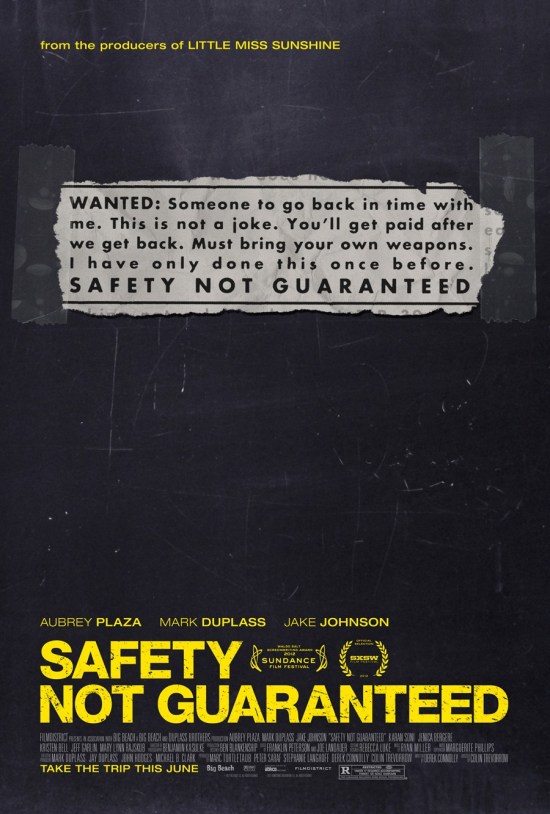
Poster for "Safety Not Guaranteed"

As SIFF continues, Glenn and Daniel check out the highly anticipated time travel comedy Safety Not Guaranteed, which comes home to Seattle along with much of its cast and crew. Then they jump out of their seats and run to the next auditorium to pose as film critics in a packed screening of Bart Layton‘s utterly fascinating documentary/thriller, The Imposter.

May contain NSFW language.

FilmWonk rating (Safety Not Guaranteed): 6/10
FilmWonk rating (The Imposter): 9/10

Show notes:

  • (00:00) Review: Safety Not Guaranteed
  • (06:45) Spoilers: Safety Not Guaranteed (although we somewhat spoil the Jake Johnson subplot starting at 05:38)
  • (13:22) Review: The Imposter
  • (19:56) Spoilers: The Imposter
  • Correction: I mistakenly refer to Colin Trevorrow as a first-time director. In fact, he has a few prior credits, including this amusing short from 2002.
  • For some reason, there’s a vague spoiler for the 7th season finale of House (at 08:12). Thanks for that, Daniel.
  • But later, Daniel redeems himself by mentioning the Ninja Kitty video, which is definitely worth watching.
  • Nerd quibble: Aragorn decapitated an Uruk-hai, not a Nazgul.
  • Unfortunately, there was no trailer available for The Imposter, so we included a brief clip from the SXSW interview with director Bart Layton, available in its entirety here.
  • We refer to the Taylor University van crash case, in which a college student named Whitney Cerak was misidentified as another student who died (even mistaken by the victim’s family).
  • I was referring to this guy in this movie. Kudos to anyone who got this utterly pointless reference.

Listen above, or download: Safety Not Guaranteed/The Imposter (right-click, save as).