This week, Glenn and Daniel follow the western genre into the oil-rich 20th century and the terror of white supremacy in the Osage Nation with Killers of the Flower Moon (55:22).
May contain NSFW language.
FilmWonk rating: 10 out of 10
Show notes:
[00:23] Review: Killers of the Flower Moon
[39:33] Spoilers: Killers of the Flower Moon
Native perspectives on Killers of the Flower Moon:
The film features Fox News newsreel footage of the 1921 Tulsa Race Riot, and Daniel referenced another terrorist attack two years later in rural Levy County, Florida, the Rosewood massacre.
This review originally appeared as a guest post on 10 Years Ago: Films in Retrospective, a film site in which editor Marcus Gorman and various contributors revisit a movie on the week of its tenth anniversary. This retro review will be a bit more free-form, recappy, and profanity-laden than usual.
“What the fuck is this?” -“It’s actually pretty good. It was made by this Danish woman in the ’70s. It’s probably not what you’re used to looking at, but it’s pretty hot.” “OK, look, I have a girlfriend, all right? So…” -“I’m sorry, did you think I was hitting on you? Because I’m not… I thought you could use something better than that shit you’re watching on your phone. …am I right? If you have a girlfriend, why are you watching dirty movies?” “You’re fuckin’ weird, you know that?” -“I don’t entirely disagree, but you’re the one who’s gonna pretend you’re texting while you watch people pretend they’re fucking on your phone.” “The shit I watch on here? They’re not pretending.” -“Of course they are!”
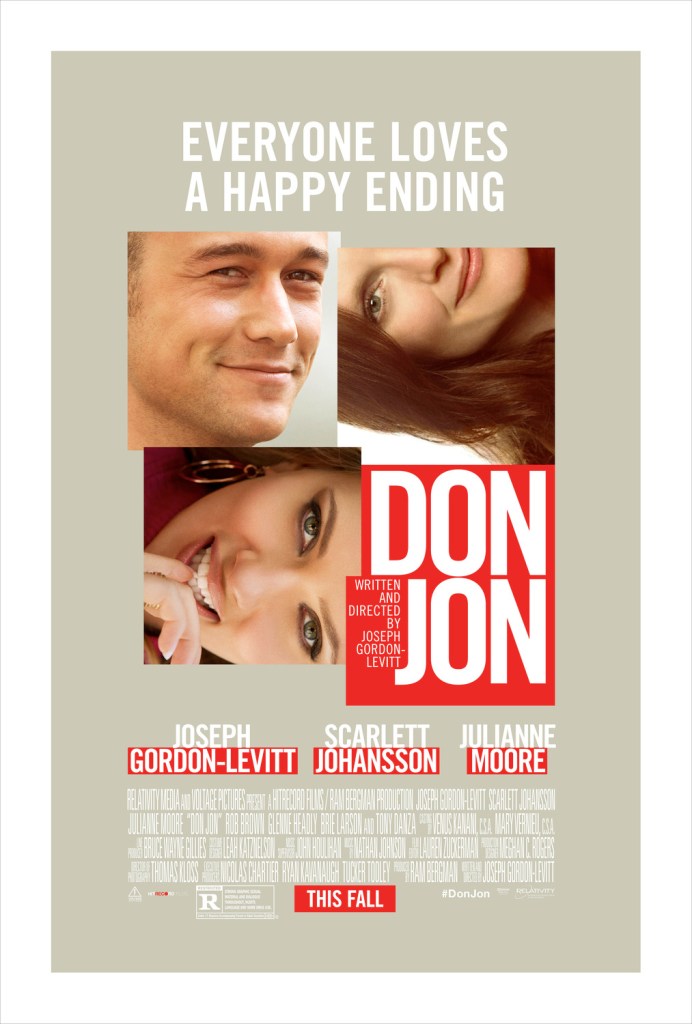
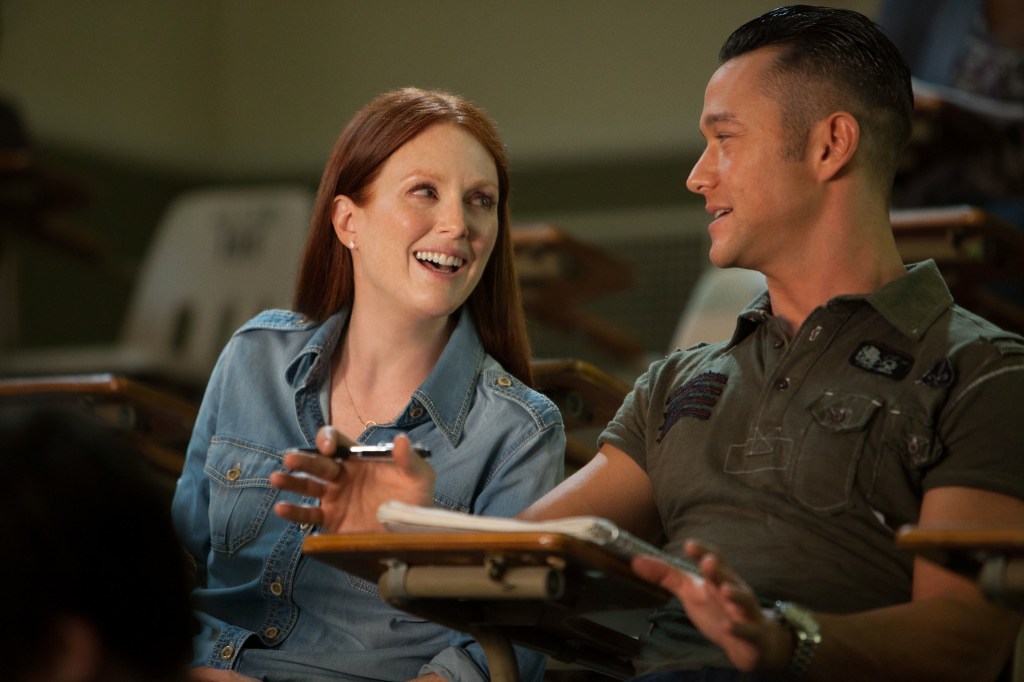
Jon (Joseph Gordon-Levitt) and Esther (Julianne Moore), having a little chat in public about porn, as I’m about to do with you.
All of the actual porn clips that appear in Don Jon are cropped narrowly enough to get the film an R rating, but its dialogue is unrestrained in both obscenity and depth when it comes to discussing all things pornographic and masturbatory. The 1994 Kevin Smith film Clerks settled the question of whether theatrical movies can discuss sexuality in such candid terms without getting an NC-17 rating, via an argument made by legendary creep and fascist-coddler Alan Dershowitz, spawning an all-timer for that “worst person you know made a great point” meme. But even as no-account New Jersey fuckboy Jon Martello, Jr. (Gordon-Levitt) explains in exquisite detail each step in his several-times-daily ritual of porn and self-pleasure (noting that the sound of his MacBook booting up gets him hard as a fucking rock), it still feels transgressive, because most candid discussion about sexuality is either preposterous (like the FiftyShadestrilogy) or in pursuit of a quick joke, never offering any real insight into sex where a brief, discomfited chuckle will do. And don’t get me wrong; Jon’s monologue is as hilarious as it is off-putting, but it never feels shallow. Jon describes masturbation like he’s ascending to Nirvana: “All the bullshit fades away…I don’t gotta say anything, I gotta do anything. I just fucking lose myself.” And that honest feeling of disconnection from his sexual partners seems worth exploring, whether or not his attitude about porn is cause or mere symptom.
This film was originally titled Don Jon’s Addiction and even premiered at Sundance under that title, and its creator’s acquiescence to the distributor’s title change makes me wonder just how confident he was about that “addiction” framing. JGL took to Facebook on that occasion and opined that he didn’t want people thinking the movie was about porn addiction and sex addiction, which is fair enough, and was probably about the limit of my understanding at the time. While Jon does try and fail to stop watching porn at his girlfriend’s behest, and another character questions whether he ever tries masturbating without it, nobody ever actually refers to this common behavior as an addiction, but rather treats it like what it is: A thing lots of people do, which can be done in excess. If you ask the professionals, the answer is pretty definitive – sex addiction does not appear as a distinct disorder in the DSM or its international equivalents. My own state’s coalition of sexual assault prevention programs (WSCAP) published a discussion guide to accompany Don Jon, and the word “addiction” does not appear in it even once. The consensus of scholarly and professional opinion is that sexuality is an ordinary human behavior expressed in a variety of ways, and attempting to isolate “sex addiction” as a distinct disorder serves to pathologize ordinary human behavior in a way that is both counterproductive to treatment for better-defined mental health conditions which might encourage illegal, disruptive, or upsetting sexual behavior, and also used as an excuse by policymakers and religious conservatives to isolate and pathologize ordinary expressions of sexual behavior that they deem undesirable and seek to repress as a means of cementing their political power. The entire LGBTQ community can tell you about that one.
So in the same way that Jon is forthcoming with the audience about what he gets out of his quotidian jerk sesh, so too is Don Jon honest about the limitations of its scope: Jon has very little at stake except his own maturity when it comes to sex and relationships, and consequently, the film plays less like a social document and more like a coming-of-age flick for horny twenty-something dudes who kinda need to get their shit together. And that is a fine and uncommon thing. It’s the rare indie gem, like Ben Lewin‘s The Sessions or Bill Condon‘s Kinsey, which discusses sexuality with any honesty, and even then, it’s usually in pursuit of some greater storytelling or biographical objective which justifies this odd moment in which we normie, God-fearing, uptight Americans find ourselves discussing sex when we’re all clearly too uncomfortable with the topic to do so. So I have to give some credit to JGL for crafting and portraying a character who is…essentially no one in particular except…a young American bro who likes watching porn between going to church to confess about it, and having sex with a parade of women he meets at The Club with The Boys, occasionally punctuated by a shouting dinner with his parents (Tony Danza and the late and excellent Glenne Headly) and his almost entirely taciturn sister (Brie Larson) about how his life is off-track and he’s a terrible football fan. That’s to say, JGL is putting himself forth through a fictional lens as a basic douchebag, and then putting that good-lookin fella on camera to confess to us, his friends beyond the fourth wall, that he doesn’t even really enjoy sex that much, and prefers the noble path of Onan and Pornhub. And lest we run the risk of liking him too much, he even troubles a one-two punch of suggesting that women can become hot enough to avoid having to give blowjobs and referring to men who enjoy performing the act of cunnilingus as “fucking crazy”.
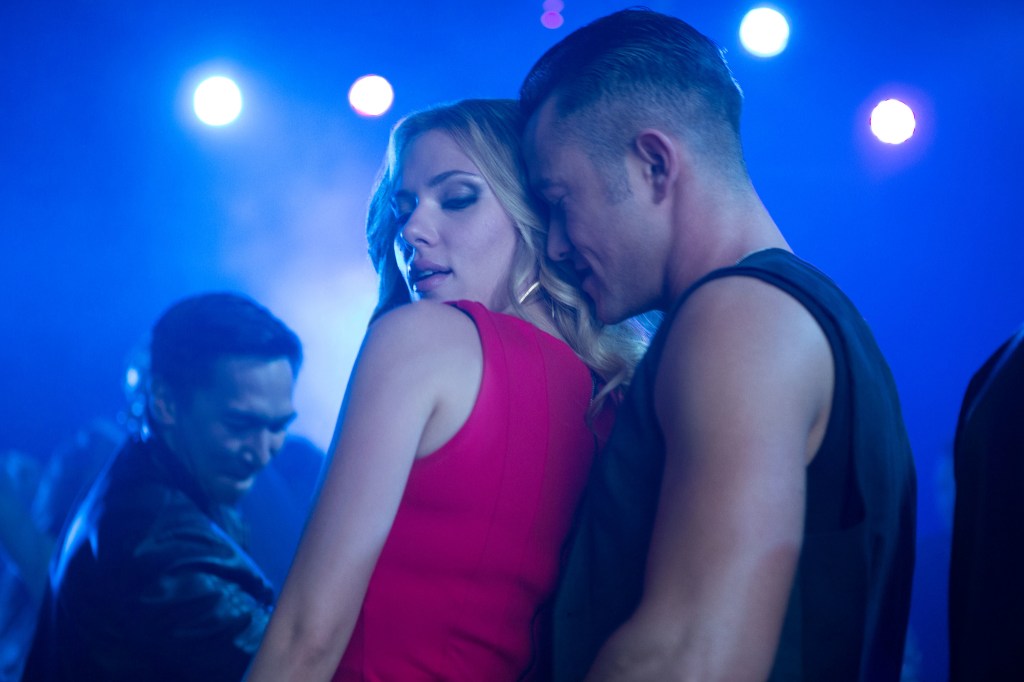
Now, I’ll leave to the reader’s imagination whether and how often my tongue does a glissando – and it’s fair to say that men’s performative outrage at anyone questioning their watercress-grazing skills usually exceeds their true aptitude down south. But it’s also fair to say that Jon’s early and repeatedly-expressed desire to get head (as well as a variety of coital positions) without providing any reason why a partner would want to do so is presented to the audience as both an unlikable characteristic and a symptom of Jon’s dysfunctional attitude toward his own sexuality. Jon’s problem isn’t that he likes porn – and it isn’t that he’s dating a woman, Barbara (Scarlett Johansson), who doesn’t trust or even particularly like him (feelings which seem to be mutual anyway). It’s that he doesn’t really understand how to connect with other humans on a deep emotional and physical level, and sees porn as an outlet that doesn’t even make him try. And all it asks in return is for us to occasionally, shamefully acknowledge that it has a better claim to invention of the internet than Al Gore.
Back to Jon’s opening monologue for a moment. He describes the feeling of ejaculating to the perfect porn clip as “losing himself”. And why not? If you’re all alone, and you lose yourself, who’s left? The contrary view is embodied by Esther (Julianne Moore), a woman of the world who lost her husband, child, and any remaining verbal filter over a year before she meets Jon at night school and casually fucks him in her Jeep Wrangler. And it is in naked conversation with Esther that we finally see another human giving and receiving the kind of honesty that Jon had never thought about pursuing before. Relationships, she explains, are reciprocal. And all of Jon’s myriad dysfunctions – which Esther freely admits she wouldn’t tolerate if a meaningless hookup with a beefy bro weren’t something she sorely needed right now – are simple enough to explain: Jon has only ever pursued one-sided relationships, in which he gets whatever he wants – his pad, his ride, his girls (always rated on the 10-scale) – and he thinks little for anything he ought to give in return. This is why he was willing to accept a different sort of one-sided relationship with Barbara, who has very particular ideas about who he should be and how he should act – many of which are presented as facially reasonable, if Jon really is ready to settle down, and really wants to settle down with her specifically. I really have to hand it to ScarJo for a brilliant performance as a character who has to act in a deeply unlikable way while also being treated unfairly and misogynistically by the film’s protagonist. Barbara fits the mold I often call “more concept than character”, representing a version of henpecked, marital femininity as rendered by men who are terrified of finding a woman they deem hot enough to make them suppress their baser nature for a while. It’s a very particular and stereotypical view of how (immature, cishet, monogamous, marriage-inclined) men and women think and act towards each other, but even for its limited intended scope, this examination feels self-aware. The heteros are upsettero*, and in the course of explaining their gross feelings, we not only get to bask in Johansson’s wicked charm, but also get a breathtaking quasi-sex scene in a hallway which is perhaps one of the best pieces of physical comedy either actor has ever performed. We also get Brie Larson in the film almost exclusively to confirm, through female lips, that “that girl has her own agenda” and “she doesn’t care about Jonny” – fine and true bits of subtext which perhaps betrayed a lack of confidence that the audience would clock that both of these people are behaving with immature emotional intelligence and communication skills which they will both, hopefully, eventually, grow out of. Apart from losing a bit of my own verbal filter when it comes to discussing sexuality (adding a bit more candor, vulnerability, and empathy to my existing repertoire of the grotesque and the profane), those are precisely the skills I’ve put the most personal effort into improving over the last decade, because they seem essential to becoming a well-functioning human.
And like Tyler Durden said, self-improvement is masturbation. Meaning it’s fine and everyone should get on it. Pretty sure that’s what he meant.
This week on the FilmWonk Podcast, we do a #Barbenheimer (Greta Gerwig‘s Barbie and Christopher Nolan‘s Oppenheimer), then split the difference of pastel colors, artifice, and nuclear testing with one we missed from June, Wes Anderson‘s Asteroid City. (1:05:52).
May contain NSFW language.
FilmWonk rating (Barbie): 8 out of 10 (Glenn) FilmWonk rating (Oppenheimer): 8/10 (Daniel), 7.5/10 (Glenn) FilmWonk rating (Asteroid City): 8 out of 10
What ultimately disappointed me about The Super Mario Bros Movie was that it contained nothing new or unexpected, give or take a Jack Black song that – despite being a pernicious little earworm – is barely a song at all. Mattel, a toy company, isn’t going to shock me with its desire to sell more toys, any more than Nintendo trying to sell more games, or Hasbro smashing toy robots together. But movies are still a medium of stories and characters who will, at some point, have to explain to me why I should bother watching what amounts to a two-hour toy commercial, and the Barbie doll’s position as an iconic but dated piece of Americana doesn’t obviate that requirement. So you can imagine my delight when director Greta Gerwig (with a script co-written with frequent collaborator Noah Baumbach) decided to play with a broad and inclusive set of dolls, all singing and dancing a medley of existential dread on the border between Barbieland – a plastic, pastel fever dream (beautifully realized by veteran production designer Sarah Greenwood) where Barbie’s in charge and Ken is surplus to requirements – and the real world, where the Patriarchy is alive and well; we just hide it a bit better than we used to. It’s not much of a boast to say I’m less of a fragile little bran muffin than Ben Shapiro, whose vague fleshy blob turned instantly to windblown ash the moment the P-word was uttered in dialogue not once, but a baker’s dozen times. But if you’ll indulge me a problematic compliment, I was genuinely delighted to see that this toy commercial had some fucking balls. Because while my cynical side will assume that Mattel approved every image and sound that appears on this screen, and corporate feminism always exists with a degree of self-aware marketability, it’s hard for me to imagine that having a modern child (Ariana Greenblatt) tell Barbie to her crying face that she’s the dumb, fascist scion of a vapid and environmentally destructive consumer culture was their first advertising choice. In truth, it was their 43rd choice. But it’s one I found myself happy that they troubled to make at all.
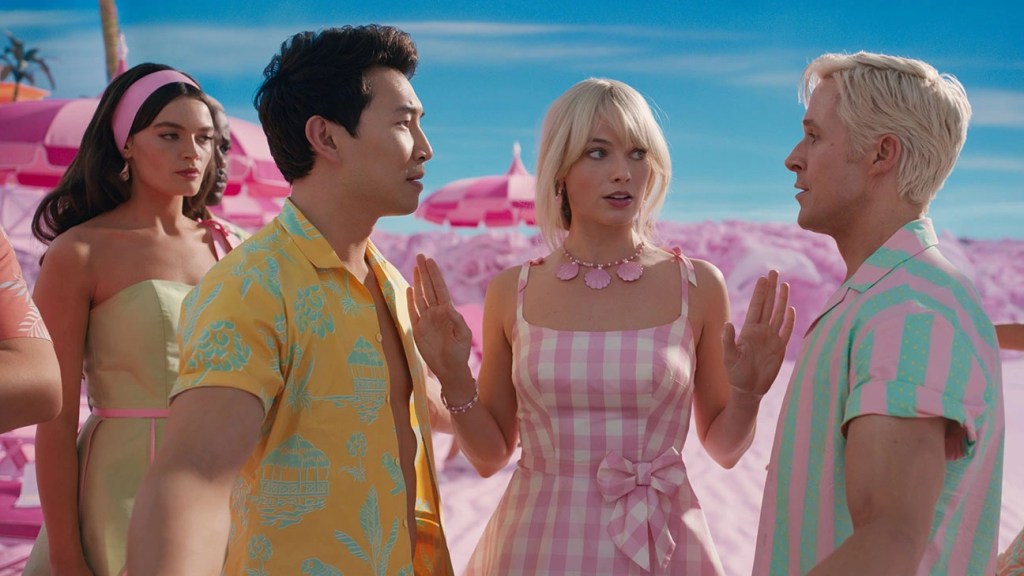
Following an amusing satirical nod to the opening of 2001: A Space Odyssey, we start in the Dream House with Barbie (Margot Robbie), a narrative device reminiscent of The Lego Movie and Monsters, Inc., as we learn that Barbieland exists in a loose, metaphorical parallel with the Real World, with each Barbie corresponding to a real human child’s toy. Robbie, the tall, blond original model, is referred to in dialogue (by herself and others) as Stereotypical Barbie, with every other woman in this world also claiming the Barbie name, from President Barbie (Issa Rae) to Dr. Barbie (Hari Nef) to various Mermaid Barbies (Dua Lipa). There is also Ken – whose original (generic white beefcake) model is played by Ryan Gosling, with the narrator (Helen Mirren) informing us that the only thing that determines whether he has a good or a bad day is whether Barbie smiles at him – a bleak existence that is presented as such. This motivation unites all of the Kens, played by other beefcakes like Simu Liu, Kingsley Ben-Adir, and – briefly, in Merman form – John Cena. Between their cloying pursuit of the female gaze and various machismo contests on the Beach (in which they offer to “beach [each other] off” repeatedly), the Kens live a vapid and ill-defined existence, with no real place to go when the nightly dance party concludes at the Dream House, and the nightly Girls’ Night slumber party begins anew. Barbie and Ken play at romance as devised by a toddler, kissing with free-floating faces near each other, and “being boyfriend-girlfriend” with only the vaguest notion of what that actually means. Although they’re both quite clear on their physical limitations, with Robbie’s Barbie dutifully informing a few catcalling real-world construction workers that she has no vagina.
The key detail about Barbieworld is that it is a perfect, happy, feminist utopia where…literally nothing is at stake. Barbie’s food and drink are all automated play-objects that she doesn’t really need to consume. Dr. Barbie displays a heart-shaped x-ray of a minor Ken injury, but heals it with the ease of a child’s narrative handwave. President Barbie is the president of dancing and wearing sashes. But make no mistake – women and girls are in charge of Barbieworld, and men are their dutiful, superfluous sidekicks. And it is that unstable malaise that kicks off Barbie‘s plot: Stereotypical Barbie ends her nightly dance party by asking some of the other Barbies in the room whether they ever think about dying. And then her permanently high-heeled feet collapse into flats, she notices cellulite on one of her thighs, and she’s immediately sent to go see Weird Barbie (Kate McKinnon), her oddball fairy godmother with a messy, multicolored hairdo, doing permanent splits – perhaps a metaphor for adulthood, feminist awakening, queerness, or all of the above – to explain what she must do: Journey to the Real World and connect with whichever human child is playing with her wrong, a girl named Sasha (Greenblatt), who greets her with the devastating takedown I mentioned above.
Barbie’s Real World mission gradually expands to include Sasha’s world-weary, millennial mother, Gloria (America Ferrera), who deals with her existential ennui about the dolls she used to play with (and a tween daughter who wants nothing to do with them) – by working at Mattel and sketching dark and fucked-up little doodles of the Barbies she dreams about now. Cellulite Barbie. Fear of Death Barbie. Barbies who are allowed to pause for a moment and consider what the world is like if everything’s not perfect all the time. When Barbie finally meets Gloria, it’s in the course of discovering that Mattel, and the world it exists in, is run by men and the patriarchy, who hold all meaningful positions of power and advance their own ambitions at the expense of anyone who challenges their vision of how they should continue to hold that power. With Donald Trump and the entire Republican coterie of lifetime-appointed priest-kings a full year into their experiment with taking women’s reproductive rights backward half a century, this should not be a controversial position for anyone other than the right-wing cohort whose paychecks derive from performative outrage at people describing the world as it is. At the same time, even for a sympathetic audience, merely mentioning the patriarchy or Barbie’s desire to smash it wouldn’t have been enough by itself. An insubstantial and inconclusive riot grrrl vibe tanked my enjoyment of Amy Poehler‘s Moxie, which ultimately felt more like the ghost of 90s feminism’s past, rather than a story with anything useful or interesting to say about the modern world.
Instead, Barbie posits and persuasively argues for a common fourth-wave feminist talking point: That the patriarchy is harmful to men and boys as well as women and girls and everyone in-between. Given the film’s dutiful fourth-wall breaking, I’ll go ahead and lay my Low-T, Beta Cuck cards on the table here: I simultaneously believe this talking point is a piece of realpolitik coalition-building on the part of feminists hoping to make disinterested men give a shit about their cause – and that it’s objectively true, so I don’t really begrudge its functional purpose. The patriarchy is real, describing a system of historical, social control that empowers and benefits men in a huge and tangible way, but ultimately harms those same men by slotting their range of possible outcomes and identities into a handful of stifling archetypes, limiting their ability to ever truly know themselves and explore the full range of who and what they could be within a mutually supportive community of other men, women, and enbies who are free to do the same. The film begins by displaying a topsy-turvy fantasy world in which women are in charge, but there’s precious little to be in charge of, and even in that place, we still get a sense of how harmful the situation is to the Kens who don’t know their place, nor particularly have the mental wherewithal to consider it at all. To wit, Barbie begins with a cartoon matriarchy and says that’s Bad Too, Actually, before it even considers what the real world is like. When Gosling’s Ken finally sees the Real World, he is instantly taken in by it – men are men (and occasionally men on horseback), constantly supporting and high-fiving each other as they prop up a world they unapologetically rule over. As Barbie is learning about catcalling and sexual harassment, the script is positing, through the eyes of its most naïve and corruptible character, Ken, that the patriarchy is seductive. And as the patriarchy roils forth to corrupt Barbieland, it somehow doesn’t feel like it’s calling out anything that wasn’t always there in both worlds. Even as Barbie’s real-life creator Ruth Handler (Rhea Perlman) appears as a wandering spirit to confess the unachievable dream she was always selling with her creation (even calling out her eventual SEC charges and removal from the company), the film digs deep into Mattel’s archives to show us some of the gross shit Mattel was engaged in as recently as 2009, when it introduced…Sugar Daddy Ken (Rob Brydon), or 40 years earlier, when it released a Skipper (Hannah Khalique-Brown) whose boobs inflated with the crank of an arm as she grew up into a “tall, slender teenage doll“. Despite the presence of Will Ferrell as a business guy in both films, Barbie goes a step beyond The Lego Movie in arguing that despite multiple chipper song and dance numbers tooting a similar horn, everything was not awesome in Barbie World or ours to begin with, and a return to the status quo in either one will not be nearly as useful as characters who can speak honestly about the sinking feeling and cognitive dissonance they experience just trying to exist.
Gloria is ultimately handed the megaphone to make this point, and Ferrera delivers this monologue beautifully, laying out a litany of dysfunctions and contradictory expectations that come with being a modern woman. And as the badass boss bitch who sits directly outside the all-male board room at Mattel, Gloria is precisely the flawed avatar that this point deserves, because she’s a character that props up a system that she knows was harmful to her own childhood, but is ultimately just an ordinary woman trying to get through the day, take care of her kid, and participate in a system that she had little say in setting up, without ever feeling like a monster or a failure or a hypocrite. It’s an impossible standard. And for Ferrera to express it in a way that simultaneously feels relatable and sympathetic for a modern, multi-gender audience is a real achievement. Because a girly movie with something to say…which is only seen and heard by girls…isn’t accomplishing nearly enough (even if it manages to bring in a few terminally online film nerds who crafted an unlikely juxtaposition with a dour historical drama). And while Robbie’s Barbie does close the show (with a line I still can’t believe the movie had the audacity to end with), she spends a fair few lines acknowledging that this wasn’t entirely or even mostly a story driven by her version of Barbie. Barbie the film knows what these dolls are and what they’ve represented in American society, and it acknowledges that history in more than a tokenistic way, speaking less about the dolls themselves and more about the oppressive system for which they always functioned as brand ambassadors. Don’t just be a girl. Be this girl, with her waist-length blond hair and giraffe neck. Gloria gets it. And she tells the audience what’s what so smoothly that it stops just shy of being didactic or punitive to any dudes who showed up, voluntarily or with some encouragement, because ultimately all I felt from Gloria was a desire to cut herself and myself some slack about what society expects us to be. Because life in plastic…ain’t fantastic.
This week on the FilmWonk Podcast, Glenn and Daniel face the destiny of Harrison Ford, who returns for his third and presumably final legacy sequel to a blockbuster franchise (barring any eventual return to Jack Ryan), Indiana Jones and the Dial of Destiny. But first, we check out the upcoming raunchy road trip comedy from Crazy Rich Asians screenwriter Adele Lim, Joy Ride, in theaters this Friday (1:10:24).
May contain NSFW language.
FilmWonk rating (Joy Ride): 7.5/10 (Glenn), 7/10 (Daniel) FilmWonk rating (Indiana Jones and the Dial of Destiny): 4/10 (Glenn), 5/10 (Daniel)
Show notes:
[01:53] Review: Joy Ride
[22:42] Spoilers: Joy Ride
[34:53] Review: Indiana Jones and the Dial of Destiny
[54:35] Spoilers: Indiana Jones and the Dial of Destiny
I did indeed misremember – Daniel did not like Crazy Rich Asians as much as I did.
How does a world-weary millennial approaching middle age with two kids even begin to discuss The Super Mario Bros Movie? By establishing his Nintendo bonafides of course. I won’t bore you with a list, but my first of 11 Mario games (plus another half-dozen Warios and Donkeys Kong) was Super Mario Land for Gameboy – the first portable Mario game ever released, and the one that became my sole obsession from that Christmas to the following June. I spent hundreds of hours playing Super Smash Bros on the Nintendo 64. And I spent a significant portion of AP Calculus in the back of the classroom tapping away on an unauthorized ZShell port of Dr. Mario on the TI-85 graphing calculator. The video game series has sold nearly 400 million copies, and I am so sure that anyone reading this also grew up with these characters that I’m cutting off the nerd solipsism right there. Truthfully, I adore Mario Mario (Chris Pratt), his brother Luigi Mario (Charlie Day), his pals Toad (Keegan-Michael Key) and Princess Peach (Anya Taylor-Joy), his pet Yoshi – whose brief, shelled appearance after the end credits is the closest thing this movie has to a spoiler but I don’t care and neither do you – and of course I love Bowser (Jack Black), as well as the waves of expendable weirdos he sends after me to be smashed and roasted and frozen and knocked aside as Koji Kondo‘s classic themes proclaim in a cheery symphony what an awesome job I’ve done – Brian Tyler allegedly composed an original score for this movie, but he was more of a DJ this time.
The reason why I love these characters is because they’re nothing more or less than they ever needed to be – bog-standard adventuring archetypes to support the world of a then-groundbreaking and still entertaining 2D side-scrolling platformer. And eventual 3D platformer. And eventual open-world game. And eventually other game mechanics. Mario the avatar, Mario the instrument – that Mario has always made sense to me. He was there to be a bright and colorful escape whose appeal was always ultimately in the sense of triumph he handed to whatever child overcame the mechanical difficulty of gameplay, whether it was you, the neighbor kid, an online strategy guide, or a call to a Clippy-like Luigi who ultimately led you to victory. And Shigeru Miyamoto is owed a debt of admiration by children of all ages for his iconic creation that can only be repaid in $60 installments to see what wondrous new game mechanics Nintendo’s skilled developers and hardware engineers have come up with this time.
But Mario the movie? It’s bright and colorful and well-made. Up to the standards of big-budget 2023 animation. Its characters and enemies and vehicles are studiously faithful to their most recent 3D game renditions. And The Super Mario Bros Movie succeeded in its supremely limited ambitions. I mentioned the voice actors above, but with the exceptions of Day and Black, they all essentially disappeared into bland characterizations with motivations and backstories whose simplicity was calibrated precisely for the 4-year-olds who will be seeing it next weekend. Including my own! And I am genuinely looking forward to seeing the delight on the faces of both my kids as they watch their favorite characters come to life on a gargantuan screen. But as an adult, I hoped that the appearance of Pratt heralded the arrival of something more like The Lego Movie, whose shallow, corporate, brand-promotional premise was handed to a pair of bonafide storytelling filmmakers who turned it into something that stands beautifully on its own, rather than a 92-minute unskippable cutscene that you’d watch once, admire for what it is, and then button-mash your way past to get back to the gameplay, the promotion of which is ultimately and transparently the only reason why this movie exists.
The plot: The Mario Bros are plumbers in Brooklyn whose mostly-mustachioed family (including a father voiced by original Mario voice actor Charles Martinet) doesn’t believe in their lofty, unrealistic dream of quitting a plumbing business to open a plumbing business. Then they’re sucked into a portal to the Mushroom Kingdom, and everything I just mentioned ceases to matter at all. Bowser, the Incel King of all Koopas, is invading every level of Super Mario World (including, eventually, the Mushroom one) with a Star power-up, which he will use to impress Princess Peach enough that she’ll overlook his status as a conquering warlord and agree to marry him. Princess Peach, a human from worlds unknown who was raised by Toads in the Mushroom Kingdom, strikes out to get the assistance of the Kong army, and allows the newcomer Mario to join her on this critical mission for the same reason she was elevated to rule the Mushroom Kingdom in the first place: Humans rule in this place, because they’re the ones who can learn the gameplay mechanics and interact with the powerups – rendered here as Mario reluctantly eating fist-sized mushrooms even though – like the four-year-olds he’s speaking to – he thinks he doesn’t like them despite how powerful they make him.
While a few brief action sequences in our world attempt to demonstrate that Mario has some natural aptitude for platform mechanics (by way of construction scaffolds, cars, and other real-world things), these mechanics become literal and unexplained once the Marios enter the Nintendo gameworld. Mario undergoes a sports training montage with Peach, as she teaches him about the powerups, and he leaps and slides his way through a 3D platform environment that just kinda floats over the Mushroom Kingdom. I managed to spend a few seconds pondering how the Mushroom Kingdom’s grasp of biohacking and gravity-defying metamaterials might, in time, make them formidable adversaries for Bowser’s warmongering, but the movie helpfully handwaves all of that away in the same manner as the games: Look, the platforms are only there so Mario has some way of hopping around up there to jump on Bowser. The Toads are just there to look helplessly adorable (one of them even explains this in dialogue), and Bowser is an unstoppable nemesis until you manage to jump on him three times and then he collapses like a neutron star. And in this movie, all of those same things will occur, but a camera will swoop around Mario impressively as he looks a bit frightened that he won’t make it, before he ultimately makes it. Peach kindly explains that not everyone gets it the first time, before strongly implying that she did. And even as we get a glimpse of the subtle evolution that Peach has made over the decades from being the object of gameplay to a sorta-protagonist, this movie contains no shortage of reminders that it has literally nothing to show you that you haven’t already seen in a video game.
There’ll be some driving, of course. The Kongs toodle around on Mario Karts, and the Rainbow Road highway chase was everything that a colorful pursuit through a formless void with shells and banana peels being thrown around can be. And Donkey Kong (Seth Rogen) was certainly a character who appeared in this movie. I’m so tired. I don’t want to dunk on The Super Mario Bros Movie anymore, I really don’t. And it’s not necessary. It’s headed for a $225 million opening weekend. Everyone already knows the emperor has no clothes (preferring to stomp around in a spiky shell), and they’re going to come see the parade anyway. Let it never be said that I can’t appreciate shallow spectacle – I did, after all, put Avatar: The Way of Water into my Top 10 for last year. I appreciate its entertainment value for a demographic I used to be in, and its mere existence won’t stop me from shelling out for the next Mario launch title whenever Nintendo gets around to releasing a new system. Which means that if nothing else, the movie was effective. I just wasn’t one of its desired effects.
On July 8th, 2000, in an episode of the NBC teen dramedy Freaks and Geeks, 15-year-old Sam Weir (John Francis Daley, who would go on to co-direct this film) explained the appeal of Dungeons & Dragons:
“We sit around and crack jokes and eat junk food all night while we’re fighting dragons and saving princesses and stuff. It’s pretty fun.”
The scene is striking in retrospect for the sheer number of successful future comics that appeared, including Samm Levine, Martin Starr, and James Franco (the series also featured some of the first appearances of Seth Rogen, Lizzy Caplan, and Jason Segel), many of whom would go on to create a body of comedic work with a mix of scripted and improvised dialogue, frequently collaborating with the writer of the episode, Paul Feig, as well as his show co-creator Judd Apatow. What does any of this have to do with D&D? Well, first, improvisors are, without exception, a huge bunch of nerds. But also, fundamentally, D&D is an improv game. It’s based on rules, and the players’ and dungeon master’s choices have to exist within some version of them. But it’s also a special, off-the-cuff, live event that will only occur in exactly that way one time, and as comedian Ben Schwartz told my Seattle audience last weekend before spinning up a long-form improv show, “If you try to tell your friends about anything that happened here, it’s going to sound like a whole bunch of nonsense” (can confirm).
This requirement to balance coherent storytelling with freewheeling anarchy might explain why a tabletop RPG like Dungeons & Dragons has some unique adaptation challenges compared to video games (which also have a fairly spotty cinematic record). If you want to adapt a video game, your choices exist on a spectrum between “make a version of the game as played by the best player ever” and “just slap the name onto an generic adventure tale that vaguely resembles it”. Previous attempts to adapt D&D have largely opted for the second method – but this feels like the first attempt to capture the loose, jokey, improvisational chaos that is fundamental to the appeal of the game. You’re telling a story, sure, and that story ultimately has to make some kind of sense. But you’re also making choices ranging from the rational to the ridiculous, and rolling the dice as to the outcomes of those choices. A skilled DM will attempt to balance the madcap randomness of gameplay with the fun and coherence of the story (usually by selectively breaking rules as needed) – and that seems to be the difficult path that these filmmakers chose to tread – or at least convincingly imitate – with the script of Honor Among Thieves. And to my unrelenting delight, it worked.
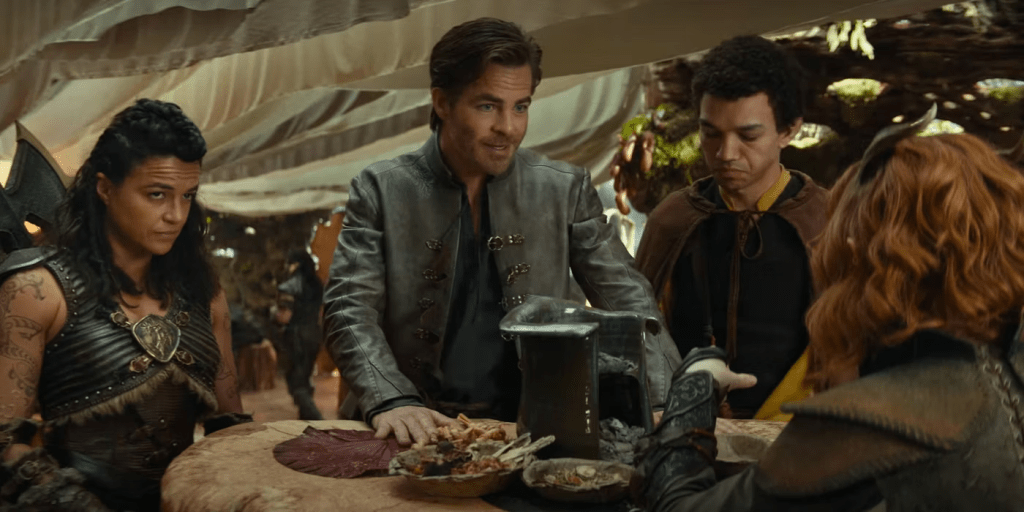
The story starts in media res with merry bard Edgin Darvis (Chris Pine) sharing a prison cell with his partner, barbarian Holga Kilgore (Michelle Rodriguez), who quickly reinforces her barbarian bonafides by fracturing an orc along several geometric planes for creeping on her while she was eating her daily jailhouse potato (per Edgin: “pretty much the highlight of her day”). If I may pause a moment and praise the sublime casting of Rodriguez as a barbarian – this is a classic performance of a D&D character with high Strength and low Intelligence on her character sheet. That’s to say, Holga is a dumb meathead who can rip people’s heads from their shoulders, and not only does Rodriguez play the character’s thickness and brutality for laughs quite effectively; she also executes stunningly brutal fight choreography. It’s a beastly dance, and the closest we’ve seen to Rodriguez whooping superheroic amounts of ass besides her variousbouts with UFC fighters during her career as the tank of the Fast party.
While the thieves rot in prison for a heist gone wrong, their former partner, conman and rogue Forge Fitzwilliam (Hugh Grant) has used the proceeds from their failed heist (both pecuniary and arcane) to elevate himself to the noble in charge of the city of Neverwinter, with Red Wizard Sofina (Daisy Head) as his silent and lethal partner, and Edgin’s long-lost daughter Kira (Chloe Coleman) as his ward. After it becomes clear that they’ll need to steal treasure and family alike back from the greedy Forge, they devise an elaborate heist to break into the city vaults on a day when every noble in Faerûn will be coming to town to bet on the local arena tournament. And yes, that is almost the exact plot of Ocean’s Eleven, but let’s not focus on that. Speaking as a D&D player who once freely ripped off Pirates of the Caribbean for one of my campaigns, that feels like par for the course, and hardly works against the film’s appeal.
What makes Honor Among Thieves work so well is that it takes pains to justify the assembly of the party and give each character a personality and a compelling reason to be there – namely, they’re all threatened in some way by Forge and Sofina’s horrific rule of Neverwinter – and a backstory which made me care about their survival and success. Simon (Justice Smith) is a low-level mage with appropriately low confidence – a partner from the previous heist who feels guilty for its outcome, which allowed himself to escape while Edgin and Holga faced the music. Holga is an exile from her tribe and became something of a sister to Edgin, as well as a surrogate parent to Kira, whose birth mother died when she was too young to remember. Doric (Sophia Lillis from It), a tiefling druid living in the woods, is directly threatened by the Bolsonaro-worthy forest destruction that Forge’s expansion of Neverwinter has wrought upon them. Xenk Yendar (Regé-Jean Page), the paladin, in addition to looking forthright and dependable every moment he swaggers around in his cape, refuses the call to adventure, but is willing to help the party out where his war ended, as a mere survivor of the Red Wizards’ conquest of his home country. And Edgin himself…he wants his daughter back, but also has to grapple with the trauma that his separation from Kira has caused her, even as she repeats back the poison that Forge has fed into her ear during her time in Neverwinter. Forge may be a selfish usurper, but he really does like having Kira around, albeit in a gross, possessive way (the idea of molding a young mind to believe whatever lies he spins for her is genuinely appealing to him), which means Edgin can’t merely steal his daughter back. He has to persuade her that she belongs back with her father. And that’s one of several strong emotional cores embedded in this heist.
Grant, as I called out in my 10YA retrospective of Cloud Atlas, is simply unmatched at playing an unrepentant shitheel. Forge’s glee at seizing power and taunting his former friends for accidentally helping him do so is…well, roguish. He doesn’t want the credit in public for all the amazing bad things he did, but he’ll happily monologue about it in private, as long as he has plenty of malevolent magicians and stabby soldiers to do his dirty work out of sight. Edgin, meanwhile, has to be likable in public, because that’s what Bards do – and this is where Pine brings his best Kirk-worthy optimism (along with a fairly pleasant singing voice) to the group. He is not only essential to selling the nobility of their quest to skeptical would-be helpers, but his bravado amounts to a compelling personal arc, because winning back his daughter’s favor will require the very things he is least suited for faking: self-awareness and remorse. This bard has to learn that being likable is not enough – you need to be reliable as well. And Pine plays every bit of nuance that this arc requires, including Edgin’s persistent struggle to stop defending his good intentions in the face of his many bad choices.
In the lobby afterward, I likened this film to “the best D&D session ever”. I wish to clarify my meaning here, because while it is literally true that this is the best D&D film ever made, what I mean is that Honor Among Thieves contained all of the peaks of a well-run D&D campaign, one right after another. The close shaves and quick reshuffling of strategy after a bad roll were all there – as were the brilliantly absurd choreography and visualization of an entire party attacking simultaneously during each six-second round. If all the best parts of a campaign occurred in a single rowdy, Mountain Dew-soaked night, without any table drama or rules-lawyering or spell slot fuckery – with good ideas rewarded by creative counterattacks from the DM, without every choice succeeding, but each one resulting in the sort of improvised flailing that molds it into an even more insane plan with each moment – it might look something like this movie. And I’d be talking my friends’ ears off about it the next day until they begged me to stop.
Like any good DM, it also welcomes newcomers. Yes, if you’re a player, you will cackle a bit as you see a barrage of magic missiles explode against a displacer beast, but even if you’ve never heard of any of that nerd shit, the script gives you just enough detail to skate freely into this world as a fun, familiar fantasy place, just like Stardust and The Princess Bride before it.
This review originally appeared as a guest post on 10 Years Ago: Films in Retrospective, a film site in which editor Marcus Gorman and various contributors revisit a movie on the week of its tenth anniversary. This retro review will be a bit more free-form, recappy, and profanity-laden than usual.
CW: Sexual assault
“You know, I’ve often wondered why it is we have children in the first place. And the conclusion I’ve come to is… At some point in our lives we realize things are screwed up beyond repair. So we decide to start again. Wipe the slate clean. Start fresh. And then we have children. Little carbon copies we can turn to and say, ‘You will do what I could not. You will succeed where I have failed.’ Because we want someone to get it right this time. But not me… Personally speaking I can’t wait to watch life tear you apart.”
-Evelyn Stoker (Nicole Kidman)
Evie’s “fuck you, child o’ mine” speech, delivered directly to the face of her daughter India (Mia Wasikowska), happens near the end of Stoker, and thanks to both Kidman’s chilling delivery and its prominent placement in the film’s trailer, it is one of the only things I remembered about this Park Chan-wook film, written by Prison Break star Wentworth Miller and punched up by playwright Erin Cressida Wilson, whom I primarily knew from her work on the 2009 erotic drama Chloe. I’m a little more selective with my 10YA selections these days, trying to revisit movies because I expect I’ll have something new to say about them. Now that I’ve been a parent for most of the last decade, I thought this could be an interesting exercise in pondering how far gone a parent-child relationship would have to be for me to say something like this.
I suppose I could’ve gone with India’s opening monologue instead, but her insistence that she can hear what others don’t hear, and see what others don’t see, plays initially like the mere self-importance of youth, and not a literal, plot-critical heightening of the senses. With the minor exception of her Aunt Gin (brief appearance by Jacki Weaver), India is the first to understand the precise danger surrounding her uncle Charlie (Matthew Goode), who appears in her life for the first time upon the tragic, car-crash death of her father Richard (Dermot Mulroney). Charlie spins a tale of adventure and world travel that explains his long absence from the family (this is the first time Evie has met him as well). But by the time her realization occurs, India has already developed an odd, incestuous connection with him, so her knowledge doesn’t matter in the way it perhaps ought to. I won’t be shy about spoiling the ways in which creepy Uncle Charlie isn’t exactly what he seems, so consider this an additional warning. But let’s talk about The Family for a minute. The Stokers are wealthy – they live in a mansion and dress with stolid, old-fashioned formality, including India’s annual parental gift of saddle shoes to emphasize her child-like innocence (the film contains a number of unsubtle visual nods to this point). Their manner, as well as the title and marketing of the film, seem deliberately intended to evoke vampirism – but the Stokers don’t need to be vampires to just seem kinda generically creepy. Evelyn is perhaps the most ordinary among them, a kept woman who feels distant from her daughter and rarely leaves the house, but brags about her formal education – she can speak fluent French despite never having occasion to use it (Je ressens ta douleur, Evie). The flashbacks (in which India and Richard go on an assortment of hunting trips together), seem to suggest a Dexter-like psychopathy shared between the two – a need to be a murderous predator that Richard sought to help her channel into safer avenues than becoming a serial killer. That is also kept pretty vague (since Richard is dead and we barely hear them discuss it), but that’s about as much of an explanation as we ever get for India’s sudden, sympathetic turn toward her creepy uncle, whose greatest service to her up to that point was choking out her would-be rapist Whip Taylor (played, with frustrating charisma, by Alden Ehrenreich) while he was literally on top of her – a scene that she would dramatically relive while washing Whip’s blood off in the shower, first weeping and then masturbating about it.
The attempted rape feels perfunctory, given that Whip is basically a non-entity prior to this moment (he’s one of several teenage dirtbags she wanders past without speaking to), but it points to Stoker‘s lurid fascination with the loss of virginal innocence. The film is rife with imagery of pure, white clothing becoming dingy or blood-soaked, and the aforementioned shower scene begins with India removing her childlike shoes, which have become stained by her uncle’s actions in the previous scene, even as she’s not quite ready to shrug them off until the end. She glances furtively into the abyss of negative experiences awaiting a girl in this world, and finds the prospect titillating. This could be an interesting – if disturbing – avenue to explore in this film. But…the shower scene is basically it. One chance (among several) for the audience to shallowly ponder that India must’ve had a dark streak prior to this moment: a hint of what’s to come, but also a cheap shock. Stoker also seems to have as little interest in clarifying the family’s vampiric and incestuous creepitude as it does in understanding why Uncle Charlie spent his 20+ years in a mental institution – after murdering his younger brother as a child – writing letters to India from the moment she was born. In his letters, Charlie plays at establishing a familial relationship with this person he’s never met, confabulating globetrotting adventures that are keeping him away from her, and endowing her as his partner in crime, whom he loves dearly. An immature mind might feel flattered. A worldly mind would see that the letters have nothing to do with India herself, so much as the idea that Charlie has built around her. Richard Stoker wisely kept the letters hidden from his daughter – we can only guess what he planned to do with them once she was old enough to comprehend her uncle’s danger and depravity – but this is perhaps what makes their revelation feel so hollow. As India peruses each letter, covered with elegant calligraphy and hand-drawn illustrations, she spends a bare moment lamenting the relationship she might have had with her uncle, then realizes (via an address stamp on the back) that the letters – and that relationship – are pure fiction. The family’s vague sense of danger goes herky-jerky for a moment, but ultimately stays vague.
Why did Charlie kill his brother as a child? Because he’s evil, I guess. Why was he romantically obsessed with a baby, like so much Jacob Black from Twilight? Because he’s evil and hypothetically pervy, I guess. And why does India decide to ditch her spacey mother and join his folie à deux, about two screen-minutes before shooting him dead with a hunting rifle? Maybe he was evil but underestimated how evil she was? Maybe the next generation is always a little bit better? Or maybe her childhood not spent in a psychiatric hospital gave her the opportunity to become a bit better at killing before the moment presented itself. Charlie might not hesitate in that moment, but he kinda peaked early with his murder-by-sandcastle – his remaining murder skills are acts of rudimentary barbarism: smacking people with rocks, and choking them them out with belts, etc. The mere vibe of Stoker is perhaps enough to carry its audience through (we did give it a 7.5/10 on the podcast at the time), but it all just feels a little bit quaint to me now. Its depiction of the surrounding town – which at its best, evokes the kind of teenage layabout antics seen in Stand by Me or Donnie Darko – albeit with a much less important supporting cast – feels perfunctory and standoffish. And while the film’s performance of uncomfortable romantic obsession is mildly interesting, Park has frankly done this better twice since (in both The Handmaiden and Decision to Leave (the latter was my #3 of last year).
In addition to becoming a parent in the past decade, I’ve perhaps become a bit less comfortable with a film presenting a set of characters as creepy or evil without even pretending to offer a reason why. I don’t need every movie to be an origin story, but I would like some mildly coherent explanation for why people are the way they are, even if it only exists in subtext. Otherwise, we can just slap the “psychological thriller” label on it and not bother to interrogate that designation, because “I dunno, he’s just crazy” is all we can be bothered to come up with. Uncomplicated evil can be interesting to watch, but…this ain’t it for me anymore. What we have instead is India, which the film treats as a sort of tableau – painted with the beliefs, biases, blind spots, and behaviors of her parents and experiences, but also tarred with the brush of original sin. India announces at the outset that in the same way a flower does not choose its color, we are not responsible for what we have come to be. And she is vaguely aware that as an adult, she can make more lasting choices about her fundamental nature. We see her make just such a choice as she waylays and murders her local sheriff – a final loose end in the trail of bodies she and Charlie have left behind. But in the end, Evie’s fuck-you speech is less about anything India is or does, and more about her own disappointment with her life and choices. Just like Charlie’s letters, she’s spinning a yarn that has little to do with its real-life subject. As I look at my own children, the idea of wanting life to rip them apart feels aberrant to me. But the fear of that very thing happening to them feels part and parcel with being a parent in this world – as it is, and always has been. Previous generations may not have had climate change to deal with, but they did have war and plague. And they carried on – at least the ones that survived. Watching this scene again, with intense anger and sadness in Kidman’s eyes, and curious, predatory nihilism in Wasikowska’s, I felt a deep swell of pity for Evie. This speech is not only the most memorable and specific component of Stoker, but it is definitely what makes Kidman’s performance the standout. Goode and Wasikowska acquit themselves well, but I have a much harder time describing what they were actually doing here.
This week, Glenn and Daniel meet a Cocaine Bear (28:43).
May contain NSFW language.
FilmWonk rating: 6 out of 10
Show notes:
CORRECTION: We misstated Elizabeth Banks‘ involvement with the Pitch Perfect franchise – she directed Pitch Perfect 2, and was initially signed to direct Pitch Perfect 3, but exited the project as director in 2016, reprising her acting role only.
“The pirate shanty movie” starring Margo Martindale from early in the pandemic was Blow the Man Down, which we reviewed in early 2020:
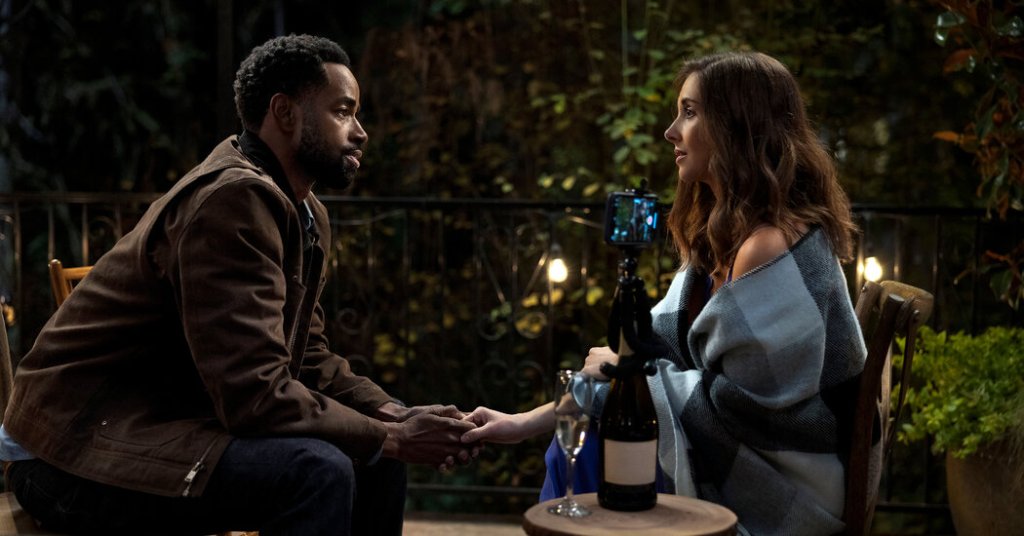
This week on the FilmWonk Podcast, Glenn and Daniel find themselves in another February streaming season, as a trope-subverting rom-com drops on Prime Video with Dave Franco and Alison Brie’s new film, Somebody I Used to Know. But first, we check out a 2022 selection we missed, Aftersun, a father-daughter drama from director Charlotte Wells, making her feature debut to great acclaim (including several Best Director awards, and the DGA nomination for best first-time feature film) (58:50).
May contain NSFW language.
FilmWonk rating (Aftersun): 9 out of 10 FilmWonk rating (Somebody I Used to Know): 6 out of 10
Show notes:
[02:01] Review: Aftersun
[18:59] Spoilers: Aftersun
[24:51] Review: Somebody I Used to Know
[42:50] Spoilers: Somebody I Used to Know
Cloudy With a Chance of Christmas is actually not on Hulu; it was a Lifetime film, and is available on Lifetime’s standalone streaming subscription, or as a paid rental.
As promised, here is a list of the rom-coms Daniel watched over the holidays:







 FilmWonk