“How to Let Go of the World” (dir. Josh Fox) – Group therapy for climate realists

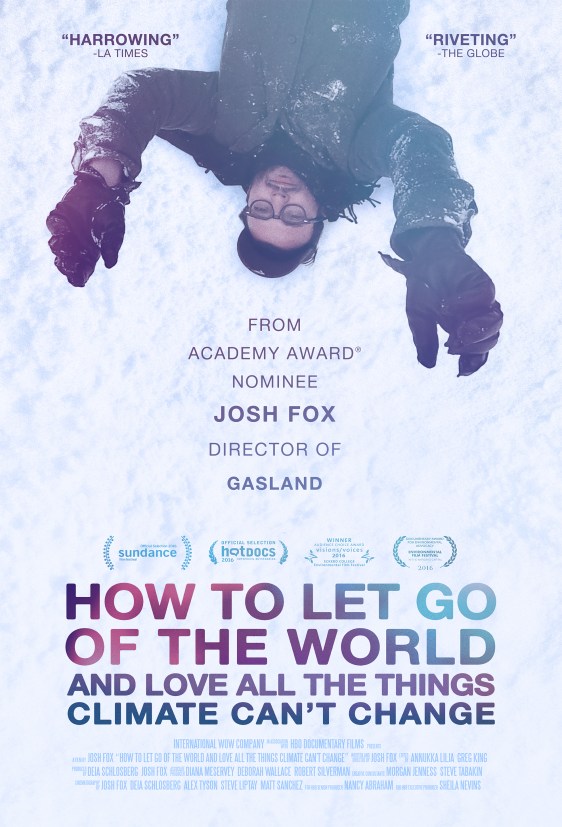
Poster for

Despite its title, How to Let Go of the World and Love All the Things Climate Can’t Change, an upcoming HBO documentary from Gasland director Josh Fox, is not trying to convince anyone of the realities of human-caused climate change. Nonetheless, it spends the first 40 minutes of its runtime dwelling on each of those effects in a gonzo, rapid-fire fashion, and allowing Fox, its frequent on-screen subject, to lapse into despair as he gradually learns the enormity of it all. Fox’s emotional journey is fundamentally at the center of the film, and between its frequent reliance on poetic (and occasionally stilted) voiceover to its various montages of original music produced on-screen by people who have been directly affected by climate change, How to Let Go of the World functions less like a documentary, and more like a sort of group therapy session for people who aren’t afraid to accept the scientific consensus and innumerable lines of evidence supporting climate change, but feel ill-equipped to confront that reality in any meaningful way by themselves. Full disclosure: I’m definitely a part of this demographic.

This is an exercise that runs a serious risk of self-indulgence, but what ultimately makes this film work so well is Fox’s credibly humble approach to such a daunting problem as climate change, and beautiful visual storytelling style as he documents this personal journey. He visits the aftermath of Hurricane Sandy in New York, witnessing the destruction and death along the Long Island Coast. Even as he remains on camera and speaking over the footage, he removes the focus from himself and points his camera squarely at the poorest and most vulnerable people – a focus that persists throughout the film. As a subway musician begins playing a hauntingly beautiful song (listen to it here!), a montage of Sandy’s unrelenting destruction flows across the screen. What follows is a litany of interviews with various climate experts (including one shot unauthorized in the Ronald Reagan Building cafeteria in D.C.), outlining just how dire the situation is now (with 1C of warming), soon (with a guaranteed 0.5C of additional warming even if we halted all CO2 emissions), and in the future (with a >2C increase). The 5-9 meter sea level rises, the loss of species and ecosystems, the displacement of hundreds of millions of climate refugees, the disease, blight, and death. And then it stops, because it’s all too much. Fox gives up, returns to his Pennsylvania hometown, and collapses into a desperate snow-angel figure on the wintry ground of his favorite childhood forest. The camera floats straight up into the sky as the poetic voiceover continues, shrinking Fox’s person – and potential impact – into a minor black dot in the distant snow. Remember what I said about self-indulgence? This was a genuinely touching moment, and simultaneously the point where if Fox had continued wallowing in his impending doom, I would’ve had a difficult time continuing to take the film seriously. But this is exactly when the film’s journey begins.

Still from

Fox asks a new question: What are the things that climate change can’t destroy? What will it leave behind? And in a moment, all of the footage of forests and oceans and glaciers and mountaintops spontaneously gets more lush and beautiful than the bleak, desaturated despair of the first act, and the film becomes nearly as slick a globe-trotting climate change doc as Racing Extinction, while perhaps remaining a bit more grounded in the human storytelling. If we can’t stop the worst effects of climate change, he asks, what can we do? The film hops around the world, telling tales of various local efforts to resist expanded fossil fuel speculation and fight climate change in critical areas. Fox keeps his camera trained on indigenous peoples who are being subjected against their will to the quasi-colonialist expansion of western energy production, posing a question which shouldn’t require an answer in 2016 – should a remote tribe be permitted to live as they wish, even if there is an alternative way of living that our western experience says must be better? We have our cars and lights and antibiotics, but what if these tribes simply have no interest in them?

The film is hardly fetishizing an archetype of the noble savage here – this perspective does not go unexamined as the film goes on. But the film’s initial view of this conflict, between the Ecuadorian government (who had an impending deal with an Argentine oil company) and natives in a remote river village called Sarayaku, presents it as a straightforward moral issue. The natives aren’t merely being offered an alternative to their indigenous lifestyle- they are having the very production of that alternative forced upon them. They can come join us in the cities and play with our plastic widgets and electricity, but we’ll have to destroy their ancestral homeland and drill for oil to create those things. The question of whether one way of life is better or worse than another is a complex one, fraught with questions about human rights and resource allocation and cultural identity. But by focusing on such a specific instance where the rights of the natives were being set aside in a zero-sum manner for those of a fossil fuel company, Fox successfully strips a great deal of the moral complexity out of the situation. Sure, energy production is an essential part of civilization. It warms and empowers and educates people, and can bring them out of poverty. Later in the film, we even see an instance of solar-powered irrigation pumps being distributed in Zambia to help impoverished women make a living by growing and selling vegetables, and thus avoid being swept up into their only alternative trade – prostitution. The film isn’t afraid to muddy the waters a bit on these issues, but it distills them into a fine argument for the idea that people should be free to refuse an outsider’s definition of progress if they wish, especially if it accompanies destruction of their way of life. This is just one small conflict in one small place, but its relevance to the lopsided struggle against climate change is palpable.

Still from

This theme continues as the film shifts its focus to Pacific Islanders, whose homes aren’t merely threatened with oil production, but rather total destruction through sea level rise. One unexpectedly poignant section focuses an affable, dancing Samoan man, Mika Maiava (whom Fox ably identifies as “the Jack Black of climate change”), a spokesman for a group of activists called the Pacific Climate Warriors. We first see the Warriors during an impressive segment in which islanders in hand-carved canoes blockade an Australian coal port. This sequence is spectacular in its tense, on-the-water coverage, and I don’t dare speak of it in too much detail. After the blockade is over, as Fox returns with Maiava to his home island to get footage of an odd local custom.

We quickly meet Maiava’s pregnant (and past-due) wife, and he tells the tale: when a baby is born, they save the placenta, and plant it in the ground, along with a coconut tree. The tree grows tall, and forms a life-long connection between the islanders and their homeland as they grow up. I must confess, I initially rolled my eyes a bit at this on-the-nose metaphor, and even wrote in my notes, “Probably don’t need to mention the placenta-trees.” As Maiava and Fox take a roadtrip to visit his father’s tree, the islander engages in what seems to be commonplace gallows humor, joking about how they’re all gonna drown when the island disappears into the sea. And then, with some difficulty, they find the spot. And Mika Maiava transforms in front of me and breaks my heart, as he realizes, for the first time on camera, that his father’s tree is gone. The entire small section of coast where it had been planted had succumbed to coastal erosion. This warrior, who fights every day for the future of his unborn child, is deconstructed before my eyes. His tough, but jovial demeanor melts away, and he is reduced to tears.
Still from

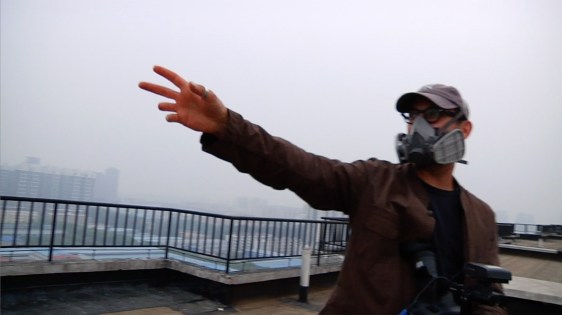
This segment embodies what makes this film so effective – its reliance on moments of genuine and irrepressible humanity. I’ve only mentioned a handful of the innumerable segments – Fox also visits the choking smog of Beijing and the Chinese countryside (where the film takes a surprisingly intense turn), melting glaciers in Iceland, and various other locations that climate change is likely to touch in some way. And in each spot, he rapidly establishes a setting and manages to tell a quick, human story in the process. Not all of these vignettes succeed (the “dancing democracy” scene is a bit baffling), but I’m hard-pressed to find one that didn’t affect me in some way. Early in the film, as Fox explores the wreckage of Sandy, he admits a minor journalistic failing, as they walk past the house of a widower whose wife had just drowned in the storm. “I just couldn’t bring myself to point the camera in a grieving man’s face and ask, ‘Can I get your story on camera?'” By bringing his camera around the world and pointing it in the faces of people who are certainly in need of help, but are nonetheless fighting for their futures every day, Fox attempts to flip the script on climate change from a daunting problem that we’re all powerless to arrest, to a daunting problem that we’re empowered to unite and face together. How to Let Go of the World is at once inspiring and sad – and a cultural document that will age in a manner entirely dependent on what we do next.

FilmWonk rating: 7.5 out of 10

How To Let Go of the World premiered at the Sundance Film Festival and is currently on a tour of the US. It will be playing in Seattle from May 20-26 at the Varsity Theatre, and there will be a Q&A with the filmmakers after the Friday, May 20th screening at 7PM. More info at this link. The documentary will also air on HBO this summer.

Editor’s note:
This review seems like a good spot to mention that my home state of Washington is trying to pass a ballot initiative for a statewide, revenue-neutral tax on carbon emissions in November. Pollution gets taxed, and 100% of the revenue goes back to the people. Pretty much a no-brainer economically – we nudge ourselves in the right direction, away from pollution, in a cost-effective manner. If you’re a Washingtonian, know that we have a chance to lead the nation in fighting climate change here and now.

Join the fight today and help I-732 pass in November.
FilmWonk Podcast – Episode #85 – “Batman v. Superman: Dawn of Justice” (dir. Zack Snyder)

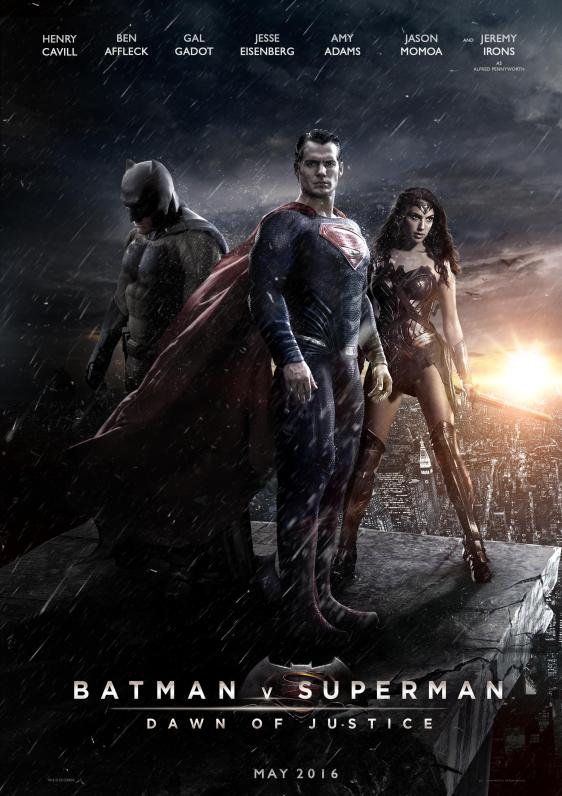
This week on the podcast, Glenn and Daniel unwittingly produce an abundance of pull-quotes for the marketing of Zack Snyder‘s latest disposable superhero mashup. Samples for the press include, “Unrelentingly grim,” “Gal Gadot is in this movie,” and “Supes could’ve blasted his medulla oblongata”(50:38).

May contain NSFW language.

FilmWonk rating: 5.5/10 (Daniel); 3/10 (Glenn)

Show notes:

  • Music for this episode is the original 1966 Batman TV series theme song. And we end with “Kryptonite” by Three Doors Down.

Listen above, or download: Batman v. Superman: Dawn of Justice (right-click, save as, or click/tap to play on a non-flash browser)

“Spotlight” vs. “Concussion” – The Hard Problem of Institutional Guilt

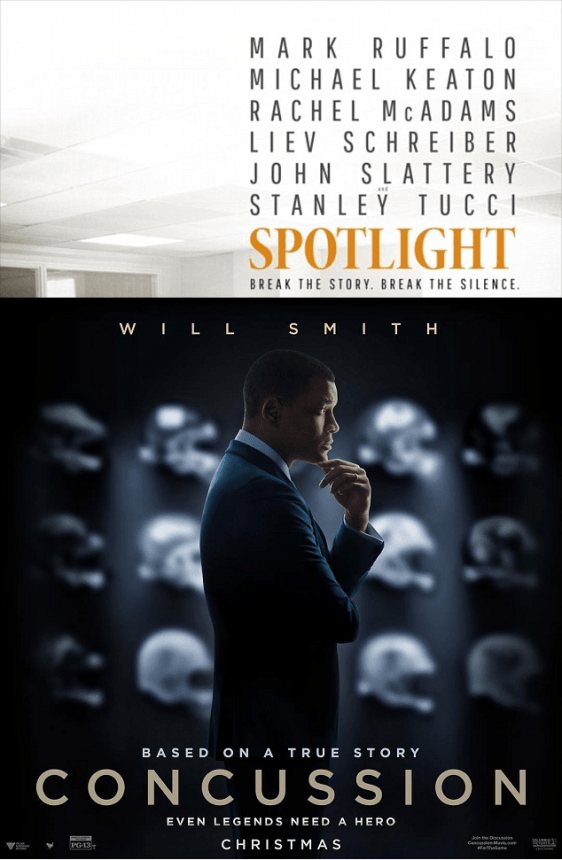
Combined movie poster for

It would be easy to say that Spotlight, director Tom McCarthy’s dramatization of a 2002 newspaper investigation that first brought to light the rampant sexual abuse and cover-ups in the Catholic Church is the same film as Peter Landesman’s Concussion, dramatizing the outside medical investigation of chronic concussion-related injuries in the NFL. But while they hew to a similar formula, they really have completely different approaches to both their underlying subject matter, as well as to institutional guilt itself.

Dr. Bennet Omalu (Will Smith) is introduced in Concussion as a capable and unbiased outsider (both as an immigrant from Nigeria, and a non football-fan) who discovers chronic (but subtle) neurological degeneration in the brains of deceased former NFL players. He comes with impeccable credentials and education, and both he and the film know that he’s always right. He’s Dr. House without the sarcasm or pill addiction. He is, in essence, a paragon. And this makes it all the more difficult to accept him as an unapologetic moral crusader in his investigation of a newly named condition, Chronic Traumatic Encephalopathy (CTE), a condition that causes former NFL players to undergo rapid neurological degeneration similar to Alzheimer’s at a young age, often coming to violent self-inflicted deaths in the process. The reason why his moral crusade doesn’t play nearly as well is because, simply put, the film has no clear idea of what the NFL might have known about the condition and when – and scientific discovery doesn’t work on a schedule. Omalu is well-meaning, but he only has a handful of initial cases, and while it’s easy to make comparisons between the NFL’s alleged “We don’t know and we don’t want to know” attitude, and the Catholic Church’s well-established institutional enabling and protection of pedophile priests (or, if you like, the tobacco industry as depicted in Michael Mann’s The Insider), the films really are dealing with completely different scopes of corruption and institutional guilt. There’s nothing ambiguous or scientifically controversial about child molestation. It’s either happening, or it’s not. A newly discovered medical condition that is poorly understood and difficult to detect (not showing up on brain scans of the living) is a bit harder to be so dogmatic about.

Meanwhile, Spotlight meticulously catalogs the varied and sprawling investigative threads of its Boston Globe reporters – Mike Rezendes (Mark Ruffalo), Walter Robinson (Michael Keaton), Sacha Pfieffer (Rachel McAdams) – we see clergy, attorneys, reporters, therapists, parents, teachers, administrators, and parishioners, all of whom had some level of knowledge about the situation, and all of whom were complicit on at least a minimal level in allowing it to continue. As lawyer Mitchell Garabedian (Stanley Tucci) says halfway through the film, “If it takes a village to raise a child, it takes a village to abuse one.” This is a damning quote because the film so convincingly makes the case that the abuse was widespread, widely known, and only came to light when people (including victims) were willing to come together and put a stop to it. Contrast this with Concussion‘s clunky proclamations about how millions of Americans love the game, and the NFL employs hundreds of thousands of people, and cities and states have built massive stadiums even as they can’t afford to fund their schools (which struck below the belt as far as my home State of Washington is concerned), and it really just doesn’t have much bite to it. Even as Dr. Omalu gets late-night phone calls asking why he wants to “vaginize” football, the stakes are thoroughly muddled. Every change that has ever been made to American football has “ruined the game” in someone’s eyes, and it’s hard to imagine that trying to reduce the frequency and treatment of concussive blows to the head would be any exception. Yes, America loves football. And perhaps the NFL knew enough about CTE that they should’ve done something earlier to try to prevent any further cases of it, or at least stop trying to wriggle out of paying adequate disability pensions for those players who were affected by it. But apart from the men we see succumbing to their illness and dying on-screen, any guilt (whether individual or institutional) is poorly delineated, and no solutions are offered. Given that Luke Wilson appears in an essentially silent role as NFL chairman Roger Goodell, I can’t help but wonder if any desperately-needed context was left on the cutting room floor.

Another way the films differ is in how they depict the effects each investigation has upon its investigators. Dr. Omalu’s devastated outlook as the NFL makes various attempts to blackball and discredit his research is probably the most interesting part of the film, if only because Will Smith so thoroughly sells his disappointment that America didn’t live up to his immigrant expectations. “This is America,” he says to his future wife Prema (Gugu Mbatha-Raw) early in the film, “Where you must be the best version of yourself.” As he comes forward to tell the NFL about this problem (by way of a case study in a prestigious medical journal), he genuinely believes that A) The NFL couldn’t possibly have known, and B) They will thank him and want to work with him. Obviously, this isn’t what happens. And Dr. Omalu is devastated to learn the true nature of the country that he has adopted as his own.

Beyond this, there is little in the way of personal stakes involved for this investigation. Sure, he’s paying for many of the medical tests himself, but we never really get a sense that this is causing him any hardship. He doesn’t know football, understand it, or enjoy it. This makes him non-malicious, but it also makes his arc as an outsider and moral paragon that much less interesting. Dr. Julian Baines (Alec Baldwin), a former Pittsburgh Steelers team doctor, has a bit more reluctance about attacking the game he loves, but he only ever voices it after he has already committed to helping Dr. Omalu. So any internal conflict that he may have experienced feels fleeting. The inevitable moments of confrontation are well-acted, but feel perfunctory and unrealistic. When Dr. Omalu meets privately with an NFL doctor, Elliot Pellman (Paul Reiser), and gives an impassioned sotto voce demand that he “Tell the truth!” about what’s going on, Smith sells the moment with his acting, but it has not been earned in the least, if only because science doesn’t deal in practical or moral certainty. It just deals with increasing degrees of understanding, to the point where we can reasonably make decisions based on them. But I suppose, “You should conduct a longitudinal study on the issue and begin taking basic precautions out of an abundance of concern for the players’ well-being” doesn’t roll off the tongue quite as well.

Contrast this with the Globe reporters, who are clearly affected by every moment of Spotlight‘s investigation. All of them are lapsed Catholics, most of them are native Bostonians, and they have no desire to eviscerate the institutions that have comprised the fabric and background of their entire lives, and will continue to surround them after the story breaks. They’re certain of the rightness of what they’re doing, and they’re also frightened, angry, and unsure what the right approach to the story really is. Is it just a few bad apples, or is it the entire institution that’s corrupt? Which is worse – perpetrating these monstrous acts, or conspiring to cover them up, enabling further victimization? And at what point do you have a level of certainty that allows you to tell this story publicly? And when Rezendes finally loses his temper and demands that the Globe print the story immediately, Ruffalo has thoroughly sold his personal stakes in the matter, and the reactions of the rest of the Spotlight team clearly indicate that he’s just screaming aloud what all of them are struggling with internally. This struggle, with how to tell the right story at the right time, is the essence of good journalism, and Spotlight depicts it as well as it has ever been put to film. It demands that the viewer place themselves in the shoes of people scrambling in the dark to reveal what had previously been unimaginable.

In the end, both films have value, even if Spotlight has a treads a much more difficult path toward the story that it’s looking to reveal, whereas Concussion often just feels like it’s going through the motions (everything to do with Dr. Omalu’s wife, for instance). However, one area in which both films excel is in depicting the victims of their respective institutions, and it is perhaps where both films deserve credit for elevating the importance of what they are depicting. David Morse, Adewale Akinnouoye-Agbaje, and Matthew Willig all play former NFL players whose horrifying deaths are at the center of Concussion‘s mystery, and even if it lacks the moral clarity of Spotlight, the viewer is at least left with a sense that we owe these men an explanation for their largely uniform mental deterioration. Conversely, the victims of Catholic clergy sexual abusers are depicted in a variety of states, both in deep denial, chemical dependency, and relative normality. There is no such thing as a perfect victim outside of fiction, and between the two films, Spotlight is certainly less interested in perfection. It shines a light into the darkness, and shows us whatever may appear there.

FilmWonk rating (Spotlight): 9 out of 10
FilmWonk rating (Concussion): 6.5 out of 10

Seattle’s One-Reel Film Festival 2015 – Sunday Roundup

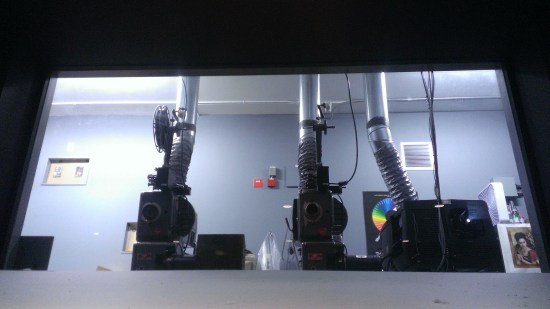
SIFF Film Center projection room

The One-Reel Film Festival is part of Seattle’s renowned Bumbershoot music and arts festival. Throughout the weekend, I’ve had the opportunity to see short films from all over the world, some of which can be viewed online (I’ve included links below where applicable). The films were arranged into blocks of around an hour apiece, which I’ve arranged in presentation order below. Bold text means I enjoyed the film, and an asterisk (*) means it was my favorite film of that block. Skip to the bottom for a list of all the films that can be viewed online.

Click here for Saturday’s films


Documentaries Hour 2

  1. Artsquatch (Director: Taylor Grigsby, USA, 22 minutes)

    Ryan Henry Ward, artist and visual arts curator for Washington’s annual Sasquatch Music Festival, says in a talking-head segment that he selects artists based on their ability to communicate effectively about their art to the public. This is one of several selection criteria he gives over the course of the film, but it certainly the most ironic, given that his interminably long interview segments are extremely rambling and repetitive. As a film, Artsquatch is visually interesting because the Sasquatch festival is visually interesting, made so by both the natural scenery of The Gorge amphitheater, as well as Ward and his fellow installation and costume artists featured here.

    But this is some sloppy filmmaking. The featured art doesn’t make the wobbly cinematography or sound mix any less awkward. If the film does anything consistently well, it’s to capture the wandering chaos of attending a music and arts festival in the middle of nowhere. But the structure is quite loose, and it encapsulates maybe 10 minutes of material in a 22-minute wrapper. Each interview could be improved by cutting the first 3-5 sentences while the subject figures out what they’re trying to say (or in at least one case, literally performs an on-camera mic-check). This looseness is evident in the editing, with random interstitial shots and a torrent of all-caps name introductions that add little, if nothing to understanding the art featured behind them.

    In the final minutes, we see footage of a man shooting footage from atop a UHaul truck (seemingly the pan of the emptying Gorge that we saw earlier in the film), followed by footage of two men on the back of a truck debating whether the joke that was just (not on camera) constitutes sufficiently “important shit” to be included in the film, followed by one last monologue from Ward explaining how great it would be to have a time-lapse of the festival setup and teardown – a time-lapse that does not appear in the film.

    There’s a fine line between free form and self-indulgence, and this amateur doc leaps across it several times. Art is perilous and bold, but the patience of its audience is not without limit. Many sacred cows needed to be butchered in the editing room to make this watchable.

    Watch it online here.

  2. Bounce, this is not a freestyle movie (Director: Guillaume Blanchet, Canada, 5 minutes)

    Where the hell is Matt?-style musical travelogue featuring a man (Blanchet) traveling around the world and shooting a few seconds at a time of himself in beautiful spots around the world. Rather than toddler-dancing, Bounce features its subject knee-bouncing a soccer ball in time with a strong musical beat, making its editing a bit trickier, as it had to both sync with the beat of the song and seamlessly transition from starting an action in one location to completing it in another.

    It’s quite fun, if a bit more inwardly focused than Matt, with which it draws inexorable comparisons*. It’s a subtle difference, but Matt Harding seemingly performed his goofball dance in order to connect with the people and places he was visiting, whereas if this film has any abiding message, it’s just… Look at all the cool places I’ve been. With few exceptions, nearly every frame of this film is devoid of any other people besides Blanchet himself. Travel is seldom as bereft of purpose and connection as depicted here, and I have to imagine that in the course of making these videos, Blanchet interacted with a great many peoples, cultures, and places along the way. We get the occasional hint of this during the actual film, then the floodgates open from a final hug into an end-credits reel that’s nearly as long as the film itself, and far and away the most entertaining segment. This is a smaller criticism than it sounds like. I enjoyed Bounce overall. But to boast so proudly in the title about what it is not, the film needs to be able to more clearly answer the question of what it is. Otherwise it’s just a stunt, however enjoyable that might be for a minute.

    Watch it online here – also, watch Globe Trot, a film with a similar concept from last year.

  3. Tomgirl* (Director: Jeremy Asher-Lynch, USA, 15 minutes)

    This doc tells a tale of a kid named Jake – born a boy, and acting like a girl. There are other terms that get mentioned – transgender, transvestite, homosexual, etc. – that may eventually describe Jake as well. But seeing a kid just be himself at the age of 7 illustrates just how useless these terms are until the kid is old enough to adopt them (or not) for himself. Kids will be kids, and this film is a well-balanced mix of both a professional explaining trans issues and gender non-conformity from a psychological standpoint, and a family that is so open and accepting of their atypical son that they hardly seem to need such help. This doc is well-paced, adeptly shot, and never lingers too long on any of the adults talking about Jake before cutting back to him doing his thing and feelin’ fine. The film ably sells the notion that kids like this are never “the problem”, until other kids or adults in their lives decide to make them such. In a world where the risk of suicide and homicide is so high among transgender people, the film’s easygoing attitude about such kids surprisingly feels like the best approach. It doesn’t elevate this to the life or death issue that it may eventually become, but it takes the situation appropriately seriously.

    More info and trailer here.


Best of the Northwest 2

  1. Chasing the Sun (Director: Jeremy Mackie, USA, 12 minutes)

    A pair of Northwest hippie siblings are on a roadtrip across Washington State to visit their long-lost even-bigger-hippie mother, who left them many years earlier. Mom is a ghost in this film, as the only real relationship on display is between brother and sister. And while not every piece of dialogue worked, their performances certainly did. Caleb (Jesse Lee Keeter) is angry at his sister Celeste (Samara Lerman) for dragging him into a reunion that he didn’t want or need in his life, but she gradually draws out his willingness to go along with her mendacious plan. The mix of frustration and familial affection between them is clear and evident on-screen – and when they reach the point of shouting back and forth at each other, it verges on melodrama, but never took me out of the film.

    Not for nothing, but I’ve driven the stretch of Thurston County interstate highway where this film was shot many times. Looks like a beautiful place for a family crisis.

    More info here.

  2. Julia’s Farm (Director: Sudeshna Sen, USA, 16 minutes)

    There’s not much to this story. It features a pair of women who embark on an ill-conceived scheme of insurance fraud together. Like the Coen Bros, it’s a morality play of greed, crime, and punishment. Unlike the Coen Bros, it’s simplistic and obviously rendered, has an awkward and implausible script, and features an overbearing afterthought of a musical score.

    More info here.

  3. Luchadora (Director: Amber Cortes, USA, 8 minutes)

    After Artsquatch, this film was a welcome guide for how to tightly edit a documentary – it’s colorful, shot well, and gets to its point quickly. The main player, a budding Northwest luchadora named La Avispa (“The Wasp”), is a compelling interview subject, speaking with eloquence and enthusiasm about ditching college in favor of “joining the circus”, in the form of a Renton, Washington training gym for lucha libre (Mexican wrestling). It helps that she delivers this entire monologue in her luchadore mask, with all the flare of American pro wrestling (something she’s apparently not a fan of herself). The film effectively introduces a little-known Northwest take on an out-of-town sport (one that I’m rather interested in seeking out now) through the lens of a budding theatrical stuntwoman who’s thoroughly entertaining to watch.

    On a personal note, I’m glad I liked this film. The director, Amber Cortes, was literally sitting next to me as I typed the first draft of these notes (in the back row, over the end credits – I’m not a monster), so it might’ve been terribly awkward otherwise.

    More info here.

  4. Signs Everywhere* (Director: Julio Ramirez, USA, 12 minutes)

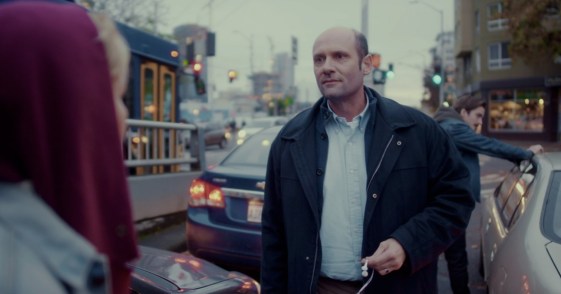
    A man wearing earbuds (Tony Doupe) wanders around Seattle. Everywhere he goes – from home to work to his commute – he sees people in pain, as rendered by simple cardboard signs held by each person, summing up their particular pain or baggage. His own family isn’t exempt – his daughter hates her body, his son is being bullied at school, and his wife longs to feel desired again. Without exception, each person that he comes across is experiencing pain and misery. After twenty or thirty of these uniformly miserable people, I couldn’t help but wonder whether this simplistic storytelling dynamic – literally the stuff of sitcoms – was striving for anything greater than blasting subtext at the screen without having to earn it in character or script.

    But there were two things that made this film work so well. First, the performances were uniformly strong. Even if the character only has a single line of text to work with, each actor or actress spells out real pathos and depth even in just a moment of screentime. The film’s emotional tapestry, spelled out in a nearly complete absence of dialogue, is thorough. But its second strength was casting reasonable doubt on the clairvoyance of the man at the center. If he is really just this adept at sensing the misery around him, he wouldn’t be much more than a facile storytelling device. But the film ends on a note of uncertainty, perhaps revealing what’s really happening with this character – that his grand insightful tableau of sadness may just be a projection of his own miserable life. There’s something gravely amiss with him, and by the end of the film, he seems just about ready to stop dealing with it alone.

    More info here.


Films4Adults

  1. Best Man Wins* (Director: Stéphane Dumonceau, USA, 20 minutes)

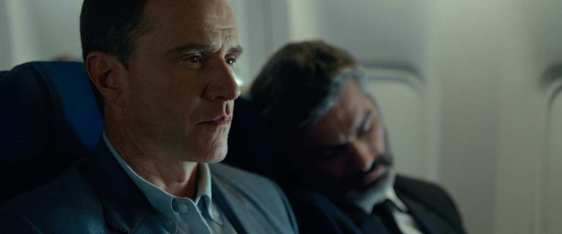
    This film features a spurned husband, master chef Edward Stiles (Tim DeKay) setting an elaborate trap for his wife’s secret lover, master vintner Jean-Louis Vachon (François Vincentelli). I don’t hesitate to reveal that setup, because this film is not shy about revealing its intentions, and it remains an absolute delight after doing so. From its initial setup, in which Stiles manufactures a “chance encounter” with Vachon on a flight from Paris to New York, every moment and line of dialogue is filled with palpable and escalating tension. The best phrase I have for this is “Tabloid Hitchcock”, with a subtle spritz of Edgar Allen Poe for good measure. Its premise is over-the-top – lifestyles of the rich and famous put through a tense filter of infidelity, friendship, and cat-and-mouse betrayal, serenaded by a grand and zany musical score from newcomer Luca Ciut. The script, co-written by Dumonceau and Frederick Waterman, is certainly one of the finest that I saw today – a feast of intrigue and tension and humor so decadent that I fear to see in a feature-length version, which would surely collapse me into a deep and diabetic slumber before the digestifs are poured. Magnifique.

    More info and trailer here.
    Buy on iTunes here.

  2. Hole (Director: Martin Edralin, Canada, 15 minutes)

    This film is utterly mystifying. Its final scene is so far on the fringes of human behavior that it’s an outstanding reveal that I dare not spoil here. The film is a successor to a film like The Sessions, presenting the unexpected experiences of a severely disabled man while somehow avoiding gawking at him. Here he is, watch how he lives. It’s not boring, and the reveal is worth it.

    More info and trailer here.

  3. The Mill at Calder’s End (Director: Kevin McTurk, USA, 14 minutes)

    This film almost feels like the product of a dare. Can puppets be used to tell genuinely terrifying gothic horror? The film features many intricate carved characters, each with a subtle look of sadness and worry on its face. And the rest of the emotional range is accomplished by a mix of talented voice-acting (mostly in the form of Jason Flemyng‘s voiceover narration as the lead, Nicholas Grimshaw) and an elaborate interplay of light and flickering shadow across the carved faces (kudos to cinematographer Kenton Drew Johnson). They don’t look alive, per se, but they nearly look animated. The result is something akin to Japanese Noh theatre, where the emotional interplay is slow and deliberate, and reflected across the faces of masks that are never removed (the director mentions bunraku puppetry as an influence). At a certain point, we do see a few of the puppets’ lips move. And while I’m still undecided whether I consider this a misstep, it is at least a jarring change in look and technique that amounted to a slight distraction.

    But did I mention that the film is terrifying? The Mill isn’t just a technical marvel – utilizing a mix of what appear to be models, live actors (shot from a distance or in shadow), and real-life skies and backgrounds – but it’s also a taut and effective piece of Gothic horror. Director Kevin McTurk, a model-maker with an impressive array of special effects credits from the Stan Winston Studio and others, builds tension marvelously through increasingly tricky camera angles in and around the mill, often looking straight up or down from impossibly close angle on a model or puppet.

    More info and trailer here.

  4. Stealth (Director: Bennett Lasseter, USA, 22 minutes)

    I recall earlier this year when a whiny filmmaker at a college festival complained that the “SJW” crowd had coopted the film festival process – that any story featuring an oppressed minority would gain traction and receive awards and accolades, while his [genuinely unwatchable schlock] would be ignored and shunned. I mention this because this is the second story I’ve seen today about transgender issues, and two is by far the most of these stories I’ve ever seen at once. One could certainly take that to mean that my objectivity in judging the film will fly out the window in the face of novelty and social pressure, but one would be profoundly arrogant to do so.

    Yes, this is all pretty new to me. And if the national media is any indication, it’s pretty new for most of us. But merely presenting something novel is not enough to make me feel something as a viewer or critic. Merely prodding my prejudices and forcing me to experience a way of living that’s different from my own is not enough. Emotional resonance doesn’t exist in a cultural void, but it’s still something that must be judged from within the text of each film. It’s what allowed me to adore Cloud Atlas and (so far) find Sense8 a bit preachy and self-indulgent. To hate myself for watching all of Entourage, but still masochistically enjoy the films of Michael Bay. Knowing that someone might be judged unfairly by smallminded bigots doesn’t make me shy away from judging them as fairly as I can.

    So when I say that these performances feel utterly real, and that this film was alternately touching, provocative, and devastating, you should know that I mean exactly that. The main character, Sammy (Kristina Hernandez), is an eleven-year-old transgender girl dealing with life at a new middle school. She has a close relationship with her mother (Liana Arauz), with whom she shares many of the film’s most tense and touching scenes. We get a hint that some serious unpleasantness befell Sammy at her old school, and while we never quite learn what it is, it hangs as a persistent threat for the rest of the film as she gets to know a pair of new girlfriends. Hernandez is affecting in the role (which is apparently a semi-fictitious version of herself). I’ll repeat what I said for Tomgirl above – these kids are never “the problem”, until somebody makes them so. This girl wants the same things as any other child – and the freedom to seek them out. And this film illuminates just how complex that process can be.

    More info here.

  5. Unleaded (Director: Luke Davies, UK, 8 minutes)
    A delightful, coincidental yarn about a gas station robbery colliding with stoner drama. Veers into the slapstick violent realm of Guy Ritchie, even if the scenario and details strain credulity a bit more than his stuff – but none of that matters while watching this. It’s still a ton of fun.

    More info here.

  6. Walls (Director: Miguel López Beraza, Spain, 10 minutes)
    A tenement building in Budapest narrates a day in the life of its two favorite residents, a pair of elderly neighbors named Mr. Istvan and Mrs. Magdi. In English, with a Spanish accent. It’s perhaps a testament to this film’s sensitive and resonant portrayal of its subjects that I was left unsure whether this is fiction or not. After the film, it identified itself as a documentary, but all I can say with any certainty is that it’s a pleasant and touching slice of life – the embodiment of a happy ending to a life well-lived. We only learn a small amount of each of them, but Mr. Istvan and Mrs. Magdi each live lives that are active, social, and surrounded by people who enjoy their company. The film uses a literal embodiment of “if these walls could talk” to add to its sense of warmth and closeness, but it never feels like a salve for the loneliness of its main characters. The building doesn’t express its love for them because no one else will – the building cares for them because it sees how many others do so as well. We should all be so fortunate.

    More info and trailer here.


Quick List: All of the films that are available online

Seattle’s One-Reel Film Festival 2015 – Saturday Roundup

SIFF Film Center projection room

The One-Reel Film Festival is part of Seattle’s renowned Bumbershoot music and arts festival. Throughout the weekend, I’ve had the opportunity to see short films from all over the world, some of which can be viewed online (I’ve included links below where applicable). The films were arranged into blocks of around an hour apiece, which I’ve arranged in presentation order below. Bold text means I enjoyed the film, and an asterisk (*) means it was my favorite film of that block. Skip to the bottom for a list of all the films that can be viewed online.

Click here for Sunday’s films


Films4Families

  1. Bear Story (Director: Gabriel Osorio, Chile, 11 minutes)

    This film tells a deep, dark story of a bear taken from his family by a dictatorial circus regime. Given the film’s Chilean origin, this seems to be a real-life tale of oppression molded into a child-friendly wrapper. I’m inclined to say the film erred by using the mechanical diorama aesthetic as a literal framing device rather than a mere visual style. The visuals of the diorama are stunning, but implausible enough as a physical streetside object to be distracting. The film could have merely adopted the style for amusement’s sake without deigning to explain it, if not for it literally being shown to a [bear] child on the side of the road. But I daresay that the reluctant satisfaction on the adult bear’s face at the end made it worth it as a framing device.

    Teaching painful history to young people in a way that doesn’t feel like medicine is a difficult task, and for this bear to have to craft his lifelong oppression into a quick, consumable format to entertain (and educate) one child at a time clearly takes a toll on him. But he’ll keep at it, if it means keeping that message alive. The film makes this subtle point rather well, even if it has to dazzle and distract a bit with its visuals before sneaking that message in.

    More info and trailer here.

  2. Bunny New Girl (Director: Natalie van den Dungen, Australia, 6 minutes)

    Never work with children or animals, so the saying goes in filmmaking. This film seemingly violates both rules, featuring a shy little girl on her first day of school wearing a paper-plate bunny mask, evoking a quick sense of schoolday dread. To her classmates, the weird kid is weird, and must be called out as such immediately. The girl’s eyes tell a story of childhood dread despite a complete lack of dialogue, and once the true meaning of this weirdness becomes clear, the story quickly takes a turn for a tale of kindness and inclusion. It’s all very sweet and funny and cute.

    More info and trailer here.

  3. Lila (Director: Carlos Lascano, Argentina, 9 minutes)

    During the first minutes of Lila, in which the title character wanders through the city rendering everyday things and people into whimsical colored pencil sketches in her magical reality-altering sketchbook (which eventually comes to life to move in a 2D plane and affect reality), I experienced two simultaneous reactions.

    First, this is all visually well-staged, and second…why is Lila in this film? She seems almost a whimsical addition herself – a projection of the filmmaker into the story, meant to hand-feed us the emotion that we’re meant to experience for each little vignette. She’s not a necessary component, and the eventual attempt to humanize her by telling a bit of her ambiguous backstory visually doesn’t do much to justify her presence. It’s no fault of the actress, who does a fine job at being a manic pixie sketch-girl, but every sketched scene would have been fine without her.

    Watch it online here.

  4. Pik Pik Pik (Director: Dmitry Vysotskiy, Russia, 4 minutes)

    A satisfying “Merry Melodies” throwback featuring a flat, bright 2D animation style and rhythmic classical underscore for its silly tale of environmental unsustainability.

    More info here.

  5. Ray’s Big Idea* (Director: Steve Harding-Hill, United Kingdom, 4 minutes)

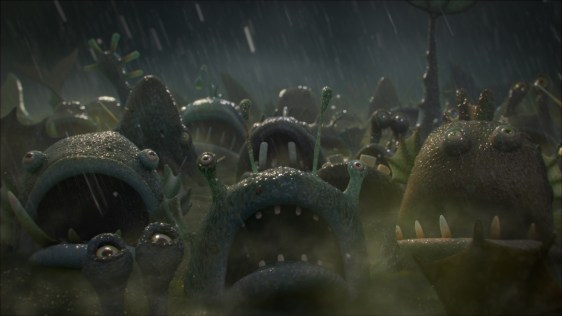
    This film’s animation is beautifully ugly. Each hideously overcrowded frame is pristinely rendered with the detail of something like ILM’s Rango, with each unique character and visual detail grandly crafted for no more than a few seconds of screentime apiece. The film’s core concept is the first prehistoric fish who thought to leave the ocean on his tiny little legs, and it renders that concept with a nice, wry sense of humor. Then it takes several hilarious (and gross-looking) turns from there.

    Watch it here.

  6. Submarine Sandwich (Director: PES, USA, 2 minutes)

    A sandwich is built through live-action stop-motion animation, turning inedible objects into slices of sports memorabilia that loosely resemble a sub sandwich. I’ve said this before; stop-motion involving live humans is a creepy aesthetic that I rather enjoy, but here’s the thing – not everyone can do this as well as Jan Svankmajer, and his creativity was creepy in the service of some sort of message or atmospheric objective. This just felt like a technical exercise by someone who was perhaps a casual fan, but didn’t quite know what to do with the look. The timing felt off, shots lingered for too long, and there were awkward shifts in zoom and framing for no discernible purpose. The result is cute, but ultimately derivative, and doesn’t do a great deal to justify its existence. Other than making an indigestible thing that kinda resembles something else.

    Addendum: It seems PES is also the filmmaker behind “Fresh Guacamole,” from 2013. I now believe even more strongly that this was little more than a technical exercise, but Guacamole was at least a better execution of the concept. Even if adding diced tomato to guac is an abomination.

    Watch it here, or if you don’t want to sleep tonight, just watch Svankmajer’s Food instead.

  7. The Trumpeteer (El Trompetista) (Director: Raúl Robin Morales, Mexico, 10 minutes)

    This film, with its dingy, grey-brown uniformed figures (seemingly the same clothing and character model), made splendid use of light and shadow and color despite its deliberate homogeneity during the opening moments. After introducing a squad of identical bandmates in a miserable prison-yard, the film erupts into a gorgeous brass symphony of color and reflected light to represent the lead trumpeter’s musical rebellion against the rigid, boring bugling prescribed to him by the bandleader. We see swirls of color and light erupt from his trumpet in a manner that is first subtle, then erupts into a full-on acid trip of fluorescent watercolor. Quite lovely.

    Watch the trailer here.


Best of SIFF 2015, Part 1

  1. Bihttoš (Director: Elle-Máijá Tailfeathers, Canada, 15 minutes)

    This unconventional, highly personal documentary about a father and daughter from an indigenous community in Canada (and another in Norway) feels like little more than a pretty solid college admissions essay. Even if the conclusions are a bit trite and not long-lasting (“And they all kinda turned out just fine!”), the visuals and storytelling are unique and thorough enough. Not bad, but not for me.

    More info here.

  2. The Chicken (Director: Una Gunjak, Croatia, 15 minutes)

    This is a rough film, illustrating both the ugly realities of meat production, as well as the dangerous ignorance of a child in a war zone trying to preserve a piece of her innocence. The film helpfully notes that no animals were harmed in its production, which is not evident while watching.

    More info and trailer here.

  3. Personal Development* (Director: Tom Sullivan, Ireland, 15 minutes)

    An absolute delight of a family dramedy about the teenage daughter of a divorced single dad who has the great misfortune to have to deal his daughter’s unexpected “woman’s troubles” during his solo weekend with her. I almost feel ill-equipped to evaluate this film, except to say that it rang true, didn’t let father or daughter off the hook for awkwardness or familial affection, and it all felt very sweet. A brief run to the shop for menstrual painkillers makes for a nice comic beat, as the pharmacist gives Dad the unexpected third degree.

    More info here.


Best of SIFF 2015, Part 2

  1. The Answers (Director: Michael Goode, USA, 8 minutes)

    Nathan, recently deceased, stares directly into the camera and asks for the objective answers to every question in his life. He quickly comes to terms with his demise, and gives way to the novelty of knowing the unknowable details of his prior existence, however alternately hilarious or distressing they might be. The infographic bits (“How many eggs did I eat?”) are quickly supplanted by greater insights, such as who was the his ideal woman. Insight gives way to a palpable sense of regret, nearing in just a few minutes what Albert Brooks accomplished in Defending Your Life – a sweet and poignant existential comedy.

    More info here, trailer here.

  2. Go Daan Go! (Director: Mari Sanders, Netherlands, 15 minutes)

    Chalk this one up to personal bias, but I found this story of simplistic family drama and sports triumph to be utterly boring. Will Daan be allowed to swim? Well, his mom has both an emotional and practical reason to not want him to do so, and his dad really wants him to, and they all love each other and they’ll all be fine regardless. But hey, at least we got to see the kid strumming on his sad guitar with a couple of broken strings while his parents fight downstairs. Total snooze.

    More info here.

  3. Listen (Director: Hamy Ramezan, Denmark, 13 minutes)

    This film is a biting piece of cultural criticism, simultaneously excoriating fundamentalist Islam, religious and sexist oppression, the role and place of insular immigrant communities, and the mainstream institutions that are ill-equipped to assist them with their problems. A battered woman sits behind a burqa, as well as barriers of language, apathy, and a near-complete lack of control over her life. Her distress is palpable, and evident in her thrice-repeated opening monologue. But there’s little that anyone can or will do about it.

    More info and trailer here.

  4. World of Tomorrow* (Director: Don Hertzfeldt, USA, 15 minutes)

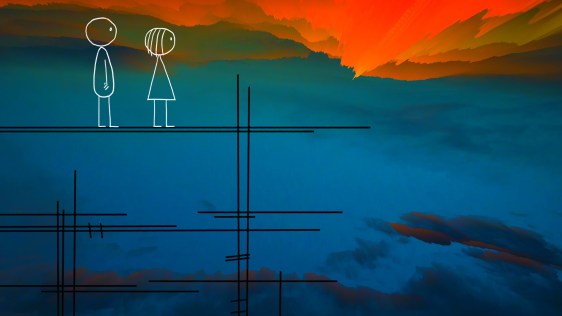
    Don Hertzfeldt’s visual style remains as weirdly splendid as ever, and it is now accompanied with a pack of fascinating sci-fi ideas that emerge in rapid-fire dialogue and visual chaos as a third-generation adult clone named Emily explains the future to her original self (Emily Prime) as a toddler, with neither one quite fully understanding the other. Hertzfeldt’s sense of humor remains pitch-black as ever, and as the ideas and implications for mankind spill forth one by one, the laughs become more and more mirthless, giving way to an imminent sense of doom. Outstanding and worth a watch.

    Watch it here (free trailer, paid rental).


Quick List: All of the films that are available online

FilmWonk Podcast – Episode #65 – “American Sniper” (dir. Clint Eastwood)

Poster for "American Sniper"

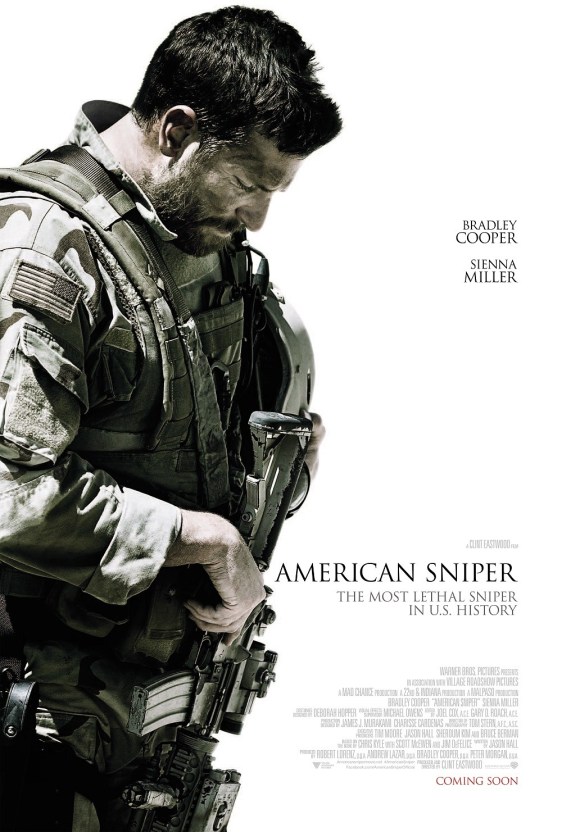
This week on the podcast, Glenn and Daniel take on the challenge and controversy of American Sniper, the tale of SEAL Sniper Chris Kyle (Bradley Cooper), and a film that is equal parts Iraq war diary and a powerful cultural artifact. And while the film only superficially reminded us of Act of Valor, much like that film, we were quite surprised which side we came down on (38:57).

May contain NSFW language.

FilmWonk rating: 8 out of 10

Show notes:

  • Music for tonight’s episode is the track, “Full of Sound and Fury“, by Dean Valentine, from the film’s trailer.
  • We mentioned a few films by way of comparison – check out our podcast review of Act of Valor, as well as one of the earliest reviews on the site, for 2009’s The Hurt Locker.
  • CORRECTION: We briefly misstated Chris Kyle’s unofficial kill record as being “over 350”. According to multiple sources (as well as the film itself), the US Navy credits Kyle with 160 confirmed kills – meaning kills that were confirmed by a witness. The larger figure is 255 claimed/unconfirmed kills, with a few other sources listing vaguely higher numbers (“more than twice that”).

Listen above, or download: American Sniper (right-click, save as, or click/tap to play on a non-flash browser)

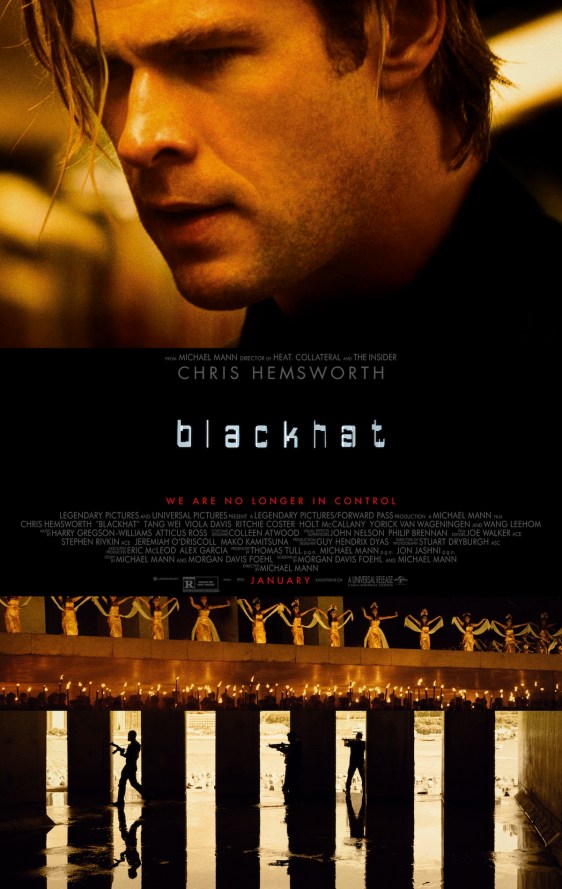
Michael Mann’s “Blackhat” – A harbinger of doom for spy cinema

Poster for "Blackhat"

I must admit, when the FilmWonk Podcast reconvened after the New Year to review Inherent Vice, and I found myself uttering phrases like “trenchant statement on post-war masculinity,” I was a bit concerned that the wondrous, cinematic wasteland that is the first month of the year might fail to deliver its full measure of seasonal stupidity. Vice may have been a holdover from an awards-qualifying run in NY and LA, but it is still a January release, and January releases are supposed to be dumb and terrible.

On that count, Michael Mann‘s Blackhat did not disappoint – it is incredibly stupid at times. But what was truly baffling about this film was just how much it got right. Out of the gate, its treatment of 21st century hacking was pretty much spot-on. Screenwriter Morgan Davis Foehl uses many real tricks – undiscovered (zero-day) exploits that abuse the autorun features of USB thumbdrives, attacks targeting industrial control systems that have the capability to both physically destroy their mechanized targets, and hide any sign of their malicious activity from safety monitoring software until the destruction can’t be stopped. All of these things are real (even if they tend to operate a bit more slowly and less publicly in real life) – and the irony of duplicating Stuxnet as a cinematic attack on both the US and China was not lost on me. And the film also remembers the best old tricks. Social engineering is by far the most resilient hack – the easiest way to get into a system in an unauthorized fashion is to convince a silly, flawed, Mark-1 human being to let you in.

But for all that it got right technologically, this film was an utter failure as a coherent piece of cinema. It attempted to apply a 20th century espionage formula to a 21st century technological crisis. As criminal superhacker Nicholas Hathaway (Chris Hemsworth) and his network engineer-cum-Bond girl, Lien Chen (Wei Tang), jaunt across the globe through multiple countries, physically chasing after a hacker who quite realistically operates from a single location behind seven proxies, my mind was abruptly drawn to the abysmal 2014 comedy, Sex Tape. Like that film, Blackhat never escapes the nonsensical logic of physically chasing errant data around the real world. But it might have worked, if only its every attempt to depict a realistic human interaction or relationship hadn’t fallen so flat.

Bless these actors, they tried hard to make this weak material work. Viola Davis steals the movie in several scenes as FBI supervisor Carol Barrett, but is criminally underused, and the film’s few attempts at humanizing her – as well as US Marshal Jessup (Holt McCallany) – were clunky in the moment, and embarrassing in retrospect. Even Hemsworth and Tang try their best to make their contrived romance succeed, and a few times, their half-decent chemistry almost makes it happen. But the worst thing about this romance is that it could easily have been buoyed with a single line of dialogue. Hathaway’s old friend from MIT, Chinese military cyber-commando Dawai Chen (Leehom Wang), is Lien’s brother, and is solely responsible for getting the two of them involved in the film. Rather than saddle Tang with awkward meet-cute lines, it would’ve been a simple enough matter to simply give the two of them some prior relationship. But the film seems content to let Hemsworth’s abs do the talking when it comes to the plausibility of their torrid affair, then proceeds to take it far too seriously.

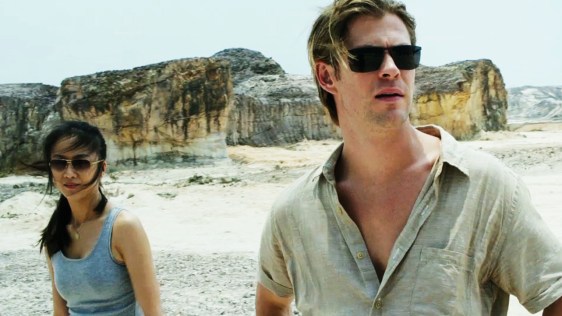
Still from "Blackhat"

In fact, the film’s self-seriousness really becomes a problem as it becomes bizarrely, graphically violent. There are some well-choreographed sequences of hand-to-hand combat and marvelously staged gunfights in this film, each more out of place than the last. Hathaway inexplicably morphs from imprisoned hacker to improvisational super-soldier in minutes, dispatching enemies with chairs and tables, handguns, and prison-fu with alarming speed and capability. Meanwhile, Lien changes from a network engineer (who does zero network engineering) to a bizarre fantasy construct that’s equal parts spy, nurse, and helpless arm-candy. Bond meets girl. And the tone is obscene.

In keeping with Mann’s devotion to every advance in digital cinema, this really is a gorgeous film, even if it does little to justify the majority of its scenery. At one point, the power-couple takes a trip to Middle-of-Nowhere, Malaysia to solve the villain’s master plan. I won’t spoil it here, but I will say that it was a breathtaking location, their presence was superfluous, and the ensuing dialogue provoked audible laughter in my auditorium. And what’s more, the film bizarrely jumps to the duo sifting through code and financial records in a hotel room moments later, redundantly solving the mystery in a much more realistic manner. The grand finale continues the film’s descent into ultraviolent madness. We know what the bad guys are up to – time to go kill them. And if the laughter in the previous scene wasn’t audible enough, it certainly resonated as Hemsworth donned his prisonesque arsenal – sharpened screwdrivers concealed about his person, and torso armor composed of magazines and duct tape. I wish I were making this up, and if the film didn’t devolve into a level of Assassin’s Creed (with inexplicably unresponsive AI from the crowd NPCs), I might have credited it with a bit of self-awareness.

But Blackhat – Hathaway – is no hero. And its awkward, genre-straddling attempts to merge globetrotting spycraft with virtual warfare do not bode well for the genre as a whole. You can’t have a Western with automobiles, and you can’t have a Bond film with realistic hackers and semi-realistic violence. Might be best to stick with the magical Skyfall nonsense next time.

FilmWonk rating: 3 out of 10

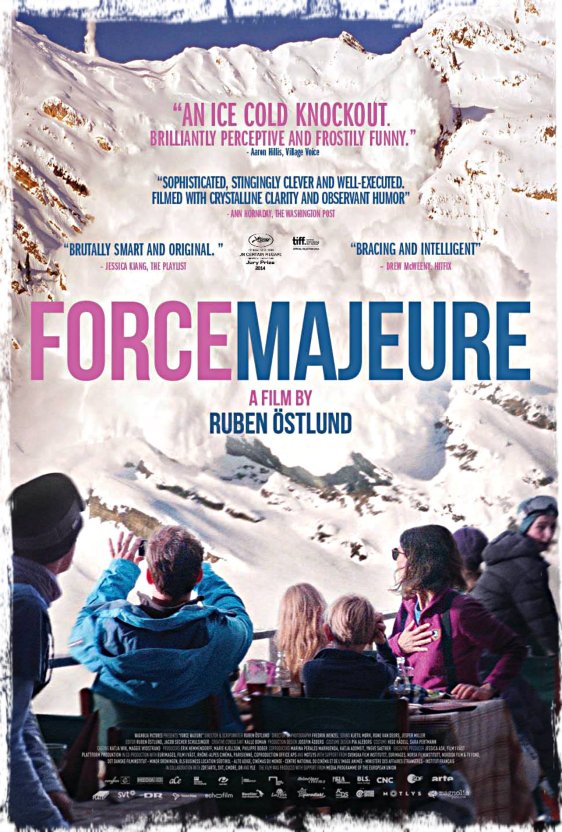
FilmWonk Podcast – Episode #60 – “Force Majeure” (dir. Ruben Östlund)

Poster for "Force Majeure"

This week on the podcast, Glenn and Daniel tackle a wondrous dilemma of heroism, masculinity, and unexpectedly hilarious drone flying in Force Majeure, a Swedish family dramedy set in a ski resort in the French Alps. Note that our review contains spoilers for Julia Loktev‘s 2012 film, The Loneliest Planet, for reasons that should quickly become clear (45:00).

May contain NSFW language.

FilmWonk rating: 8 out of 10

Show notes:

  • Music for tonight’s episode is Antonio Vivaldi‘s “Summer” (from “The Four Seasons”), as performed live by Norwegian soloist Mari Silje Samuelsen.
  • Check out the film’s excellent trailer here:
  • The MS Estonia is indeed a well-known maritime disaster in Sweden. This large ferry boat was crossing the Baltic Sea from Talinn, Estonia to Stockholm in 1994, and capsized and ultimately sank in a storm. Of the 900+ passengers aboard, only 138 survived, most of whom were young, strong males. About 650 of the passengers were estimated to have been trapped in the ship when it sank.
  • On the subject of Tomas bringing along his iPhone when he runs away, a story from Seattle comes to mind, wherein an armed robber points a gun into the face of a bus passenger who is staring at his phone. In an instant, the passenger shoves the gun away, then springs out of his seat to shove the robber away down the aisle. As he gets up to shove with one hand, he can clearly be seen to put his phone away in his pocket with the other. This is a perfect example of someone “acting on instinct” – an instinct that, in this moment, included the familiar muscle memory of holstering his phone. You can see the entire incident on video here.

Listen above, or download: Force Majeure (right-click, save as, or click/tap to play on a non-flash browser)

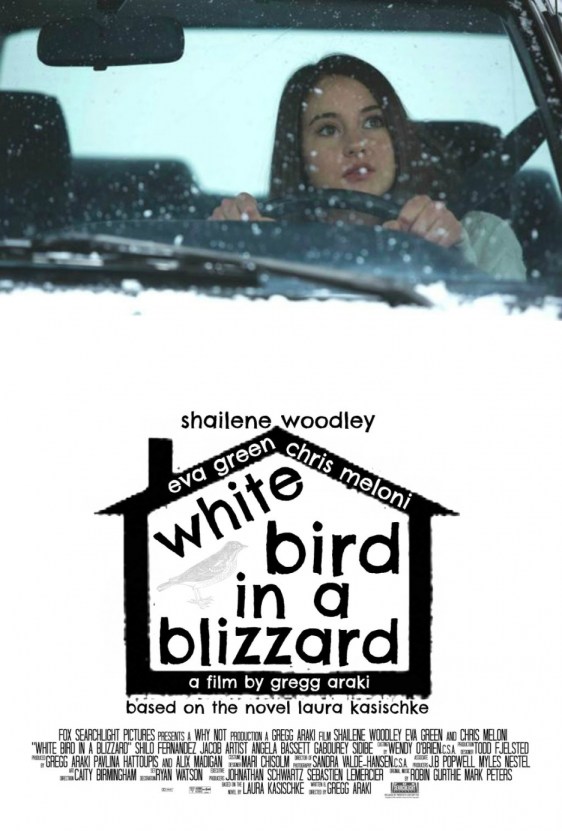
Gregg Araki’s “White Bird in a Blizzard” – An enigmatic coming of age.

Poster for "White Bird in a Blizzard"

In our podcast review of Divergent, co-host Daniel commented that Shailene Woodley could probably play a high school girl forever. For that particular film, neither of us meant this as a compliment. Following her fascinating but nonetheless sidelined role in The Spectacular Now, I was quite curious to see what Woodley would make of a solo lead in a film that is equal parts stylized mystery and erotic bildungsroman. White Bird in a Blizzard is adapted from a novel (by author Laura Kasischke), and as is often the case with such things, it relies heavily on voiceover, and occasionally gets a bit too far up its own ass with literary metaphors. But that’s the last dismissive thing I’ll say about this film, because after 10-15 minutes of this, I was completely sold on both Woodley’s casting and on the premise of the film itself.

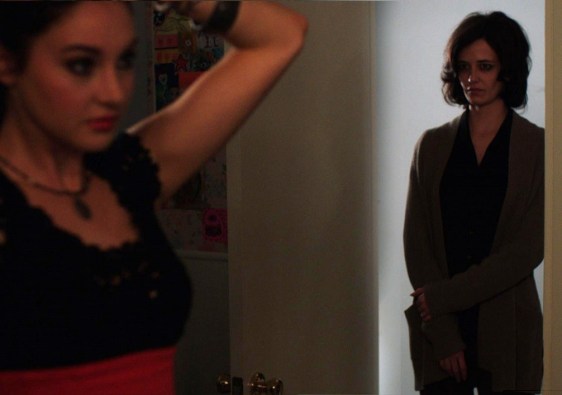
The film begins with the introduction of Kat Connor (Woodley), whose mother Eve (Eva Green) disappears without a trace. Christopher Meloni plays Kat’s beleagured father Brock, and we learn through flashbacks just how little regard her parents had for each other. The production design during these sequences can best be regarded as a dystopian mash-up of Mad Men and The Stepford Wives. Eve is unsatisfied both domestically and sexually, and Kat (then at age 8, played by Ava Acres) is disturbingly aware of the minutiae of her parents’ sex life, or lack thereof – her mother’s nightly solo trips to bed, unsatisfied, and her father’s none-too-secret locked stash of Hustler mags in the basement. After Eve vanishes (when Kat is 17), the flashbacks spend much less time on her discontented marriage with Brock, and far more time on her relationship with her daughter. Kat’s teenage sexual awakening is fully on display in this film, and the film strikes an interesting balance between her various boundary-prodding dalliances and her mother’s competitive attitude about her youth and beauty.

Still from "White Bird in a Blizzard"

Green is much closer in age to the younger version of the character, and yet seems to sell the middle-aged, despondent version far more through her performance than through any sort of age makeup. As she vamps around the screen – frequently with a glass of wine in hand – she stares creepily at Kat and tells her just how closely she resembles her younger self. This character is Betty Draper in one moment, and channeling the best of Helena Bonham Carter in the next – it’s really quite an impressive balancing act. Given that all of these flashbacks seem to be taking place in Kat’s memory (sometimes literally, as she recounts them to Angela Bassett as her therapist), it’s hard to shake the feeling that Kat is an unreliable narrator. That these are merely her last interactions with her mother as best she can distantly recall them – a bitter recollection of a half-remembered ghost.

Shiloh Fernandez gives a nice turn as Phil, the boy next door (and Kat’s not-too-serious boyfriend). As Kat puts it, he reminds her a great deal of her father – scratch the surface, and you just find more surface. This is perhaps why she meanders elsewhere over the course of the film, seducing 40-something Detective Scieziesciez (Thomas Jane), who is assigned to her mother’s case. The film’s treatment of their erotic interaction is nothing short of masterful. At this point in the film, it’s unclear whether Kat has yet turned 18 (she mentioned previously that she was a few weeks away), and the police detective more than twice her age clearly knows that he’s toeing – and then leaping across – a dubious ethical line. The resulting encounter strikes a frankly miraculous balance – a pair of consenting adults who prod the edges of an improbable power dynamic until they emerge as equals. This becomes one of the most tense and fascinating relationships in the film, and it could never have done so without such a tonally perfect opening scene.

Much like Ellar Coltrane‘s central character in Boyhood, it is a single youth – Kat – whose development is fully on display in this film. And no matter what’s happening in the background, the film only works if we care about this character throughout the film. Woodley is aloof at times, but only when it seems appropriate – when her character can’t be bothered to deal with the chaotic and painful changes in her life. At no point in the film does Kat feel unaffected by either her mother’s disappearance (despite her protestations to the contrary) or any of the linked events, and this makes for a nice, slow-burn mystery as she decides just how much she really wants to know the truth. This film blends mystery into a coming-of-age drama most effectively – and in a way I’ve never seen before. The mystery is ever-present, but impressively restrained to make room for the rest of the cast to get on with their lives.

FilmWonk rating: 8 out of 10

Seattle’s One-Reel Film Festival 2014 – Monday Roundup

SIFF Film Center projection room

The One-Reel Film Festival is part of Seattle’s renowned Bumbershoot music and arts festival. Throughout the weekend, I’ve had the opportunity to see short films from all over the world, some of which can be viewed online (I’ve included links below where applicable). The films were arranged into blocks of around an hour apiece, which I’ve arranged in presentation order below. Bold text means I enjoyed the film, and an asterisk (*) means it was my favorite film of that block. Skip to the bottom for a list of all the films that can be viewed online.

Click here for Saturday’s films
Click here for Sunday’s films


Best of SIFF 2014: Jury Award Winners

  1. Rhino Full Throttle (Director: Erik Schmitt, Germany, 15 minutes)

    A beautiful tale about temporary friendship amid wanderlust, the expectations we impose on those who pass through our lives on a transient basis, and how to express those feelings outside of Facebook. The main character is an artist (Tino Mewes) who uses the city of Berlin as his medium and muse, using cardboard and forced perspective to carve out a magical world straight out of the minds of Michel Gondry or Terry Gilliam. The in-camera visual construction and deconstruction are marvelous, even as he finds a partner in crime, Vicky (Marleen Lohse), with whom to construct his elaborate artwork. And he loves her, because of course he does – and then this film delivers a powerfully subtle message that no, the girl in your life doesn’t lose the power to make her own decisions just because you develop a crush on her. And the main character’s journey ends up spinning this dilemma into a beautiful tale of friendship and mutual acceptance – the idea that no matter where you go in the world, your friends will always be your friends unless you give them a serious reason not to be.

    Trailer here.

  2. Twaaga* (Director: Cedric Ido, Burkina Faso/France, 30 minutes)

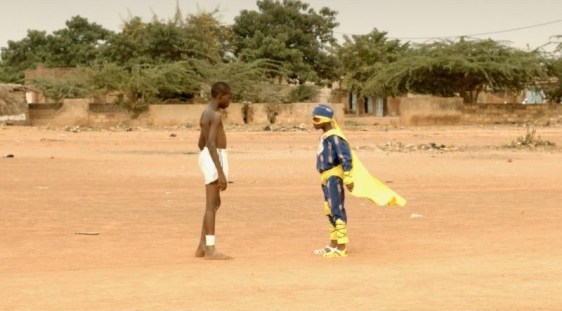
    I don’t know Burkina Faso, but this short historical family drama acquainted me with a huge amount of detail in its brief runtime, projecting the uncertainty and weirdness of a post-revolutionary environment with remarkable skill. The secretiveness, the petty grievances settled under the auspices of revolutionary fervor, and the grand uncertainty about the future are put on display through the eyes of a young boy, Manu (Sabourou Bamogo), who desperately wants to be a superhero. The film’s title, Twaaga, means “Invincible”, and evokes a tribalistic ritual that we see at the film’s outset, designed to instill revolutionary fervor by imbuing the recipient with an ancestral and magical sense of invincibility. Manu sees his brother Albert (Harouna Ouedraogo) becoming anointed in this manner, and it melds seemlessly with his superheroic desire to navigate his own childhood perils and look after his family. Manu converses with the local comic merchant about the various parallels between the X-Men and the American civil rights movement, then dons a superhero costume to confront his local bullies on the soccer field. And all around the edges of this family, the revolution rages on. This is exactly how powerful, personal storytelling is done, and it has stayed with me since I saw it.

    More info and trailer here.

  3. Maikaru (Director: Amanda Harryman, USA, 7 minutes)

    Maikaru is a powerful, personal testament from a young man who grew up in Seattle’s underbelly as a victim of human trafficking. The vast majority of the film is shot up close and personal in Maikaru’s face, his piercing gaze heightened with a pair of stylistic contact lenses that make his pupils look like stars going nova. The contrast created by his upbeat persona, artistic endeavors, and positive outlook is overwhelming as he reveals one terrible thing after another that happened to him, his siblings, and his mother during his upbringing. This is not a pleasant film, but it is certainly an important one for me to properly understand my hometown of Seattle. The Greyhound bus station at 9th and Virginia, the colony of drug culture on Pike between 2nd and 3rd… These were the bedrooms of Maikaru’s childhood, as well as for countless others that I pass each day, whose stories I may never hear.

    Watch it here.


Down Under

  1. Thanks For the Ride (Director: Tenika Smith, Australia, 17 minutes)

    There’s one of these every year – a short with the narrative ambition and depth of character that it would’ve worked better as a feature film, and in this case, that is almost to the film’s detriment. From the hearse driver sitting at a funeral who clearly doesn’t give a damn, to the young man with a cast on his arm who “shouldn’t be here” (according to an angry man who chases him from the funeral), these characters (played by Simon Lyndon and Matt Callan) were instantly intriguing. The resulting short left me wanting another two acts to help fill out their unlikely friendship a bit more – a few of the emotional beats (including a bit of an improbable fistfight) happened just a bit too quickly. But the film’s every attempt at emotional resonance landed well thanks to Lyndon and Callan’s solid “lovable loser” performances, and all told, the film is well worth a look.

    Watch it online here.

  2. In Autumn (Director: Rosanna Scarcella, Australia, 15 minutes)
    Is “romantic dreadnaught” an appropriate name for a film about romance that evokes a persistent and deliberate sense of impending doom? This film was…utterly boring and macabre. And if its objective was to properly express the uncertainty and malaise of middle-aged romance… Here’s where I should dismissively say, “Bravo” and get on with my life, but this film hardly even deserves credit for that. Romance is hard at any age, until the moment it stops being so. For some people, this moment might be death. And this film earns no credit for a tedious slog in the service of such a banal observation.

    More info and trailer here.

  3. A Great Man (Director: Joshua Dawson, Australia, 17 minutes)
    There’s something rather powerful about two boys lying on the grass in small-town Australia debating the definition of a great man, as they stare up at the bright full moon – a celestial body which, at that exact moment in 1969, has two great men walking on it, as a nearby radio helpfully informs us. These boys engage in the sort of Stand By Me risky exploration emblematic of this time period (at least in cinema), including dares and dangerous stunts. There’s an axiom in population studies that males slightly outnumber females at birth, but by age 25 or so, it all evens out. Because boys, the axiom says, are more likely to do stupid things that will get themselves killed before they come of age. This axiom is likely not actually borne out by statistics (boys are more likely to be victims of violence, for instance), but it’s fair to say stunts and dares do inform society’s notions of greatness and masculinity to some degree. Great men do dangerous things, the story goes, sometimes for no reason whatsoever. And as these boys debate jumping from a 50-foot waterfall, the adult in me was certainly saying “hike to the bottom and check the depth first!”, even as the teen boy in me said I should go for it, or more likely, chicken out, get called a pussy, and get on with my day. This film captures something very real about boyhood, even if it’s just the legend of great men that we grow up with, and never fully realize in the real world.

    Trailer here.


Show Me The World

  1. The Queen (Director: Manuel Abramovich, Argentina, 19 minutes)
    After watching this film (a documentary?), I just hope there’s a teen beauty queen out there who’s doing it by choice. Because this film depicts an Argentinian carnival beauty (who is perhaps 10 years old) in a manner that is nothing short of child abuse. The film is told almost entirely through an extended close-up on the girl’s face, as frigid stage mothers dance around the periphery of the frame strapping a 10-pound rhinestone monstrosity to the top of her head. They thread zip-ties through her hair, offer lidocaine creams to numb her scalp, and eventually, just straight-up pills to pop (which she refuses, despite no longer being able to feel or move her head and neck). We hear about the various scars borne across the backs of these beauty queens by the end of their teenage years, even as we see them forming across this girl’s face. This film made its point effectively, even if I’m torn as to whether the mere act of making it was despicable.

    More info and trailer here.

  2. Mother Corn* (Director: Guillermo Lecuona, USA/Mexico, 16 minutes)
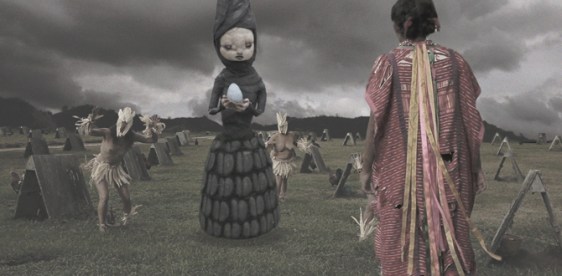
    If nothing else, this film demonstrates the sad truth that as any culture approaches extinction, it becomes, at best, a thing to be packaged and sold to tourists. This dilemma is addressed through a grandmother and granddaughter who struggle between their linguistic and cultural identity – Trique vs. Mexican. Infused with Pan’s Labyrinth style imagery, this film mingles the girl’s uncertainty with images of death, floating souls, and fantastical creatures.

    Trailer here.


Films4Adults #3

  1. The Man Who Knew a Lot* (Director: Alice Vial, France, 20 minutes)
    It’s the ugly truth of every specialized touristy shop that the knick-knacks contained within – the authentic Southwestern pottery, the deer antlers, the gargoyle statues – won’t look nearly as good on your apartment shelf as they do in a perfectly lit store surrounded by similar crap. They’re selling an image, not an object. And this film takes this idea to the nth degree by taking place inside a dystopian IKEA store called Paradesign. On the show floor, scenes of everyday life and household situations in various disembodied rooms are expertly staged, complete with human beings who spend all day – indeed, live their entire lives – sitting in the chair, laying on the bed, and so forth. An old man on the first floor, Mr. Beranger (André Penvern), teams up with a little girl (Naomi Biton) who was born on a €59.99 bassinet, both of them desperate to break free from Paradesign and find out what lies beyond. The result is somewhere between WALL-E and Dark City – an oppressively well-rendered piece of short science fiction.

    More info here.

  2. Deadbeat (Director: Danielle Morgan, USA, 12 minutes)
    Still a better love story than Twilight. This film acts as an unofficial sequel to the inexorable love story between a perpetually 17-year-old vampire (John Brodsky) and his now upper-30s human lover (Melissa D. Brown). Great fun made at the expense of a genre that richly deserves it.

    More info and trailer here.

  3. Syndromeda (Director: Patrik Eklund, Sweden, 22 minutes)
    A naked, bloodied man (Jacob Nordenson) is found wandering in the middle of nowhere. What ensues is a fascinating dramatic parable about how our minds deal with trauma and uncertainty. From its non-linear storytelling to outright confabulations on the part of the main character, this film depicts a man utterly perplexed about what has happened to him, filling in the details of ambiguous sensory input with his own culturally informed ideas. And the result is a smart, solid, visually stunning horror short.

    More info here, scene from the film here.

  4. The Fall (Director: Kristof Hoornaert, Belgium, 16 minutes)
    A couple debates what to do when they accidentally hit and kill a child in the middle of the woods. Because everyone knows the road less traveled is the easiest spot to dispose of a body. This film is beautifully shot, but existentially unpleasant. And that may have been the point, obliterating Eden with original sin and all that – but the experience wasn’t exactly enjoyable.

    More info and trailer here.

  5. We Wanted More (Director: Stephen Dunn, Canada, 16 minutes)
    Just add water for instant body and existential horror, as a singer (Christine Horne) loses her voice the night before a concert tour, and imagines it appearing before her in the form of a creepy child (Skyler Wexler). Her angst about her career is compounded by having just dumped her boyfriend (it’s implied, because he proposed). This is a simple, effective premise with stirringly disturbing imagery, bringing to mind the likes of Black Swan. And it turned out to be the perfect recipe for a personally high-stakes horror short that comes to a swift and pitch-perfect conclusion.

    Trailer here.


Quick List: All of the films that are available online: