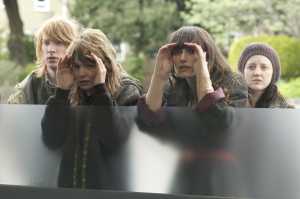
Greg Mottola’s “Paul” – An overstuffed road trip

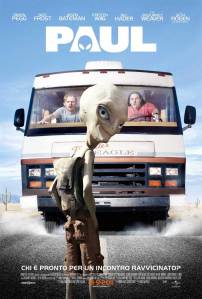
For some, Paul might provoke a sense of nostalgia. It is chock full of so many elaborate and perfectly executed pop culture references that you’ll spend far more time knowingly chuckling than actually laughing. It has all the ingredients of a solid road-trip comedy – Graeme (Simon Pegg) and Clive (Nick Frost) are a pair of unabashed nerds who take an RV across the American Southwest in search of gorgeous scenery and all things UFO. Halfway to Roswell, they run into an honest-to-goodness alien named Paul (voiced by Seth Rogen). Oh, and did I mention that Pegg and Frost, the beloved comedic duo from Shaun of the Dead and Hot Fuzz, also wrote the screenplay? And that they secured director Greg Mottola, whose last film made my Top 10 of 2009?

With all of these players involved, I am baffled as to why Paul is staggeringly unfunny for most of its runtime. The first 15 minutes, in which we get to know Graeme and Clive, are downright tedious. Pegg and Frost have their usual rapport, but their naturalistic banter is saddled with an overabundance of scatological humor and enough gay jokes to overwhelm Adam Sandler. Pegg and Frost’s relationship definitely got stronger as the film went on, but this first act was bad enough that I found myself wondering if, in a world where I hadn’t seen their prior collaborations, I would have bought them as friends at all.

Nonetheless, the film becomes truly enjoyable as soon as Rogen enters the picture. Rogen’s voice performance is hilarious and raunchy (like Rogen himself), and the repartee between Pegg, Frost, and Rogen (which allegedly contained a great deal of improv) is definitely where Paul is at its strongest. And that’s just what this film needed! Bring these giants of geek comedy together, and just let them be funny with each other. Instead, there were far too many scenes that dragged on for just a bit too long in the service of gags that aren’t nearly as funny as the movie thinks they are. When Paul brings a bird back to life with his E.T. mind-magic and then eats it, I chuckled (at least, I chuckled when I saw it in the trailer). But did it merit such an awkward pause in both story and comedic timing? Not at all. And there were a dozen other gags that felt just as expendable.

I’ve omitted some characters thusfar. Jason Bateman plays Agent Zoil, the ruthless man-in-black who is doggedly pursuing Paul. And I must say – this is one of Bateman’s finest performances. Bateman is the consummate straight man in every comedic project, and to see a straight-man who is heavily armed and committed to tracking down and killing every comedic character in the bunch is frightening and hilarious. Kristen Wiig is also in the mix as Ruth, the daughter of a Christian fundamentalist, and quasi love interest for Graeme. I don’t have much to say about this character – mocking religious nuts is pretty passé (and a bit too easy), and Ruth and her dad were perhaps the most extreme indications that this script was written by a pair of Brits who only had an eye for American caricature. The film simply felt overstuffed with both one-note characters and underused comedic talents (including Bill Hader, Joe Lo Truglio, Jeffrey Tambor, Jane Lynch, David Koechner, and one more I won’t spoil), who had very little to do with their brief screen-time except make the audience wonder why they showed up.

The most frustrating thing about Paul is that there seems to be a truly great road-trip adventure film at the center of it. Pegg, Frost, and Rogen (and eventually Wiig) are an affable group, and the wide open spaces and scenery look gorgeous (can’t go wrong with the American Southwest). Blythe Danner shows up as Tara Walton, the adult version of the little girl who first discovered Paul’s crash site, and I must say – this is a backstory that deserved more screen time. This film teases the kinds of strong relationships found in E.T. and Close Encounters, but seems too timid to actually embrace them. Every time it comes close, it wastes time on a throwaway line or shot-for-shot scene remake of one of those films instead. Comedy cannot survive on referential gags alone, and Paul‘s focus on them is entirely to its detriment.

FilmWonk rating: 4.5 out of 10

Sidenote: Kudos to the effects team that designed the alien Paul. This was a perfect fusion of reality and CG character design, on the same level of realism as District 9, but with a much more cartoonishly designed alien (which makes it even more impressive).

George Nolfi’s “The Adjustment Bureau” – All according to plan

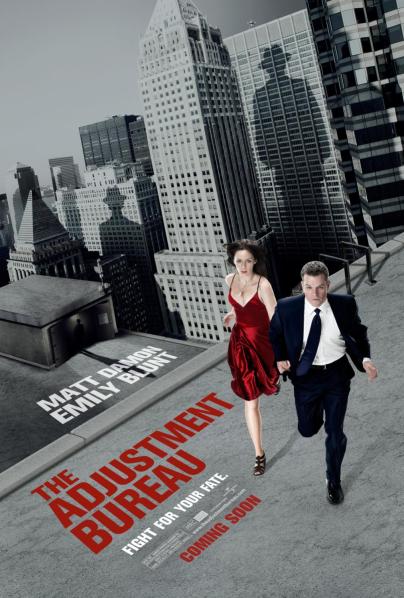
When I saw the trailer for this latest Phillip K. Dick adaptation, I was intrigued, but mostly disappointed. To see the film squander its high-minded concepts of fate, free will, and strangers in suits in the service of what seemed to be just another “us against the world” romance seemed like a profound waste of time. We see Matt Damon, an able presence in any film, once again showcasing his four-minute mile, this time with an out-of-breath Emily Blunt in tow, and the film seemed like little more than a chase thriller saddled with superficial overtones of meant-to-be amour.

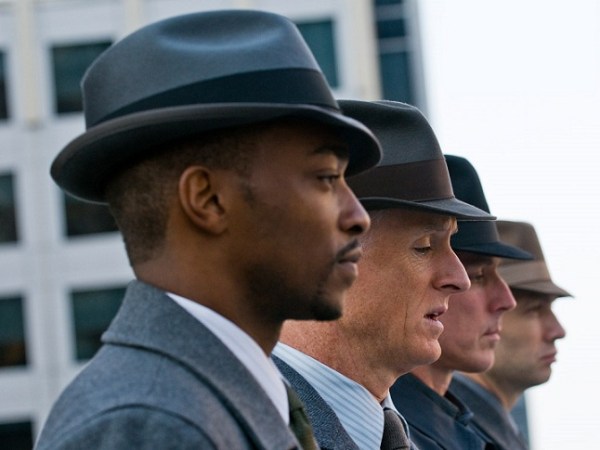
It’s the story of New York State Congressman David Morris (Damon), who meets the girl of his dreams in ballet dancer Elise (Blunt), but never gets her last name or phone number. The besuited members of the Adjustment Bureau, guardians of fate the world over, go out of their way to ensure that the two never meet again. And why? Because “the Plan” says they’re not supposed to be together. But when Adjuster Harry Mitchell (Anthony Mackie) dozes off on the job, the two star-crossed lovers meet and form an instant and irrevocable attraction, prompting higher-ups Richardson (Mad Men‘s John Slattery) and Thompson (Terence Stamp) to come in and set the world back on track.

David’s inadvertant glimpse at the Adjusters in action has cosmic consequences, leading to a multitude of lengthy deliberations about fate and free-will. These discussions are probably where Dick and Nolfi’s carefully-crafted dialogue is at its strongest, striking just the right balance between existential technobabble (“We’re seeing some shifting confluence tides!”) and adept worldbuilding. In addition to the discussions, there are plenty of foot-chases wherein the Adjusters show off their uncanny ability to flit between any two locations via doorways. This is a mechanic we’ve seen before, in both Pixar’s Monster’s, Inc, as well as The Matrix Reloaded. I regret to invoke that first Matrix sequel, but The Adjustment Bureau feels in many ways like a spiritual successor to that film. It has a similarly controlled and constructed reality (complete with its very own Agents), but unlike Reloaded, manages to philosophize without becoming overly self-indulgent. The foot-chases increased in length and complexity, and I actually found myself getting bored with them as the film went on. Its parallels to Reloaded became so striking at this point that I thought the only way the film could end was with David and Elise pleading their romantic case in front of the Architect (or “The Chairman”, as he’s known in this film).

I won’t spoil how the film ends, but I will say I found it mildly satisfying. It was a brave choice to focus on such a seemingly conventional romance (and give us not one, but three meet-cute scenes), but the undeniable chemistry between Damon and Blunt managed to justify it even as each leap forward in time made it less and less coherent. Blunt’s performance is striking, but her character exists as little more than an object of beauty and desire, her appeal explained solely as a product of her masterful skill in the art of ballet. Damon, meanwhile, is given a great deal more to work with as a would-be politician as well as a romantic. He delivers a speech that the film’s fictitious journalists rightfully refer to as “electrifying”, and has a number of fantastic scenes debating fate and free-will with the always enjoyable Terence Stamp. If the film’s romance offers one great disappointment, it’s that Elise is never given any say in the matter- indeed, she’s never even given a chance to understand what’s going on, and pays a great emotional price for it. While David knows he’s risking his life and defying his fate to be with her, Elise is simply caught in an on-again, off-again romance with an unreliable politician, and comes along for the ride simply because it feels right.

The romance aside, the film’s most fascinating character might just be Harry (Mackie), the Adjuster who’s had just about enough of manipulating people’s lives. Mackie gives an adeptly understated performance. Even as he delivers the bulk of the film’s exposition, he remains aloof and otherworldly while clearly feeling a measure of compassion for the people he’s manipulating.

In the end, The Adjustment Bureau is an adept rendition of unoriginal ideas, and that might just make it worth watching. Its grand questions about fate vs. free will are doled out at about the right pace – just as I began to wonder how the present world (or indeed, the past century) can be explained as a delicate web of clockwork predestination, the film offered what can at least be deemed a plausible excuse. In this world, God (or “The Chairman”) appears to be quite fallible, or at least willing to indulge in the kind of experimentation that inadvertently brings about the Dark Ages or the Holocaust. The film sidesteps the contradiction between omnipotence and omnibenevolence by never quite presuming either. The Adjusters aren’t all-seeing or all-knowing (despite their frequent claims to the contrary), and film’s resulting deity is neither a hands-off Deist type nor an ever-present micromanager that makes everyone’s dreams come true. The Bureau’s specific interest in David is never quite explained, but any success he might achieve will come at a significant personal cost.

FilmWonk rating: 6 out of 10

FilmWonk Podcast – Episode #8: Tom Hooper’s “The King’s Speech”

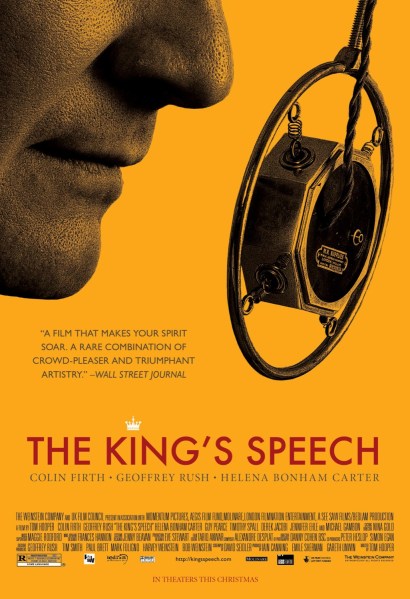
Poster for "The King's Speech"

This week, Glenn, Daniel, and guest Nick don their most dapper suits and get stoked for Oscar gold as they review The King’s Speech, starring Colin Firth, Geoffrey Rush, Helena Bonham Carter, Guy Pearce, and Michael Gambon. (20:00)

[may contain some NSFW language]

FilmWonk rating: 8 out of 10

    Show notes:
  • Music for this episode comes from Alexandre Desplat’s original score.
  • At the beginning of this episode, we refer to a blooper from our last podcast which riffed on a scene from the film’s theatrical trailer (scene begins at 1:22).
  • Special thanks to guest reviewer Nick for joining us for this review!

Listen above, or download: The King’s Speech (right-click, save as).

2010 Glennies, Part 5: Best Picture (Top 10 Films of 2010)

#11: Splice


Directed by Vincenzo Natali, screenplay by Vincenzo Natali, Antoinette Terry Bryant, and Doug Taylor

There are films I enjoyed more than Splice this year, but it earns a place on this list for the sheer audacity of its premise and execution. Vincenzo Natali’s shocking portrayal of the creation and upbringing of a human-animal hybrid strikes a tone that falls somewhere between Gattaca and Jurassic Park, raising the former’s complex bioethical questions while striving for the latter’s excitement amid the uncontrollable chaos of the natural world. While it never quite reaches the heights of either of these films, I can safely say that it is one of the most unforgettable and shocking films I’ve ever seen. It boasts a trio of mostly strong performances, including a disturbing and utterly fearless performance from French model/actress Delphine Chanéac as the adult creature.

#10: Inception


Written/directed by Christopher Nolan

In 2008, when I named Christopher Nolan’s The Dark Knight my #3 film of the year, I simply (and lazily) wrote, “You either already know why, or you probably don’t care. See this film. If you already have, see it again.”

Nolan’s latest film, Inception, seems to provoke the opposite reaction on both counts. Its fans and detractors alike have written volumes on the subject, and most casual viewers are compelled to see it again if only to make sense of the entire mind-bending spectacle. I can’t praise the film quite as dismissively as I did The Dark Knight, but while Inception is not a perfect film, it is certainly one of the most complex visual and technical spectacles ever put to screen, and for that much alone, it must be recognized. While the film’s action descends into slightly shallower video-game territory by the end, it still manages to offer one of the finest deconstructions of reality and consciousness since The Matrix.

#9: Never Let Me Go


Directed by Mark Romanek, screenplay by Alex Garland, novel by Kazuo Ishiguro

The appeal of this film is difficult to describe without spoiling its intriguing alternate-reality premise and fantastic worldbuilding, but this is a film that succeeds masterfully at building an atmosphere that makes the audience care deeply about its characters. The film was not without its hiccups – the resolution of the love triangle seemed almost deliberately anti-cathartic – but the performances of the core cast (Carey Mulligan, Keira Knightley, and Andrew Garfield) are more than enough to make up for any of the film’s relational shortcomings.

Adam Kimmel’s cinematography makes every frame of this film look gorgeous, even with an utterly bleak color pallette (à la Children of Men), and Rachel Portman’s atmospheric score struck just the right balance to resonate with the film’s emotional beats without overwhelming them. I was not prepared for how this film would affect me, not sure exactly how to feel when it was over, and still haunted by it several days later.

#8: Winter’s Bone
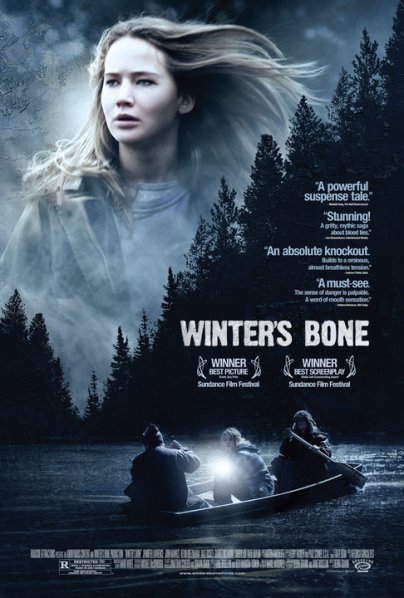


Directed by Debra Granik, screenplay by Debra Granik and Anne Rosellini, novel by Daniel Woodrell

“You’ve always scared me,” says Ree (Jennifer Lawrence), a tough-as-nails 17-year-old girl who searches desperately for her meth-cooking, bail-jumping father in the Missouri Ozarks.

“That’s because you’re smart,” retorts Teardrop, in a stunningly intimidating performance from John Hawkes. Apart from a pair of brilliant performances (and an impressive supporting cast), this film’s success is in its simple, high-stakes premise – an unlikely detective story in a masterfully realized Southern Goth environment. What’s more, this is a film that keeps the audience fearing for its characters at every turn – a surprisingly rare achievement for modern cinema.

(Debra Granik’s “Winter’s Bone” – A masterful dose of guns, guts, and gloom)

#7: The Fighter


Directed by David O. Russell, screenplay by Scott Silver, Paul Tamasy, and Eric Johnson, add’l story by Keith Dorrington

This is a crowd-pleaser, plain and simple. A formulaic film can still be an effective one, and I can offer no better evidence than The Fighter. While Mark Wahlberg’s performance as boxer “Irish” Micky Ward is perfectly solid for the subject matter, the real star of this film is Christian Bale, who gives his best performance in years as the boxer’s crackhead brother, Dicky Eklund. This is a film I can safely recommend to anyone (even, surprisingly, those who don’t care about boxing).

(FilmWonk Podcast – Episode #7: David O’Russell’s “The Fighter”)

#6: How to Train Your Dragon
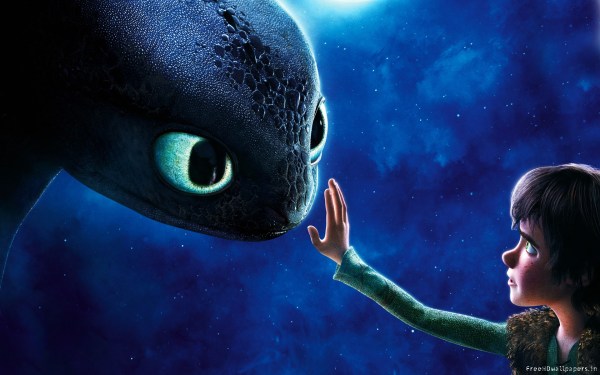


From Dreamworks Animation, directed by Dean DeBlois and Chris Sanders, screenplay by William Davies, Dean DeBlois, and Chris Sanders, novel by Cressida Cowell

This is, hands down, the most impressive and immersive 3D animation experience that I’ve had in theaters since Avatar, and its dragon flight sequences were even more impressive than the latter film. This 3D managed to not only convey a well-defined sense of scale and distance, but also the sheer speed at which its characters were ripping through the air. As a silent, but nonetheless fully realized character, Toothless the Dragon far surpasses Stitch (DeBlois and Sanders’ last such creation) – the character falls somewhere between pet and trusted companion, but the facial animation and voice work manage to convey an impressive degree of personality.

While the film still falls prey to some of Dreamworks’ usual casting largesse (did Jonah Hill and Christopher Mintz-Plasse really need to be in this movie?), the core cast – Jay Baruchel, Gerard Butler, America Ferrera, and Craig Ferguson – all give impressive voice work. And finally… John Powell’s score is easily one of my favorites of all time.

#5: Exit Through the Gift Shop



Directed by Banksy

Banksy is a force of nature, and I mean that in a good way. This is one of the most informative, engaging, and hilarious documentaries I’ve had the pleasure of seeing. Right from its masterful opening credits sequence, it managed to immediately rope me into the heretofore unknown world of street art – a world in which I had absolutely no interest prior to this film.

Regardless of the veracity of the film’s premise and events, it raises some very real questions about the nature of art and its relationship to commerce, and explores them through both the wry wit of Bansky and the bizarre life and outlook of subject Thierry Guetta, a fascinating character unto himself. If you have a Netflix streaming subscription, you can watch this film right now.

#4: Animal Kingdom
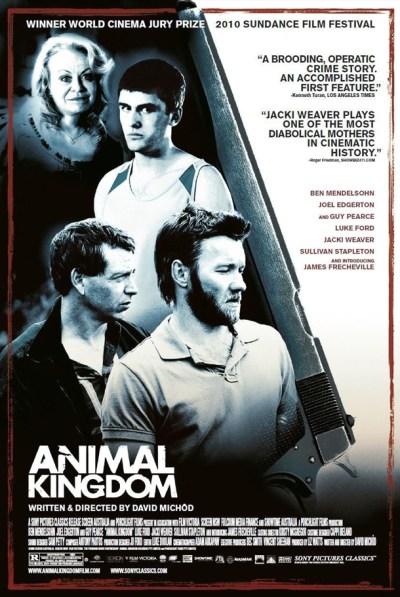


Written/directed by David Michôd

This Australian gangster film is a slow burn, but a complete pleasure, and boasts a cast of strong performances (including Jacki Weaver as the most stunningly creepy and effective villain since Heath Ledger’s Joker). Daniel and I couldn’t stop raving about this film – hear more below.

(FilmWonk Podcast – David Michôd’s “Animal Kingdom”)

#3: Mother


Directed and story by Bong Joon-ho, screenplay by Park Eun-kyo and Bong Joon-ho

In the past few years, Korean cinema has excelled in producing films that defy categorization, at least in Western terms of genre. At its core, Mother is about a relationship between a mother (Kim Hye-Ja) and her mentally disabled adult son (Won Bin), with a murder mystery thrown in for good measure. I’ve already raved at length about Kim’s masterful performance, but I must also praise the film for its effectiveness and innovation. This film had me from the very beginning, and I was happy to come along for the ride, even as I had no idea where it was going.

#2: The Social Network



Directed by David Fincher, screenplay by Aaron Sorkin, book by Ben Mezrich

I know Mark Zuckerberg. Every time I start to write about this film, I keep coming back to this simple sentence. Certainly, I can’t be sure I’ve seen an accurate rendition of his life based on the events of this film. As I subsequently read both Ben Mezrich’s “The Accidental Billionaires” and David Kirkpatrick’s “The Facebook Effect”, I slowly began to get a picture of the man through wildly divergent (and self-serving) accounts of his life, and I was forced to the same conclusion I had when the film ended.

The film’s accuracy with regard to Mark Zuckerberg is irrelevant. We all know Mark Zuckerberg, or at least recognize the character. This film proffers an astounding look at a period of substantial change to society and internet culture, and it does so by crafting one of the most fascinating characters in cinema history and running him through the paces of age-old themes – friendship, desire, and betrayal. As expected with a David Fincher film, The Social Network is technically perfect filmmaking, and brings Sorkin’s rapid-fire script and dialogue to stunning life while showing remarkable restraint with many of Fincher’s typical visual flourishes (although there was still the obligatory “camera passes through balcony rails” shot).

This is a film that everyone will take away something from, even if it’s completely different from person to person. And for a film about the disputed origins of a website, it manages to be completely engaging from start to finish. I’ve said plenty about the performances, but I have to also mention Trent Reznor’s score, which builds a intense and ominous atmosphere from the film’s first scene.

#1: Toy Story 3
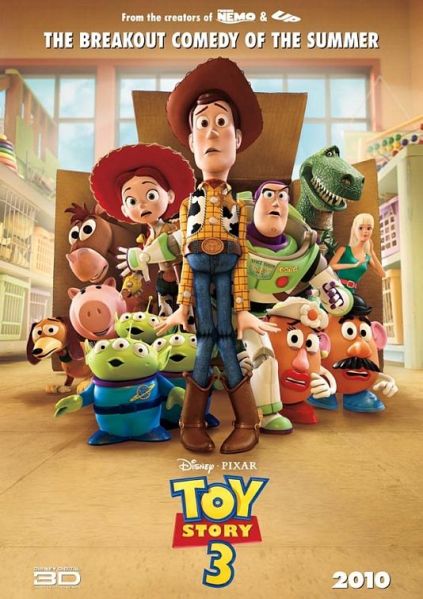


From Disney/Pixar, directed by Lee Unkrich, screenplay by Michael Arndt, story by John Lasseter, Andrew Stanton , and Lee Unkrich

From my 10/10 review:
In the 15 years since the first Toy Story, Pixar’s animation has progressed immeasurably, but time and again, they have proven that their greatest strength is their understanding of character and story. Pixar has crafted an absolutely gorgeous film here, but it is not about plastic toys – the soulless, lifeless, disposable pleasures of youth. It is a film about life, love, friendship, and loss; hope, despair, and finding one’s purpose. It is funny, exciting, surprisingly poignant, and easily Pixar’s finest film. I’m a little wary of giving this film a perfect score, since I may well have handicapped myself by revisiting the first two films immediately beforehand. This might better be considered a rating for the entire trilogy, and not just its brilliant send-off – but I can’t help it. I’ve seen this movie twice and I wouldn’t change a thing.

Honorable Mentions:

  • 127 Hours (directed by Danny Boyle, screenplay by Danny Boyle and Simon Beaufoy, book by Aron Ralston)
  • Kick-Ass (directed by Matthew Vaughn, screenplay by Matthew Vaughn and Jane Goldman, comic by Mark Millar and John Romita, Jr.)
  • Scott Pilgrim vs. the World (directed by Edgar Wright, screenplay by Edgar Wright and Michael Bacall, graphic novel by Bryan Lee O’Malley)
  • Buried (directed by Rodrigo Cortés, written by Chris Sparling)
  • True Grit (directed by Joel and Ethan Coen, screenplay by Joel and Ethan Coen, novel by Charles Portis)
  • Catfish (documentary, directed by Henry Joost and Ariel Schulman)
  • Black Swan (directed by Darren Aronofsky, screenplay by Mark Heyman, Andrés Heinz, and John J. McLaughlin)
  • Shutter Island (directed by Martin Scorsese, screenplay by Laeta Kalogridis, novel by Dennis Lehane)
  • The Town (directed by Ben Affleck, screenplay by Peter Craig, Ben Affleck, and Aaron Stockard, novel by Chuck Hogan)
  • Restrepo (documentary, directed by Tim Hetherington and Sebastian Junger)
  • Greenberg (written/directed by Noah Baumbach, story by Noah Baumbach and Jennifer Jason Leigh)
  • Get Him to the Greek (written/directed by Nicholas Stoller, characters by Jason Segel)
Click here to see the rest of the 2010 Glennies.

2010 Glennies, Part 4: Best Actress

#5: Annette Bening – Nic, The Kids Are All Right

This film didn’t quite do it for me, and reminded me that I sometimes have to catch myself from thinking that the best performances of the year will invariably fall within the best films. But while Lisa Cholodenko’s sex comedy/family drama was not without its flaws (particularly in the second half), Annette Bening’s performance as the conservative “patriarch” of this surprisingly* conventional family was immaculate. She completely sold her ever-changing reactions to the introduction of her kids’ birth-father (Mark Ruffalo), treating him first like a looming threat to her primacy, then laughing and drinking wine with him and the family. This is a completely authentic character, and Bening’s delivery of dramatic outbursts and comedic barbs alike was spot-on. Her chemistry with Julianne Moore felt mostly believable – it had a kind of comfort and ease, just like an old married couple.

She also completely nails the best two lines in the film, which I won’t spoil here.

*By the standards of quirky indie film, that is.

#4: Carey Mulligan – Kathy, Never Let Me Go

I’ve seen Carey Mulligan play cheerful, but I’ve seen her play somber much more frequently. While I may eventually reach a point of wanting to see a wider range from this actress, I found every dour moment of her screentime in Mark Romanek’s Never Let Me Go to be completely compelling. This film relied heavily on tone, and Mulligan’s performance and chemistry with her fellow leads (Keira Knightley in particular) helped maintain the film’s bleak and somber atmosphere without ever letting the audience lose emotional touch with the characters. These are wretched and pitiable creatures, and it is Mulligan’s heart and compassion that keeps the audience caring for them right to the end.

#3: Hailee Steinfeld – Mattie Ross, True Grit

An early scene in True Grit features Mattie Ross in hardball negotiations with a stable owner over her late father’s horses. Her unrelenting performance amid rapid-fire dialogue in this scene would have been enough to get 13-year-old newcomer Hailee Steinfeld a supporting nod from me, but the Academy be damned – this is unquestionably a lead performance. Steinfeld is in every scene of True Grit, and the film could not have succeeded without such a mature and charismatic take on this character. Mattie Ross is articulate, intimidating, and a bit of a gadfly, and has to keep up with powerful characters three times her age without ever overstaying her welcome with the audience. It’s a tall order, but Steinfeld completely pulls it off. Her rapport with Jeff Bridges was admirable, treading some fascinating ground between road-trip comedy and an intense father-daughter bond. This film is a delight, and it owes much of its appeal to Steinfeld.

#2: Natalie Portman – Nina Sayers, Black Swan

The effectiveness of Nina Sayers is in both her initial state- the pure and fragile “sweet girl”- and her incredible mental and physical transformation. Natalie Portman not only sold both aspects of the character, but fearlessly committed to all the pain and revulsion – bordering on body horror – that she must experience. Portman’s chemistry and frightful interactions with her fellow players (Barbara Hershey in particular) become increasingly fascinating as Nina descends into full-blown schizophrenic madness. Along with Aronofsky’s direction, this was a performance that would make or break the film, occasionally even compensating for deficits in the screenwriting.

“I’M the Swan Queen!” screams Nina as she embarks on the film’s final performance. And indeed she is. Embodying both the white and black swans, Portman’s performance is complete and unmatched.

#1: Kim Hye-ja – Mother, Mother

It is a rare movie tagline that so adequately captures the tone of a film. For Bong Joon-Ho’s Mother, it was this: “She’ll stop at nothing.” Simple and straight to the point. Kim Hye-ja, an actress primarily from Korean television, gives a tour de force performance as the unnamed titular matriarch. Every one of her character beats rang completely true, from her constant worry about her mentally disabled adult son (Won Bin) to her utter desperation to clear his name for murder. She goes to some alarming lengths as the film goes on, and Kim’s performance completely sold each one of her increasingly heartbreaking decisions. The gorgeous opening scene features Kim breaking into an uneasy dance in the middle of the field, with a very pained expression in her face and body language. The full meaning of this scene becomes apparent later in the film, but from the outset, it is clear that Kim Hye-Ja can convey a great deal of emotion in completely unspoken terms. This is a character that the audience wants the best for at all times, no matter what she becomes.

Honorable Mentions:

  • Jennifer Lawrence as Ree in Winter’s Bone
  • Noomi Rapace as Lisbeth Salander in The Girl with the Dragon Tattoo
  • Emma Stone as Olive Pendergast in Easy A
  • Marisa Tomei as Molly in Cyrus
  • Julianne Moore as Jules in The Kids Are All Right (Honorable, honorable mention: as Catherine Stewart in Chloe)

Click here to see the rest of the 2010 Glennies.

2010 Glennies, Part 3: Best Actor

#5: Russell Brand – Aldous Snow, Get Him to the Greek

I was worried when I heard that 2008’s Forgetting Sarah Marshall would be getting a spinoff featuring supporting rockstar Aldous Snow. Brand’s performance was certainly a highlight of one of my favorite films of that year, but it was a very broad, drugged-out lothario of a character. Could the rockstar (and Brand) carry his own film?

Somehow, the answer was yes. Nicholas Stoller’s comedy is a significant departure in both tone and content from Forgetting Sarah Marshall, and Brand’s performance gives some surprising depth to the rockstar Aldous Snow. The film is a broad and scatological comedy with the dark undertone of Snow’s various addictions. It’s also a wild sex romp that relies heavily on Snow’s on-again, off-again one-true-love. The film’s appeal is in its sincerity, and Brand completely commits to this character, warts and all.

#4: Jeff Bridges – Rooster Cogburn, True Grit

I don’t have a lot to say about True Grit, except that it’s a brilliantly written genre exercise. It is a legitimate western as surely as the works of Ford or Leone, and Jeff Bridges’ take on the one-eyed marshal Rooster Cogburn feels right at home. His dialogue is slurred to the point of incomprehensibility, and his appearance is utterly unglamorous. This character is a slobbering, drunken mess, and I mean that as a compliment. I can safely say I’ll never forget this performance, and Bridges deserves every bit of the credit he’s getting for it.

#3: Ryan Reynolds – Paul Conroy, Buried

From my review: “This may be the most electrifying performance yet from Ryan Reynolds. Like Tom Hanks in Cast Away before him, Reynolds has crafted a masterful one-man show, and he never lets up on the stakes. Paul is dying alone, and Reynolds deftly conveys his ratcheting hopelessness and frustration.”

It’s Ryan Reynolds kidnapped and buried in a coffin for 90 minutes. That’s the entire film. But the above description may make Buried sound a good deal more serious than it actually plays for much of its runtime. This film is lurid and hopeless, to be sure, but it is also a pulp masterpiece. Its tone and editing style is reminiscent of Hitchcock, and Reynolds plays just the right blend of realistic terror and anger while preventing the character from becoming overly bleak. One scene, in which Paul solicits help (via cell phone) from one of his wife’s loathsome friends, ends with such a pitch-perfect delivery of its final line that my entire theater erupted in laughter. This is a film whose tone lives and dies by the performance of its lead actor, and Reynolds completely pulls it off.

On a related note…

#2: James Franco – Aron Ralston, 127 Hours

Aron Ralston leads a charmed life. He’s a brilliant stuntman – completely in control, but clearly a little unbalanced. Franco had to take this reckless and cocksure character on a physically and emotionally heart-wrenching journey, without any other actors to share the burden for most of the film’s runtime. 127 Hours has a similar premise to Buried – a man gets trapped under a rock for 90 minutes – but it is a very different film in both tone and characterization. Unlike Reynolds’ character above, Ralston doesn’t have access to a cell phone, so he spends the majority of the film talking aloud to himself, or saying nothing at all. The film utilizes various storytelling devices (including one involving a handheld camera that I wouldn’t dream of spoiling), and Franco’s performance played into all of them nicely.

I’m not sure if it’s even possible to spoil this film, since its title, premise, and the fact that it’s based on a true story should be enough to tell you how it ends. But suffice to say, this film takes a brutal and unflinching look at one of the most difficult physical tests ever imposed on a human being, and somehow comes out of it with a heartwarming message about how much life is worth living. It does all of this while wrapped in an unconventional character study, and never once lets Ralston off the hook for getting himself into the situation in the first place. Insofar as this is an exercise in filming the unfilmable, Franco’s performance seems equally improbable. It carries this film, and I know of no other actor who could have pulled this off.

#1: Jesse Eisenberg – Mark Zuckerberg, The Social Network

I know Mark Zuckerberg. I don’t know the man, but I recognize the character. Each viewer will likely take away a different interpretation of this performance, depending on their feelings on the real-life Zuckerberg, but this performance stands alone in a film that’s virtually impossible to separate from its real-life context. As a reflection of my time and generation, I found Eisenberg’s captivating and enigmatic portrayal to be utterly unmatched this year. For a character who seems almost defined by a lack of chemistry with the people in his life (reminiscent of Dr. House, perhaps), he also plays brilliantly alongside Andrew Garfield in the film’s most crucial relationship.

This Zuckerberg is hard to read, but conveys a great deal through his glowering stare, or the slightest twitch of a smile. This Zuckerberg is insightful, determined, perhaps even ingenious. And on some level, he knows the effect his actions have had. This Zuckerberg may or may not bear any resemblance to the real one, but Eisenberg’s performance and Sorkin’s script make him the most fascinating and well-realized characters of this year.

Honorable Mentions:

  • Ben Stiller as Roger Greenberg in Greenberg
  • Mark Wahlberg as Micky Ward in The Fighter
  • Michael Cera as Nick Twisp/François Dillinger in Youth in Revolt (Honorable, honorable mention: as Scott Pilgrim in Scott Pilgrim vs. the World)
  • Leonardo DiCaprio as Teddy Daniels in Shutter Island
  • Michael Nyqvist as Mikael Blomqvist in The Girl with the Dragon Tattoo

Click here to see the rest of the 2010 Glennies.

2010 Glennies, Part 2: Best Supporting Actor

#5: Jonah Hill – Cyrus, Cyrus

In this film from Jay and Mark DuPlass, most of the film’s dialogue was improvised by the actors, and I can only imagine what kind of direction the brothers gave to Jonah Hill as the title character. Creepier… Wider eyes… Like you’re boring into my soul with a searing fireplace poker… This film presents an utterly bizarre, almost marriage-like relationship between Cyrus and his mother (Marisa Tomei), and an instant antagonism for her budding romantic interest, played surprisingly straight by John C. Reilly. All three actors boast a fantastic chemistry, but it’s Jonah Hill’s performance that is easily the most memorable and comedically disturbing.

#4: Armie Hammer – Tyler and Cameron Winklevoss, The Social Network

I don’t generally give credit to an actor simply because of the likely-difficult circumstances of production (I’m sure Sam Worthington’s Avatar shoot was no picnic), but Armie Hammer managed to navigate the movie-magic vagaries of playing composited crew-rowing twins while simultaneously imbuing each of them with a distinct and memorable personality. The level of sympathy for these characters will likely depend on your feelings on the Facebook/Harvard Connection litigation (ongoing as of this writing), but Hammer’s take on the brothers Winklevi never waivers from portraying them as consummate and forthright “gentlemen of Harvard”. Even as they seem determined to bring down the ostensible antihero of the tale, they never quite seem like true villains – they are honest, self-conscious, and perhaps a little naive. Hammer manages to convey all of the dimensionality and noticeably distinct personalities amid Sorkin’s signature rapid-fire dialogue, turning in two of the most memorable performances in an equally impressive cast.

#3: Andrew Garfield – Eduardo Saverin, The Social Network

Minor spoilers for the film, and to a lesser extent, real life, will follow.
The effectiveness of The Social Network hinged on a great many things, but easily the most important aspect of the film is the erstwhile friendship of Mark Zuckerberg (Jesse Eisenberg) and Eduardo Saverin. Without Zuckerberg, there’s no Facebook. Without the relationship with Saverin, there’s no movie. Garfield and Eisenberg had a great comedic chemistry (a scene in which Saverin explains to Zuckerberg his treatment of a pet chicken is easily one of the funniest in the film), but Garfield also played the character with such earnestness and emotionality that this relationship and its inevitable dissolution were utterly captivating to behold. What happens to Saverin is business, to be sure, but the film manages to also sell it as a significant personal betrayal. While this owes a great deal to Sorkin’s writing, it is Garfield’s heartbreaking final scenes that make it succeed so masterfully.

While Garfield is receiving this award for The Social Network, I was also impressed by his turn in Mark Romanek’s Never Let Me Go. I can’t imagine what sort of Spider-Man he’ll be, but I’m a lot more interested in finding out after such a remarkable year of introductory performances.

#2: John Hawkes – Teardrop, Winter’s Bone

While Jacki Weaver may have played my favorite villain this year, it is John Hawkes who beats her out for the most terrifying screen presence. Given his unassuming and light comedic performance in 2005’s Me and You and Everyone We Know, and his thoroughly likeable run on HBO’s Deadwood, I was completely blown away by Hawkes’ transformation into the heroine’s wiry meth-addict uncle. From my original review:

His physique was more or less unchanged (except for a slightly graying beard), but his demeanor was something new and thoroughly intimidating. Every word Teardrop says seems to carry a simmering threat of violence, and although the character actually perpetrates very little, Hawkes brings a fiery intensity that makes him downright terrifying to watch.

He and Jennifer Lawrence match each other’s grit quite nicely, and their unlikely alliance was crucial to the film’s effectiveness.

#1: Christian Bale – Dicky Eklund, The Fighter

As I noted in the podcast review, Christian Bale has mostly approached his last few years’ worth of roles in a gruff and humorless fashion, and the resulting performances have not been too impressive. The moment Dicky Eklund steps into frame in the film’s opening street scene, I forgot all of that. This character is such a firecracker. As Eklund saunters down the streets of Lowell, Mass. greeting every inhabitant he comes across, Bale utterly oozes with charisma. His physical and verbal commitment to this character is unparalleled in this cast or any other film this year.

This is the self-destructive crackhead you’d love to be friends with. At the outset, he’s wiry, twitchy and completely high in every scene, but just a load of fun to be around. He plays the most dysfunctional member of a severely dysfunctional family, and yet every one of his early scenes is an absolute pleasure. Minor spoiler, revealed in the trailer: When the character detoxes in the second half of the film, Bale manages to make the personality change believable, and yet still keeps the character completely engaging even without hopping uncontrollably as he did in the first half. This is the best Bale performance in several years, and easily boasted enough screentime to rightfully be considered for Best Actor. But the Academy has spoken

Honorable Mentions:

  • Justin Timberlake as Sean Parker in The Social Network
  • Ewan McGregor as Phillip Morris in I Love You, Phillip Morris
  • Jeremy Renner as James Coughlin in The Town
  • Matt Damon as LaBoeuf in True Grit
  • Mark Ruffalo as Paul in The Kids Are All Right

Click here to see the rest of the 2010 Glennies.

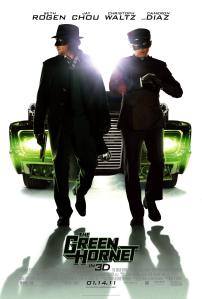
Michel Gondry’s “The Green Hornet” – The hero L.A. deserves?

Seth Rogen might just have found his niche playing detestable heroes. He gave a thoroughly entertaining performance as a psychopathic mall cop in Jody Hill’s pitch-black 2008 comedy Observe and Report, and indeed, his performance in Michel Gondry’s The Green Hornet bears some similarity. Both would-be heroes are infantile, petty, helpless around women, and prone to occasional bouts of alarmingly skillful violence. But while Observe was an unapologetic celebration of terrible people doing terrible things, The Green Hornet is ostensibly a light-hearted comic tale about a self-styled hero that’s meant to be worthy of our admiration.

Tonally, the film falls somewhere between Kick-Ass and Iron Man. Like the former, Britt Reid (Rogen) is delusional and borderline incompetent, but like the latter, he has all the physics-defying gadgetry he needs to keep himself alive for longer than 30 seconds. In the place of a mellifluous holographic A.I. to build his gadgets, Reid has a Q-ish tech wizard, kung-fu master, and expert barista named Kato (Jay Chou). Kato’s relationship with Reid fluctuates wildly between buddy comedy and guardian for a special needs child – a scene in which Kato explains to Reid why he might need a gas-slinging sidearm is one of the most painfully funny in the film. The audience is left wondering why Kato puts up with his boss’ constant abuse and mockery, but it might have something to do with his seemingly unlimited budget for high-tech toys. In any case, this is not a film for believable (or even comprehensible) relationships.

If The Green Hornet is about anything, it’s narcissistic image-obsession. Over and over again, the characters speak at length about how they look, how they are perceived by others in the story, and what the characters in a violent comic farce should do. Nearly all of the scenes featuring the villainous Chudnofsky (Christoph Waltz) play like cringe-inducing, metafictional peeks into the writers’ room. “Do I look scary? Is my gun scary? What do you think of my costume? Do you know how many different suits I’ve tried?” Chudnofsky may come with Waltz’s adeptly intimidating presence, but he has no real identity of his own, and feels almost like he is trying to conceive one in front of the cameras. But he’s not half as self-conscious and directionless as our heroes. In a line seemingly tailor-made for the film’s trailer, Reid explains to Kato, “Here’s what will make us different!”

Their grand plan is essentially to start a gang war and kill every criminal in the city. Brilliant in its simplicity, I suppose. But while Black Beauty, the tank-like super car, may allow the Hornet and Kato to viciously slaughter any evildoers with all the subtlety of Depression-era gangsters, it basically just feels like an old-timey and borderline magical version of the Batmobile. What’s more, their grand plan seems as likely to ensnare police and innocent bystanders as rival gangsters. This is Iron Man without a conscience. And strangely, that’s where the film started to appeal to me.

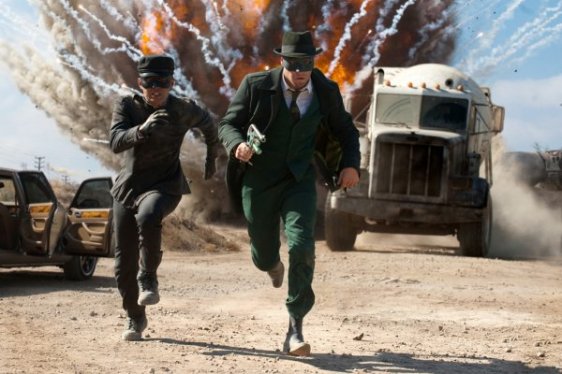
If there is one attribute that has defined nearly all modern superhero films, it’s self-importance. Even in the most schlocky and unwatchable incarnations of the genre (I’m looking at you, Fantastic Four), there are always ponderous questions about what it means to be a hero and how much is at stake if the hero fails. The Green Hornet has no such lofty ambitions, and I was surprised to find its sadistic playfulness and dark humor to be a refreshing change of pace. Nearly every scene in this film is simultaneously exhilarating and painful to watch on some level, from its farcical attempts at romance (for which I give a great deal of credit to Cameron Diaz) to its utterly balls-out action sequences, which are at least impressive on a technical level. They don’t all land perfectly, but I’m happy to see that director Michel Gondry (Eternal Sunshine of the Spotless Mind) remains as skillful as ever, even with a blockbuster budget. What’s more, he even managed to shoehorn in a dream sequence chock full of practical effects and camera trickery – a skillful display which felt mostly out of place, but by the time it appeared, I was past caring about the film’s lack of consistency.

The Green Hornet is an oddity, to be sure. I didn’t emerge from it without a laundry list of complaints, but I still found the sum of the experience enjoyable. Seth Rogen and Evan Goldberg’s script feels like it’s trying to be the buddy-comedy spiritual successor to Superbad, and it at least partially succeeds. The writing is very jokey and surprisingly dark, but exhibits a clear understanding of comic book tropes. In a genre that’s gradually starting to wear out its welcome, this bizarre spectacle of a film feels far more like a labor of love than a cynical cashgrab, and that might just be what makes it watchable.

FilmWonk rating: 5.5 out of 10

2010 Glennies, Part 1: Best Supporting Actress

#5: Keira Knightley – Ruth, Never Let Me Go

Still from "Never Let Me Go"
Spoiler warning: In order to discuss this performance, I must reveal the premise of this film, which some might consider a spoiler.
Mark Romanek’s Never Let Me Go was an absolutely haunting experience. The alternate-world tale of three friends who grow up to be harvested for their organs, this film doesn’t feel overtly like science fiction, but instead relies on a triumvirate of strong performances to convey the somber and limited lives these three must experience. Keira Knightley gives easily her strongest performance in years, conveying every bit of the jealousy, longing, and regret that this tragic character demanded. While the film’s love triangle was one of its weakest aspects, Ruth’s relationship with Kathy (Carey Mulligan) worked masterfully, and owes just much to Knightley’s supporting turn as to Mulligan’s strong lead.

#4: Delphine Chanéac – Dren, Splice

Still from "Splice"

Dren, the human-animal hybrid from Splice, certainly owes some of its effectiveness to makeup and visual effects, but I must nonetheless applaud this utterly fearless portrayal from French model/actress Delphine Chanéac. This creature must convey a huge range of emotions and instincts through expressions, tics, and growls, often during some pretty harrowing and horrific sequences. Like the residents of the uncanny valley, Dren seems irrevocably human, and yet even when her animal parts aren’t visible, she just seems…wrong. Chanéac lends just the right amount of humanity and intelligence while never failing to remind the audience, whether through a jerk of the head or a high-pitched whine, that this character is not and cannot be human. As a bioethical thought experiment, this film’s ideas are effective. With this performance, the film approaches disturbing near-realism.

#3: Chloë Grace Moretz – Mindy Macready/Hit-Girl, Kick-Ass

Still from "Kick-Ass"

As I said in the second FilmWonk podcast, I found Chloe Moretz’s performance as the psychopathic superheroine Hit-Girl to be downright unsettling. Not when she was hopping down a hallway dispatching gangsters with the same eerie speed and dexterity as Prequel Yoda, but when she was having sweet father-daughter moments with an utterly ridiculous Nicolas Cage. Through no fault or will of her own, Hit-Girl has been saddled with an upbringing not unlike that of a Rwandan child soldier, and the cringe-inducing warmth of these family scenes lends nicely to the film’s pitch-black satirical tone. Hopefully, Moretz won’t get saddled with the child-actor typecasting curse, as this is the second film in which she’s played a wildly unrealistic child prodigy. Physically and emotionally, this performance is nothing short of mind-boggling in its scope and commitment to the role, and firmly cements her as one of the finest young actresses working today.

#2: Amy Adams – Charlene Fleming, The Fighter

Still from "The Fighter"

Oh, what to say about Amy Adams? This is a fantastic performance in a mostly impressive filmography, made even more so by what a radical departure it is from her usual “sweet girl” persona. Charlene is, and I mean this with the utmost respect, a tough bitch. Her strong, confident demeanor proved a fascinating counterpoint to Mark Wahlberg’s understated performance of an overshadowed character, and the chemistry between the two was undeniable. But even outside the romance, Charlene is a fascinating character, and Adams gives just the right balance of confidence and vulnerability to what could have been a very one-note love interest.

#1: Jacki Weaver – Janine Cody, Animal Kingdom

Still from "Animal Kingdom"

Not since Heath Ledger’s Joker have I seen such an delightfully creepy villain as this. Jacki Weaver’s appearance as the Aussie gangster matriarch Janine Cody quite deliberately evokes a lioness dutifully guarding her cubs, but at the same time, Weaver’s intensity muddles the metaphor a bit as she seems poised to devour any family member that gets in her way. This performance is utterly magnificent, from her every little interaction with her sons and grandson to her dismissive taunts to law enforcement (“but I’m not afraid of you, sweetie!”). As I said in the podcast, this film is a slow burn, but it’s Weaver, the standout in a cast of strong performances, that makes this film such a compelling watch.

Honorable Mentions:

  • Dale Dickey as Merab in Winter’s Bone
  • Rebecca Hall as Claire Keesey in The Town
  • Michelle Williams as Dolores in Shutter Island
  • Mia Wasikowska as Joni in The Kids Are All Right
  • Rooney Mara as Erica Albright in The Social Network

Click here to see the rest of the 2010 Glennies.

2010 Glennies Roundup

It’s that time again… 2010 is over, and it was a surprisingly great year for cinema, especially given the rocky start and franchise-laden middle. I’ve seen movies great and terrible this past year, as well as some fantastic performances.

A note on exclusions… As I round up the films I’ve seen this year, there are always a few I meant to see, but didn’t get around to it. As of this writing, I have not had a chance to see the following films. I don’t know (and in some cases, doubt) if they would have made the top 10, but naturally they are ineligible:

  • The King’s Speech – An award-fodder period drama featuring Colin Firth’s usual awesomeness and a surprisingly chipper Helena Bonham Carter (watched since)
  • Four Lions – a terrorist comedic satire, perhaps this year’s True Lies or In The Loop? (watched since)
  • A Prophet – an epic crime drama
  • The Greatest – a somber romance
  • Micmacs – Jean-Pierre Jeunet’s whimsical take on Lord of War
  • The Lottery – a documentary on charter schools (watched since)
  • Valhalla Rising – Nicolas Winding Refn’s viking romp
  • Centurion – the latest from horror director Neil Marshall, who made a turn for the sword-and-sandals (watched since)
  • Dogtooth – A disturbing Greek drama (watched since)
  • The Tillman Story – A look back at the life and representations of famed American soldier, Pat Tillman
  • Let Me In – An unnecessary, but nonetheless good-looking remake of 2008 fave, Let the Right One In from Cloverfield director Matt Reeves.
  • Nice Guy Johnny – A straight-to-iTunes release from actor/director Ed Burns.
  • Blue Valentine – A strangely controversy-fueled romantic drama.
  • The Illusionist – An French animated film from a 55-year-old Jacques Tati script? I’m intrigued.
  • Monsters – First-time director and visual effects artist Gareth Edwards takes low-budget filmmaking ambition to shocking heights. By all accounts, this film was at least gorgeous-looking, despite not being this year’s District 9.

Also, Trash Humpers.

In the ensuing year, I sought to find a new symbol for the Glennies, but the blue Egyptian hippo began invoking ancient curses, so I’ll just have to leave him be. His name is Roger, and he is the official statuette of the 2010 Glennies. Enjoy!

2010 Glennie Awards


Egyptian Blue Hippo


Best Supporting Actress
Best Supporting Actor
Best Actor
Best Actress
Top 10 Films of 2010