FilmWonk Podcast – Episode #39 – “Labor Day” (dir. Jason Reitman)

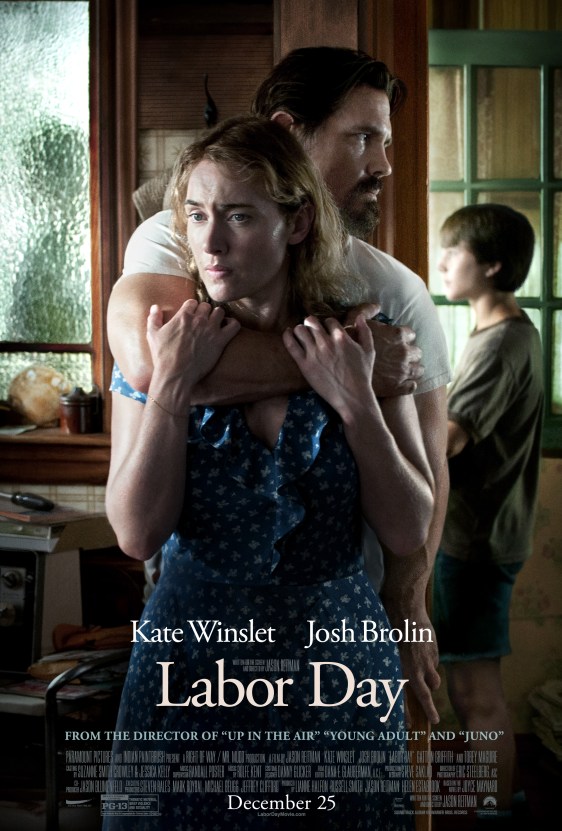
Poster for "Labor Day"

This week on the podcast, Glenn and Daniel dive into Labor Day, a surprising genre exercise from beloved director Jason Reitman, featuring Kate Winslet as a single mother who is taken hostage by – and finds herself falling for – an escaped convict named Frank Josh Brolin. Can a talented cast and filmmakers elevate a premise that seems, on the surface, to be the fodder of Nicholas Sparks novels?

We thought so – and we promise we’re not damning with faint praise. Check out our discussion below (42:32).

May contain some NSFW language.

FilmWonk rating: 7 out of 10

Show notes:

  • Music for tonight’s episode begins with “Criminal” by Britney Spears, and ends with Spanish guitarist Fernando Sor‘s “Exercises in B. Minor, Op. 35, No. 22” (as performed by Stephen Novacek) a variant of which appears on the Labor Day soundtrack. Why didn’t we use the version from the movie? Because it wasn’t available as a standalone track. Listen to the lovely guitar. And eat your vegetables. Punks.
  • Correction: Alexie Gilmore played Marjorie, Hank’s stepmother. Evelyn (the annoying neighbor) was played by Brooke Smith, best known from Grey’s Anatomy.
  • Correction: J.K. Simmons is indeed an insurance spokesman, but he represents Farmers Insurance, not Allstate (Dennis Haysbert) or State Farm (“Mayhem”/Dean Winters). As an advertising major, Daniel regrets the error.
  • Correction: It turns out 17-year-old Henry is actually played by a different actor, Dylan Minnette.

Listen above, or download: Labor Day (right-click, save as, or click/tap to play on a non-flash browser)

2013 Movie Catchup: “The Way, Way Back”, “The Conjuring”, “The Hobbit 2”

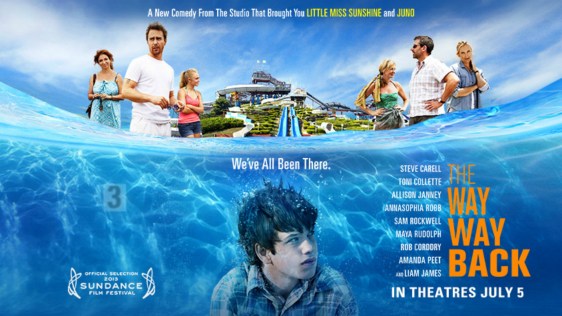
The Way, Way Back
Poster for

It’s not that The Way, Way Back is a bad film. But it really brings nothing new or interesting to the table. The film tries to succeed as a poignant coming-of-age tale, but really just feels like an exercise in dishonest nostalgia. Nearly every scene in this film is crafted in such a way as to glorify the motivations of its brooding, pure-at-heart teen protagonist, Duncan (Liam James), who I must admit is such a bland presence that I couldn’t even remember his name as I wrote this a day later. At all times, the film embraces his perspective, and while the awkwardness and pain of his dysfunctional family situation play with a modicum of plausibility, the details just seem a bit too perfect, like Duncan is the unreliable narrator spinning this particular yarn. Was his mom (Toni Collette) really this much of a doormat? Was the mom’s boyfriend Trent (Steve Carell) really this much of a monster? Was the genial water park manager Owen (Sam Rockwell) really this hilarious and likeable? Did Duncan really win the respect of some neighborhood hooligans (as well as the preposterously on-the-nose nickname “Pop’n’Lock”) in a dance contest scene right out of the 1980s?

Many of the performances above (with the exception of the lead) were quite nuanced and interesting, particularly that of Carell. But at no point does the film shake the sense that it’s just trying way, way too hard- whether to be a better coming-of-age dramedy like Adventureland, or at least a more interesting one like The Spectacular Now. And I doubt that’s the kind of nostalgia that The Way, Way Back wanted me to experience.

FilmWonk rating: 4 out of 10


The Conjuring
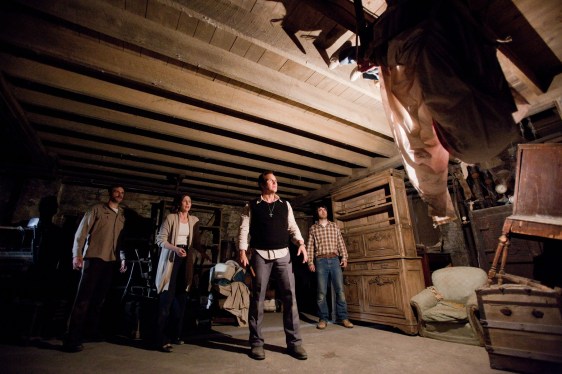
Still from

In the world of James Wan‘s The Conjuring, ghosts and demons are real, all of this was based on a true story, and Ed and Lorraine Warren (Patrick Wilson and Vera Farmiga) are a couple of well-meaning, true-believing, honest-to-God ghostbusters with actual powers to vanquish genuine supernatural phenomena. For some reason, the film’s insistence on its own historicity initially rubbed me the wrong way more than usual, perhaps because we almost immediately get a scene in which Ed and Lorraine have a discussion alone together, and we the audience learn that yes, they really do believe that they’re vanquishing demons. But the film’s lack of interest in questioning the credibility of the real-life “experts” is matched by its interest in establishing them as interesting characters.

In the end, what makes this movie work so well is not just Wan’s well-developed sense of how to construct a taut supernatural thriller, but Wilson and Farmiga’s performances and credible, long-term affinity – both for each other, and for the important work that they believe they’re performing. By the time the film ends, when Lorraine insists to Ed that God brought them together for a reason, it has earned the audience’s credence that the couple genuinely believes this. Their faith, for lack of a better word, is inspiring, even if the “true story” is bewitching, fictitious nonsense like any good haunted house story.

FilmWonk rating: 7 out of 10


The Hobbit: The Desolation of Smaug
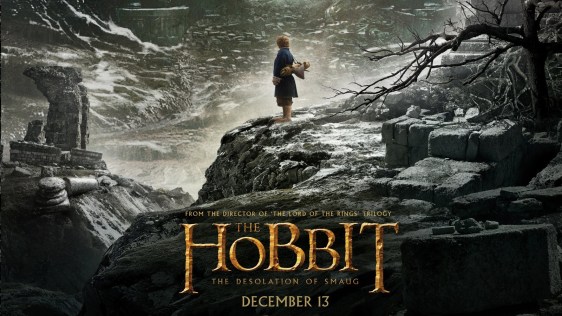
Poster for

I began my review of the thoroughly underwhelming first Hobbit film by questioning the need for its existence. But by the time the franchise’s equally lengthy second entry was near, I had not only come to terms with its existence, but I was weirdly, horribly excited for it. Whether the music, the 48fps 3D, the non-canonical addition of Legolas (Orlando Bloom) and a brand new elf-maiden named Tauriel (Evangeline Lilly), or the intense, shouty dude (Bard the Bowman, played by Fast and Furious 6 villain Luke Evans), something about this trailer got me right on board for it, and by and large, the film is a far superior entry to its predecessor.

It is still problematic in a number of ways. The dwarves – with the exceptions of Thorin (Richard Armitage), Balin (Ken Stott), Bombur (Stephen Hunter), and newly crowned heartthrob Kili (Aidan Turner) – remain interchangeable and undifferentiated as ever. The film’s insistence on sending away Gandalf (Ian McKellan) to fruitlessly poke at the mystery of the Dark Lord Sauron’s inevitable return is a complete waste of time – and when the film dispatched a septuagenarian wizard to the top of a mountain for a meeting that lasted literally two minutes, I couldn’t help but wonder if it knew exactly what the hell it was doing.

But this film did a lot of things right – by and large, it managed to make me believe it was making real progress toward telling a complete story. The action setpieces hung together much better this time. Everything surrounding the elven realm in Mirkwood – from the arachnid craziness on the way in, to the white-water rafting ride on the way out – was a ton of fun. And don’t let anyone tell you that Bowling With Bombur is any dumber than Legolas single-handedly dispatching an oliphaunt in Return of the King. Sometimes, a film just has to go a little crazy for the kids, and this sequence completely succeeded. As for the dragon Smaug (voice of Benedict Cumberbatch), I don’t have a lot to say, except that it was all very well-rendered, the scale of the sequence was impressive, and it ended with a bizarre thud. Despite an impressive performance by Evans, none of the Laketown sequence was well-established enough to make the stakes of the film’s ending (i.e. the town might soon be destroyed by a dragon) matter to me in the least. All it really made me do was lament the film’s criminal misuse of Stephen Fry, who is doing little more than a half-baked impression of Lord Denethor of Minas Tirith.

It would be easy for a non book-reader to look at the preceding paragraph as complete gibberish. And yet, this seems like a good time to point out the patent hypocrisy in many of The Hobbit films’ detractors. They criticize Peter Jackson in one breath for cynically inflating a 300-page children’s book into a meandering trilogy of films, and in the next, they can’t stand the notion of well-established characters from the existing Lord of the Rings universe stepping in to help round out the runtime and storytelling a bit. For the record, I thoroughly enjoyed the inclusion of pre-Gimli, dwarf-racist Legolas (and Evangeline Lilly feels like she was born to live in Middle Earth). But more importantly, I cannot and do not accept the notion that fidelity to half-remembered source material from one’s preadolescence is an intrinsic good. Are these bad films? Quite possibly. And feel free to blame Jackson and his team if you think so. But blame them for being poor screenwriters, not poor adapters. Because no matter how these films turn out, no one will come to your house and take away your dog-eared paperback copy of the source material. And we might just get something halfway entertaining out of this before the end.

FilmWonk rating: 6.5 out of 10
FilmWonk Podcast – Episode #38 – “12 Years a Slave” (dir. Steve McQueen)

Poster for "12 Years a Slave"

This week on the podcast, Glenn and Daniel witness the harrowing new film from director Steve McQueen, 12 Years a Slave, based on a memoir by kidnapped slave Solomon Northup (Chiwetel Ejiofor). Featuring one of the most sprawling and talented casts of the year, this film proved to be absolutely essential viewing. Check out our discussion below (53:09).

May contain some NSFW language.

FilmWonk rating: 9.5 out of 10

Show notes:

  • Music for tonight’s episode includes the tracks “Roll Jordan Roll” and “Solomon” from the soundtrack and score to the film. To hear the other Hans Zimmer track that came to mind during this film, check out “Time” from the original score to Inception.
  • The banality of evil” is a historical concept and phrase from Hannah Arendt‘s Eichmann in Jerusalem, and is not without controversy. Curiously, Northup expressed a similar idea near the end of his memoir, which can be read at the end of the NY Times article below.
  • Eric Herschthal wrote a fascinating article for the NY Times on the veracity of the memoir and real-life story: The Passion of Solomon Northup
  • The audio lecture series we referred to from The Great Courses is “The Other Side of History: Daily Life in the Ancient World,” from Colgate University history professor Robert Garland.

Listen above, or download: 12 Years a Slave (right-click, save as, or click/tap to play on a non-flash browser)

Alfonso Cuarón’s “Gravity” – Life in space

Poster for "Gravity"

Astronaut Matt Kowalski (George Clooney) has the rather annoying habit of mentioning, for no reason whatsoever, that he has a bad feeling about the Earth-orbital mission at hand. That he uses the non sequitur to introduce an endearing personal anecdote is probably small consolation to Mission Specialist Dr. Ryan Stone (Sandra Bullock), a first-time astronaut who feels like she’s inside a tumble dryer. The two of them are hurtling through space (inner space, really) on a repair mission for the Hubble Space Telescope when suddenly their high-speed platform becomes a shooting gallery of orbital debris. In the space of a few minutes, Hubble is destroyed, and Dr. Stone is sent tumbling into space.

The opening title card of Alfonso Cuarón‘s Gravity announces, in no uncertain terms, that life in space is impossible. And as hard as that is to believe in the glorious age of information and space exploration in which we live, the film does a marvelous job at conveying just how much we might be kidding ourselves with all this manned space travel nonsense. Every slender thread of survival that we latch onto as a species is useless in space. Food? Water? Air? Only what you take with you. Something’s coming at you- what do you do? Smack it away? Vacate its path? Every attempt at avoidance or deflection is dependent on your ability to exert force, and that ability is non-existent without gravity. Perhaps the most emblematic and disturbing image in the film is of an unlucky astronaut killed in the initial volley, who is left with a large, frozen, awkwardly-shaped hole straight through his facemask, skull, brain, and skull again – hit by a single giant bullet that passed all the way through his head like it wasn’t even there.

Force and gravity are the central setpieces of this film, and for the most part, the physics seem to be dead-on. If you hurtle someone through space, they keep going until something stops them. If you impact a structure in space, it doesn’t explode; it shatters, and every piece keeps right on floating or speeding in the same space and trajectory until some other force acts upon it. Apart from her own despair, Dr. Stone’s only nemesis in this film is Sir Isaac Newton. Possibly my sole complaint about this film is that there is a rather significant plot moment, about halfway through the film, that appears to abandon the laws of physics in the interests of drama. What’s more, there’s basically nothing I can else I can say about it that wouldn’t spoil a rather major event in the film. Suffice to say, it bothered me a great deal in the moment, despite my scientific mind coming up with a plausible (if a bit fanwanky) explanation after the film. I was a bit surprised to see the film resort to such a cliché at the expense of its own plausibility, but it is surrounded by enough well-realized physics and plotting that it certainly didn’t ruin the film*.

Still from "Gravity"

Sandra Bullock heartily defeated my skepticism in this film. I was not sanguine about her ability to carry a solo survival thriller, but she delivers an incredibly taut and tense performance. This character is broken on multiple levels before the film even begins, which makes her pursuit of triumph and homecoming that much more poignant as the film goes on. Much of the film’s imagery, right down to its stunning final shot, relies upon Bullock’s ability to convey this tension between hopelessness and survival, and she pulls it off masterfully. If there was ever a character with the proper temperament to be the sole survivor of a disaster, it’s this one – even if the actual body count will still be luck of the draw. George Clooney makes a welcome addition to the crew as charming, cocky flyboy Kowalski. If it didn’t involve such bulky costuming and wirework, this would be a role that he could play in his sleep. Kowalski is on his last mission before retirement (never a safe character move), but always maintains his composure and professionalism when the situation becomes dire. His radio interplay with Bullock works well, even as it becomes clear that simply being able to do the best possible thing in a bad situation might not be enough.

Gravity is not only one of the finest hard science fiction films ever made; it is a stunning treatise on the limits of human exploration and survival. Unlike a film like 127 Hours, which is better regarded as a treatise on human endurance, Gravity is a film in which simply “choosing life” is not enough. When you’re in an environment that is anathema to human survival, your choice must be accompanied by expertise, equipment, and a whole lot of good old fashioned luck.

FilmWonk Rating: 9 out of 10

*My spoilery physics complaint (highlight to view): When Stone was tangled up in the Soyuz parachute attached loosely to the ISS, Kowalski should not have continued to pull away from her after she had successfully halted him. Whatever force was supposed to be acting upon Kowalski in that moment was not made clear at all. Like a continuously decompressing aircraft with a hull breach (which made an unwelcome appearance only two episodes into Agents of S.H.I.E.L.D.), this is just a lazy violation of physics to heighten tension, and it really only works if your audience isn’t hip to it. This one definitely bugged me in the moment, but it was surrounded by enough good stuff that I wasn’t inclined to mark down the film for it. And I did manage to think of a plausible, albeit fanwanky explanation after the fact – if the ISS were in an uncontrolled rotation, Kowalski could be propelled away from it in the manner depicted.

Neill Blomkamp’s “Elysium” – Fakery in lieu of satire

Poster for "Elysium"

In the distant future, Earth is a polluted, overpopulated wasteland, no longer capable of supporting human life. A privileged few have managed to escape into the only place left for them – outer space. But something is amiss. Humanity is stagnant – out of balance. All of its resources benefit a privileged few. But soon, a lone hero will venture forth from his ruined home planet to save humanity from itself. And that hero…is a cute little robot named Wall-E.

I made the profound mistake of rewatching District 9 the day before seeing Elysium. The former, Neill Blomkamp‘s 2009 feature film debut, posits an alternate present-day in which aliens landed 20 years ago, and now exist in a beleaguered slum in South Africa. District 9 revels in cynicism, and does so quite effectively. As a viewer, I patted myself on the back in smug self-assurance that – yes, that’s exactly how terribly that situation would play out. In fact, it would probably be a lot worse. Elysium posits a similarly broken and unjust world, but does so in a manner that feels completely derivative (see Wall-E) and isn’t particularly effective at world-building or satire. The viewer must either accept Elysium as a straightforward piece of populist propaganda – without an ounce of self-awareness – or simply enjoy it as a film in which Mecha-Matt Damon blows a few things up. I tried to enjoy the film on one of these levels, but found each of them to be lacking.

Many of the film’s action beats felt like pale shadows of things I had already seen in District 9. This included a few identical weapons, but let’s face it, rail guns are cool enough to include twice. Unfortunately, in several cases, the action direction and cinematography have gotten noticeably worse. The moment Damon put on his cyborg exosuit, all of his fights turned into fast-cutting, incomprehensible blurs. Whatever blend of physical and virtual effects was in play here, it clearly didn’t work well enough that they felt comfortable showing it for more than a half-second at a time.

Much of the world building of the earthbound slum (or slumbound earth) worked fine, and some of it even approached decent satire. The overwhelming reliance on automated law enforcement (including a hilarious parole droid) definitely hits a few familiar notes for American audiences. The problem is that the satire is basically non-existent on Elysium – the titular space platform. There is no allegory in place here. Elysium is America, or at least the most wealthy Americans. And this isn’t the future – this might as well be now. This attitude is readily apparent from the film itself (and the director has confirmed as much himself), and it might have even succeeded as a passable allegory if not for the one crucial detail- the most alluring amenity of Elysium is a medical bed in every home that effectively and instantaneously cures any disease or injury. You read that correctly. The MacGuffin in this science fiction film…is a magical healing bed that grants immortality.

elysium-jodie-foster-photo

That’s it, folks. That’s when I checked out of this movie. Because if you’re the person who is withholding the magical healing bed from the rest of the world, you are evil, you are irredeemable, and you are utterly boring. Saddling strong performers like Jodie Foster and William Fichtner with such one-note villainy feels like a waste, despite both of their passable performances. And the less said about Sharlto Copley the better. He plays a neat (if slightly incomprehensible) psychopath, but he feels like a bearded retread of David James‘ psychopathic soldier from District 9. He likes killing, he’s good at it, and he’s in gleeful service of a corrupt regime. If the regime itself had been a bit more believable, I might have enjoyed this performance a lot more. Copley is clearly having a good deal of fun with it.

Elysium should have worked as a concept. There was much about this world that made me intrigued, made me curious… I wanted to know more about how the government of this place operated. I wanted to know more about its relationship with Earth. The platform clearly possesses either the military might or political capital to exert force on the planet below (at one time locking down the airspace of Los Angeles through sheer force of will). There is enough implied substance here that the film could easily have built out that relationship further, peppering in the small details that would have made it a credible world. Science fiction (or at least its marketing) used to be about making the audience “believe” something. You’ll believe a man can fly. You’ll believe a spaceship can fly to Mars. As a film intended to make me believe in an orbital platform for the super-rich, the film was a total failure. All it really made me believe in was a world broken so badly that the film’s pretense of a happy ending provoked nothing but a mirthless chuckle.

FilmWonk rating: 3 out of 10

FilmWonk Podcast – Episode #35 – “The Bling Ring” (dir. Sofia Coppola)

Poster for "The Bling Ring"

This week on the podcast, Glenn and Daniel find out how the other half lives, when the other half is a bunch of bored, extremely wealthy teenage criminals. If there’s one thing our intrepid heroes love, it’s a pleasant surprise, and Sofia Coppola‘s audacious examination of celebrity worship dovetailing into grand larceny definitely qualifies (36:39).

May contain some NSFW language.

FilmWonk rating: 7.5 out of 10

Show notes:

  • Music for this episode comes from the film’s soundtrack, including the tracks “Bad Girls” by M.I.A., and “Gucci Bag” by Reema Major.
  • We refer to an episode of the Slate Lexicon Valley podcast, an absolute must for language nerds. Check out the episode, which is entitled “Undocumented Illegals“.
  • In case you’re curious which film we were planning to see before the cell phone incident, I won’t promote it by mentioning its title here (and I’ve redacted it from the podcast), but the offending studio was Fox Searchlight.
  • The real-life players and criminal proceedings surrounding the Bling Ring are summarized on Wikipedia.

Listen above, or download: The Bling Ring (right-click, save as, or click/tap to play on a non-flash browser)

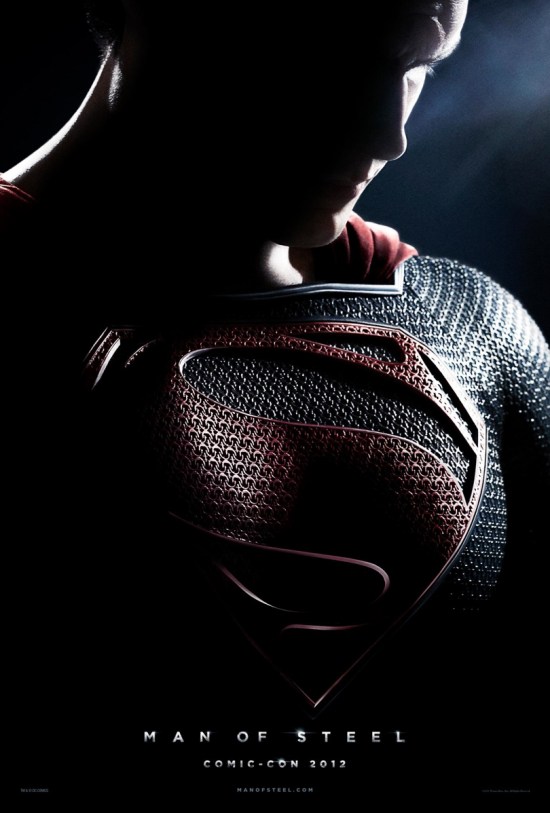
FilmWonk Podcast – Episode #34 – “Man of Steel” (dir. Zack Snyder)

This week on the podcast, Glenn and Daniel dive back into the rough-and-tumble world of Zack Snyder and Superman – two characters whose prior installments have given us a healthy dose of skepticism. Can the stewardship of Christopher Nolan bring all the brooding angst and box-office domination that this franchise needs? Find out after the jump (45:48).

May contain some NSFW language.

FilmWonk rating: 5 out of 10

Show notes:

  • Music for this episode is the rather ironically-titled “What Are You Going to Do When You Are Not Saving the World?“, from Hans Zimmer’s enjoyable and epic score.
  • Pa Kent’s first name is Jonathan. I don’t believe this was ever mentioned in the film.
  • Adam Quigley‘s “Antisocial Commentary” defense of Sucker Punch can be found on here on YouTube.
  • The good folks at BuzzFeed hired a consulting firm to estimate the costs and casualties – both direct and indirect – of Superman and Zod’s fight at the end of the film. The results: 129,000 dead, minimum. I misstated a couple of these figures on the podcast, so be sure to check it out for all the details.

Listen above, or download: Man of Steel (right-click, save as, or click/tap to play on a non-flash browser)

SIFF Review: “Celestial Wives of the Meadow Mari” (dir. Aleksey Fedorchenko)

Still from "Celestial Wives of the Meadow Mari"

Warning: As has become SIFF tradition, this review was typed and posted after midnight. The copy-editing and coherence may be a bit more lax than usual.

The Mari are an ethnic and religious group living primarily in a Russian republic 700 kilometers east of Moscow. And prior to learning of this movie, I had no idea they existed. Celestial Wives of the Meadow Mari could be seen as little more than a series of disconnected vignettes, but I found it to be a master class in short-form storytelling. The film uses the lens of 22 women, all of whose names begin with the letter “O” (and please don’t quiz me on them – even with 2 years of Russian under my belt, these names were utterly unfamiliar to me) to explore the customs, culture, attitudes, cuisine, and pastimes of the Meadow Mari. And did I mention that the Mari worship trees? Animism, paganism, naturism… There are elements of all sorts of nature-imbued faiths at work here, and a healthy measure of mystery, sorcery, gods, and demons. And did I mention this is not a documentary? Each of these stories is a work of fiction.

And it is in its treatment of fiction that the film absolutely shines. There is a quote, often attributed to Ernest Hemingway, that is allegedly the shortest novel ever written: For sale: baby shoes, never worn. This is the sort of densely poignant short-form storytelling that the film embraces. While the stories vary in length from around 2-7 minutes, some of the shorter ones are also some of the most powerful. In one segment, a bride and her friends are bathing in a creek on the eve of her wedding. At the top of the overlooking ravine, a lone girl leans against a guard rail – fully clothed, and whistling with a leaf. As the merry, naked romp continues down below, the groom-to-be approaches the guard rail from off-screen. He attempts to touch the hand of the odd girl out, and she responds with a simple “Don’t”, and resumes her whistling. Each of these stories has a beginning, middle, and end – even if we don’t see all of the pieces on-screen. This is not to say that I found the film completely coherent – there were a great many inexplicable moments and eccentricities that I couldn’t explain, due to my complete lack of knowledge of this entire people. And yet, there was never a moment that I found myself doubting that there was a reason for everything I was seeing on-screen – which had the effect of keeping me completely engaged throughout the film.

Still from "Celestial Wives of the Meadow Mari"

While we’re on the subject of films that take place in Russia, the filmmakers of A Good Day to Die Hard should pay particular attention to this point: if I can’t explain why any of the characters are doing what they’re doing for the majority of your film, it’s a huge potential problem. But Celestial Wives presents the perfect solution – an ensemble cast of characters who always know why they’re doing what they’re doing, and do a magnificent job of conveying that certainty to the audience. The Mari women are strong and powerful creatures, and they take center stage in this film. Their primary ambition is marriage and family, and yet it is clear that they sit in a position of particular power and reverence in this community. And what’s more, they are incredibly sex-positive and open in discussing their sexuality, which leads to a multitude of interesting moments. The film mingles desire and seduction with the group’s nature-focused religion (and sorcery) in ways that are alternately poignant, hilarious, disturbing, and at all times incredibly invigorating. One segment, in which a group of young women perform a ritual (seemingly) to both honor the dead and ensure that they find good husbands, they are interrupted by a group of…well, they appear to be young men…who slap a pig hock onto the table and say, without preamble, “Let’s play hoof.” I won’t say what “hoof” entails, but suffice to say, it is one of the most bizarre and hilarious sequences I have ever seen put to film.

Still from "Celestial Wives of the Meadow Mari"

How can I possibly discuss this film further? Since each of these segments tells a complete story that is nonetheless a part of a coherent whole, I find myself unable to even discuss my favorite segments without entirely spoiling them. To put it simply, this film is exhilarating – and prone to moments of staggering poignancy. While there were certainly some segments that I enjoyed more than others, there was not a single one that I found boring. The film’s open approach to sexuality raises a myriad of fascinating questions over the course of the film’s runtime, to say nothing of the role of this culture that has somehow managed to remain a band apart (culturally and religiously) for so many centuries despite being surrounded at all times by conflicting ideologies. And I know you. You might be bringing a few of those ideologies to the table yourself. You might not be eager to check out a film with not one, not two, but 22 strong female characters. But that’s okay. Well, it’s really not okay… But I can assure you that the cast also includes the fine, upstanding gentlemen below.

FilmWonk rating: 9 out of 10

Still from "Celestial Wives of the Meadow Mari"

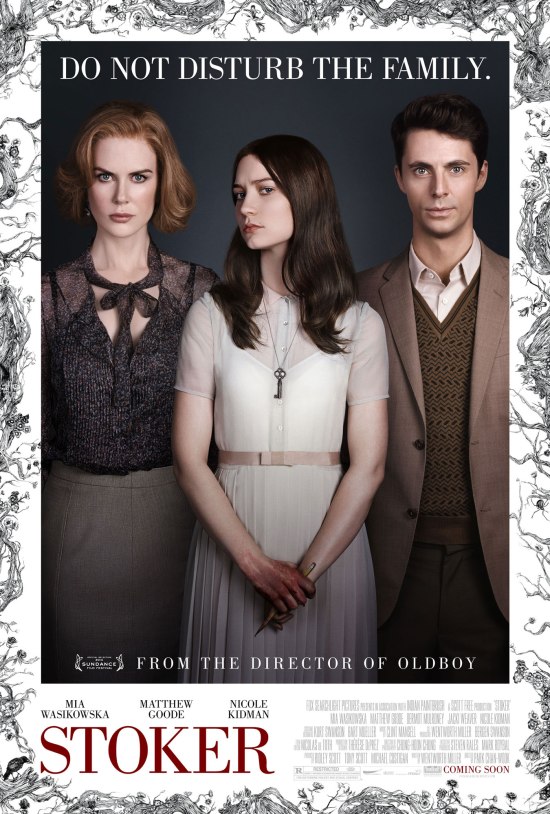
FilmWonk Podcast – Episode #33 – “Stoker” (dir. Park Chan-wook)

Poster for "Stoker"

This week on the podcast, Glenn and Daniel take a dour and disturbing journey into director Park Chan-wook‘s first English-language film, starring Mia Wasikowska, Matthew Goode, and Nicole Kidman. Can this bizarre, gothic fairytale rise to the levels of disturbing sophistication of Park’s beloved Vengeance trilogy? Listen below and find out! (34:48)

May contain some NSFW language.

FilmWonk rating: 7.5 out of 10

Show notes:

  • Music for this episode is the track “Uncle Charlie”, from Clint Mansell‘s original score.
  • Minor correction: When this film was shooting (September 2011), Wasikowska was 21 years old.

Listen above, or download: Stoker (right-click, save as, or click/tap to play on a non-flash browser)

FilmWonk Podcast – Episode #32 – “Warm Bodies” (dir. Jonathan Levine)

Poster for "Warm Bodies"

This week on the podcast, Glenn and Daniel check out the latest bizarre genre blend from writer/director Jonathan Levine, Warm Bodies. Can Nicholas Hoult leverage all of his acting prowess from the second series of Skins as a disaffected romantic zombie? Can Rob Corddry exhibit some alarmingly effective dramatic work with less than a dozen words of dialogue? Can a truly disgusting romantic premise wildly succeed? Find out below! (25:31)

May contain some NSFW language.

FilmWonk rating: 5 out of 10

Show notes:

  • Music for tonight’s episode comes from the Warm Bodies soundtrack, including Bob Dylan’s “Shelter From the Storm” and M83’s “Midnight City“.
  • The zombie augmented-reality running game that Daniel referred to was called Zombies, Run!.

Listen above, or download: Warm Bodies (right-click, save as, or click/tap to play on a non-flash browser)