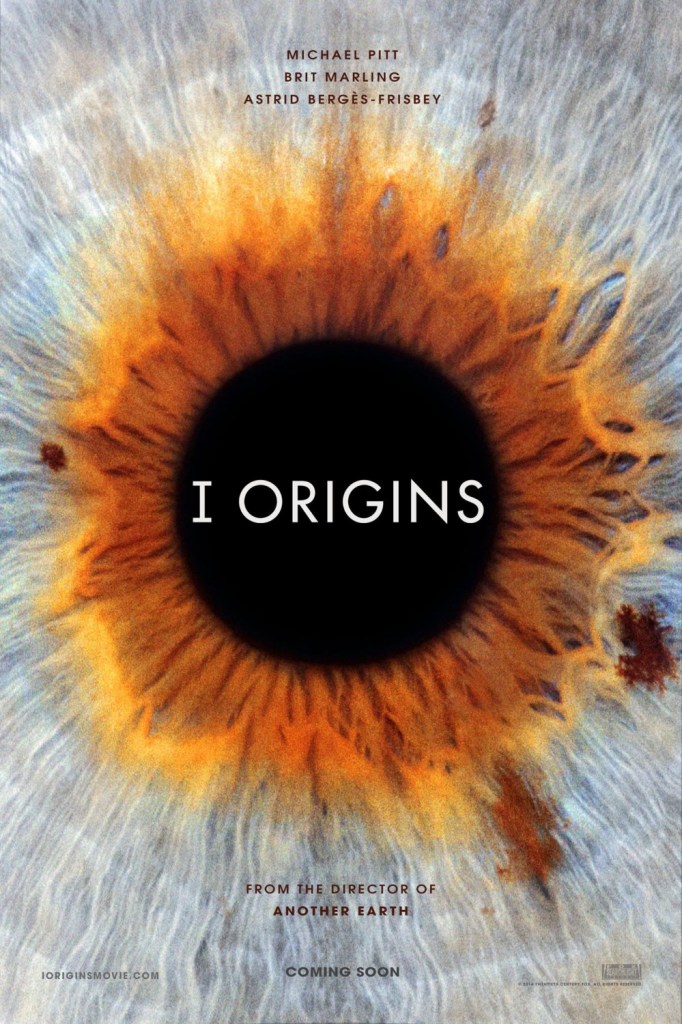
This review originally appeared as a guest post on 10 Years Ago: Films in Retrospective, a film site in which editor Marcus Gorman and various contributors revisit a movie on the week of its tenth anniversary. This retro review will be a bit more free-form, recappy, and profanity-laden than usual.
“If I drop this phone a thousand times, a million times…and one time, it doesn’t fall. Just once…it hovers in the air. That is an error that’s worth looking at.”
-“You’re so fucking stubborn.”
I’ll be honest; I’m not sure my eye has evolved enough in ten years to give me anything new to see in I Origins. You can consult my 2014 review or our spoiler-filled podcast discussion, as I did after rewatching the film this weekend, found that my opinion about the film itself has not substantially changed.
“I worry that some people will come away from I Origins believing that it has abandoned its post in the apocalyptic battle between science and religion – that after spending easily half the film with atheistic scientist Dr. Ian Gray (Michael Pitt) fastidiously attempting to model each of the evolutionary steps in the development of the human eye, the film veers off into more conventional territory. That by delving into the supernatural, the film strips away its ambitions and becomes yet another Hollywood-kumbaya tale of how we should probably all just get along and believe what we want. But based on the evidence presented in the film, this couldn’t be further from the truth.”
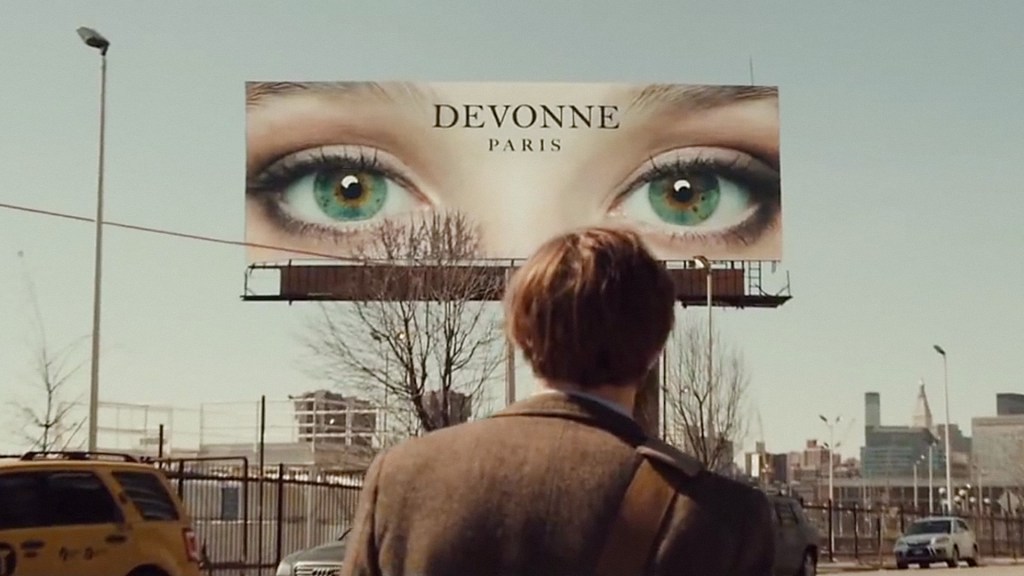
By and large, I still felt this way when the film was over. The battle rages on, but this film takes a nuanced position on it. The first act of I Origins is a whirlwind romance between Ian and Sofi (Àstrid Bergès-Frisbey), a vaguely defined spiritualist and model, which begins with an impromptu and nearly silent party hookup, continues with an oddly mystical Cinderella search in which Ian follows a string of coincidences and numbers (and eventually Sofi’s eyes on a billboard makeup ad) to the woman herself. Their relationship remains firmly in the honeymoon phase, presented in montage form, before reaching an abrupt end as Sofi gets suddenly and brutally bisected in an accident involving a malfunctioning metal box in her apartment building. This follows a fight in which the pair seems on the verge of breaking up, and Ian doesn’t come off particularly likable, and in a way, that’s what made the scene so effective? Freak accidents aren’t tidy or narratively satisfying – a terrible thing happens so fast you barely realize it, and then you realize it, and then you scream. Despite a heartfelt performance from Bergès-Frisbey and impressive, if perfunctory, chemistry with Pitt as her ontologically mismatched boyfriend, Sofi fits a dismissive mold that I still use all the time: “more concept than character”. I was critical of Sofi’s short shrift and fridging when I saw the film originally, but as Cahill’s next film Bliss would illustrate 7 years later, this is a filmmaker whose slightly muddy sci-fi ideas often land better with me than his storytelling and characterization.
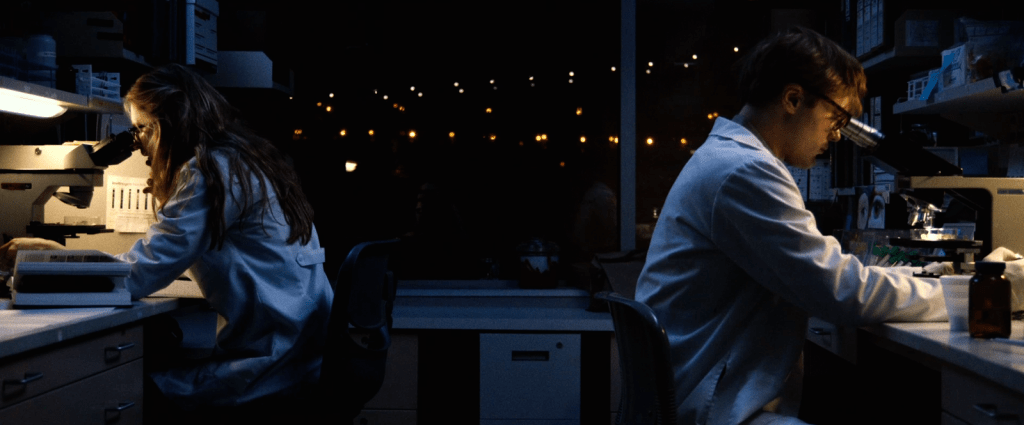
In I Origins, these ideas are initially voiced by smug atheist Ian, who literally pauses his search for Sofi to read Richard Dawkins at a bar (as if trying to give her a head start on not fucking him again). In his molecular biology lab, Ian seeks to understand the evolution of the human eye in order to provide a scientific rebuttal to the creationist notion of irreducible complexity, which posits that certain biological systems (like the eye) are so complicated that they simply couldn’t have evolved on their own without the guiding hand of God to make them do so. “Why are you working so hard to disprove God?” asks Sofi, and Ian clarifies that he has no interest in God – he’s just trying to fill in a gap in human understanding. Like every component of “intelligent design”, irreducible complexity is unpersuasive pseudoscience whose sole purpose is to give young-Earth creationist dogma a patina of intellectual rigor in order to be able to argue falsely in acquiescent Republican-stacked federal courtrooms that it is not a violation of the separation of church and state to force every teacher to tell every child that yes, Virginia, there is a Santa Claus. But more on that in a moment.
First, my priors. I was raised Christian. I spent many years in the church, and even went on missions to persuade others to forge a personal relationship with Jesus Christ. The beginning of the end of my religious years was like something out of a Pureflix script, as poorly explained by Kevin Sorbo: I went to college and attended a meeting of Campus Crusade, and I chatted with the other Christian boys about the origins of *gestures around* all of this. I asked how they squared the evidence for evolution and the age of the Earth with the existence of the God we both believe in, and I meant every word of it. I was trying to keep my religion, not continue losing it. We treated each other well. The conversation was kind, cheerful, and civil. We met each other as we were – ignorant young adults – and I heard arguments presented with love and sincerity ranging from “God made the universe and can use whatever tools He wants to make it run” to “yes, the Bible says it all happened in seven days, but who knows how long a day is in Heaven, God exists outside of time”, etc. This was a nice moment in my life in which imperfect humans came together with good intentions to explore ideas together. And I found the Christians’ answers so unsatisfying that it was the beginning of the end of my belief in God – or at least, my belief in any specific deity as a necessary or productive component for humanity’s ability to know and describe the Universe. I read books on biology and anthropology and geology and cosmology and astronomy and became an atheist so gradually that I hardly even realized I’d lost touch with the man upstairs. Fundamentally, I still believe in humanity’s capacity to be persuaded to change its ideas, because it happened to me and I’ve seen it happen to others. I know that one of my faults entering middle age has been the temptation to view myself in a static sort of way – I bask in a cozy feeling that because I’m comfortable in my own skin now, I always have been. I’m an imperfect rationalist! I look for the truth even if it’s difficult or complicated. I have my biases, and I can absolutely be wrong. And it’s been a hard ten years watching the world go insane.

After watching the unchecked march of the religious right in my country (including their baffling choice of Messiah, Donald Trump – who worships no god but himself) – I come back to I Origins and think to myself, “Alright, solidifying the evolution of the eye is an interesting argument. But who is it for?” Christian supremacists have shown that they have little use for evidence or ideological coherence as they consolidate their power. Dobbs, Burwell, and other court decisions have made it clear the degree to which the federal judiciary has become a Calvinball venue for rubber-stamping right-wing policy that they can’t achieve via other means, culminating in Trump v. United States, an ably named case in which the Supreme Court unconditionally surrendered on behalf of the country. To borrow a phrase from the angel Loki (Matt Damon) in Dogma, Christian fascists only need one argument: “Do it or I’ll fuckin’ spank you.” This loud and deplorable faction’s assault on institutions of knowledge and science has culminated in a know-nothing certainty that the loudest, richest assholes in the room know what’s really going on, blaming those people you already hate for every problem, including many that don’t exist, and eliding past the ones caused and exacerbated as a matter of policy by their own elected selves. And it has gotten worse. The GOP was smugly denying climate change for decades before they gained the power to literally make it illegal to mention climate change in Florida law and policy. They were trying to foist religion back into schools for decades before Louisiana passed a law requiring the Ten Commandments to be displayed in every classroom. And from coast to coast in this country, right-wing politicians spent the duration of a deadly viral pandemic watching millions of Americans die as they formed a deliberate, strategic alliance with the virus itself, and while some of them were punished for it electorally, it seems to have collectively exited the American psyche as we barrel toward reelecting the man who offered to cure what ailed us with bleach and sunshine up our collective asses. The storm rages on, and King Donald scribbles it away with a Sharpie. I’ve run afield of the film a bit, but I guess I’m just tired. In 2014, I regarded I Origins as Cahill’s full-throated allegorical endorsement of the scientific method as well as humanity’s capacity for reasoned discourse, and I loved the film for that. But that faith has become harder to maintain in the face of evidence that knowledge doesn’t matter nearly as much as power.
After a seven-year time jump, Ian goes on a book tour chronicling his successful work replicating the evolution of the human eye in a lab using genetically engineered worms, and when I first saw the film, I was fresh off watching all 3 hours of the debate between creationist Ken Ham and science communicator Bill Nye. There’s a moment near the end of this debate in which the men are asked what it would take to change their minds, and while the Ken Hams of the world are happy to tell you that they need no facts whatsoever to believe that the Earth was created 6,000 years ago by Almighty God, the Bill Nyes will still volunteer that all it would take to change their beliefs is one single piece of evidence. This same sentiment appears in the text of this film, placed in the mouth of both Ian and the Dalai Lama, and then it goes a step further: It presents Ian with evidence for persistence of memory and reincarnation after death – evidence he could simply choose to ignore, because the idea of his dead girlfriend’s soul finding a new corporeal home is preposterous, disturbing, and sad to him. But instead, he does the right thing: He pursues the truth even if it doesn’t agree with his prior assumptions. In a parable featuring a single fact which upends Ian’s understanding of science, he and his team choose to react in an admirable way: Let’s do more science! I maintained this rosy view of the film’s third act even as the science turned out to be poorly designed and yielded mixed results. Pro tip for anyone testing paranormal activity: keep your methods consistent and don’t call out “correct/incorrect” unless you wish to be branded a poor scientist. But at least they tried! And in performing their messy and imperfect science, they not only made the ending feel grounded in reality, but they unlocked a whole new branch of research which a mid-credits scene all but confirms reflects reality in the film’s world.
Conversely, it’s fair to say that reality in our world has soured I Origins for me a bit. The film’s world can remain rosy because it doesn’t need to persuade me of what might change as a result of this discovery – it merely needs to maintain internal consistency. Ian’s proof (or rather, well-designed experimental model) of the evolution of the human eye would probably attract little notice in real life. And in the event it were noticed and perceived as a threat, I know there is an entire propaganda ecosystem which could be deployed to pillory, dox, threaten, and swat this man until he stops talking about it, just as it has been used against every other enemy of the religious right, from pediatricians to beer spokesmodels to climate scientists to IRS agents. I’m even further removed from the church that raised me than I was in 2014, but I still remember what I saw there: A few weirdos, a few kooks, a few fanatics… but mostly just…people. Ordinary people forming community with their neighbors, living their lives, and doing their best with what they had. I don’t really think all or even most religious people are fascists, dogmatic, or unreasonable – and I would regard it as a personal failure if I ever came to believe this, even as our government continues to operate lopsidedly in favor of that fringe minority, and a reliable percentage of Christians turn out to vote Republican no matter how violent or depraved the resulting governance turns out to be. I really hope I’m right to maintain my faith in people. I hope the ones who love the Lord Their God with all their hearts, souls, and minds will try to remember to engage those faculties – as should the rest of us, for whatever value they hold as metaphors for what makes us human. I hope history will swing back in a direction where facts and science matter more than holding up a Bible you haven’t read and cutting rich people’s taxes. Perhaps when that happens, I can have fun with a rip-roarin’ science vs. religion debate again.


 FilmWonk