FilmWonk Podcast – Episode #44 – “Divergent” (dir. Neil Burger)

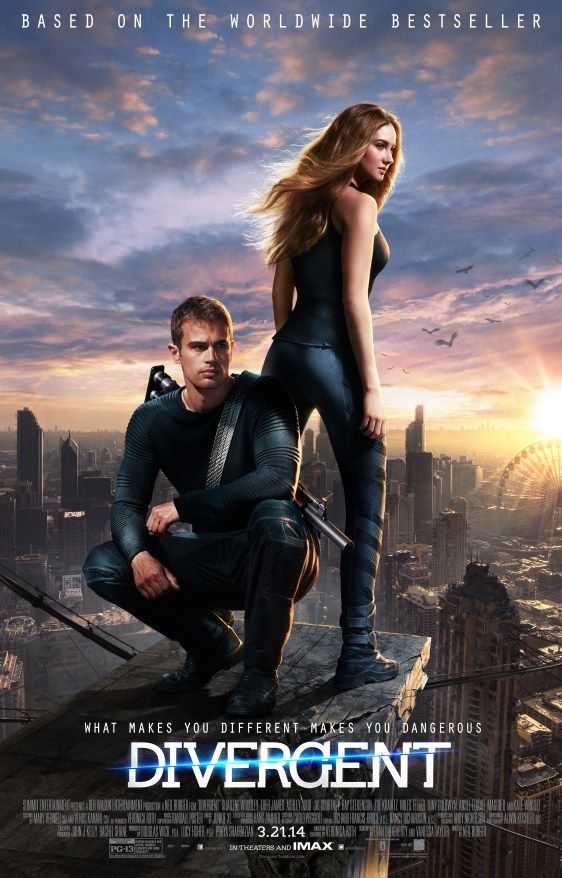
Poster for "Divergent"

This week on the podcast, Glenn and Daniel take another angry departure from their original screening plans to check out the latest pretender to the Hunger Games throne, Divergent. Will Shailene Woodley prove a worthy contender, or will she be taken out with slings and arrows in the first round? Find out below (37:40).

May contain some NSFW language.

FilmWonk rating: 5 out of 10

Show notes:

  • Music for tonight’s episode is “Beating Heart” by Ellie Goulding
  • and “I Won’t Let You Go” by Snow Patrol, both from the film’s soundtrack.

  • CORRECTION: It is Lake Michigan, but the Chicago pier in question is called “Navy Pier”, not “Fisherman’s Wharf” (the latter of which is in San Francisco).
  • Yep, there will be a Divergent sequel. It was greenlit after one day in theaters.

Listen above, or download: Divergent (right-click, save as, or click/tap to play on a non-flash browser)

FilmWonk Podcast – Episode #43 – “The Grand Budapest Hotel” (dir. Wes Anderson)

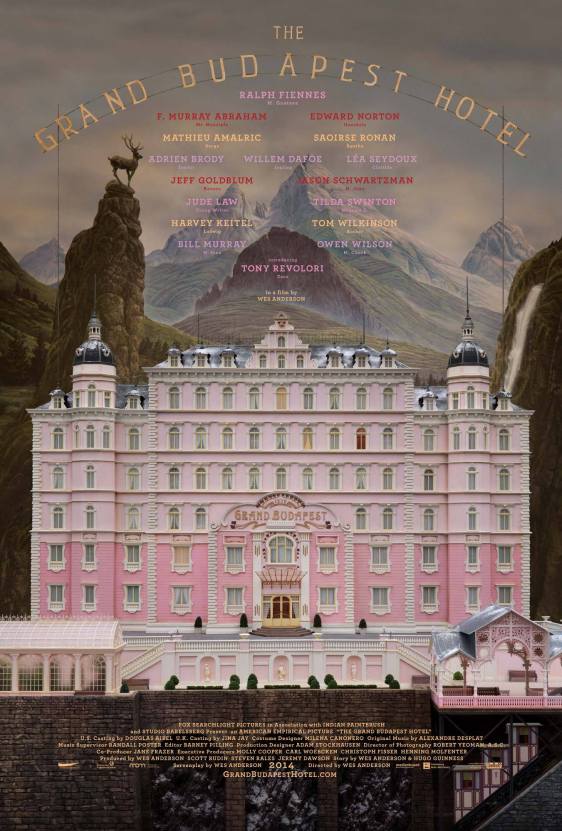
Poster for "The Grand Budapest Hotel"

This week on the podcast, Glenn and Daniel take a deep dive into historical whimsy in Wes Anderson‘s latest film, The Grand Budapest Hotel (34:00).

May contain some NSFW language.

FilmWonk rating: 8 out of 10

Show notes:

  • Music for tonight’s episode was the track Canto at Gabelmeister’s Peak, from the film’s original score by Alexandre Desplat.
  • Correction: The conversation between Jude Law and F. Murray Abraham takes place in the 1960s, not the 1980s.
  • We referred to the historic Empress Hotel in Victoria, B.C. as a visual reference for this film. According to Wikipedia, two real hotels in Hungary and the Czech Republic were influences, as well as archive images from the Library of Congress.
  • Alas, my epidemiological French vocabulary isn’t what it used to be… Grippe is the French word for influenza, not measles.
  • The term “bellhop” does indeed come from a slightly demeaning etymology. “Hop to it, I rang a bell” is an accurate summary of its origins.

Listen above, or download: The Grand Budapest Hotel (right-click, save as, or click/tap to play on a non-flash browser)

Rob Thomas’ “Veronica Mars” – We asked for it…

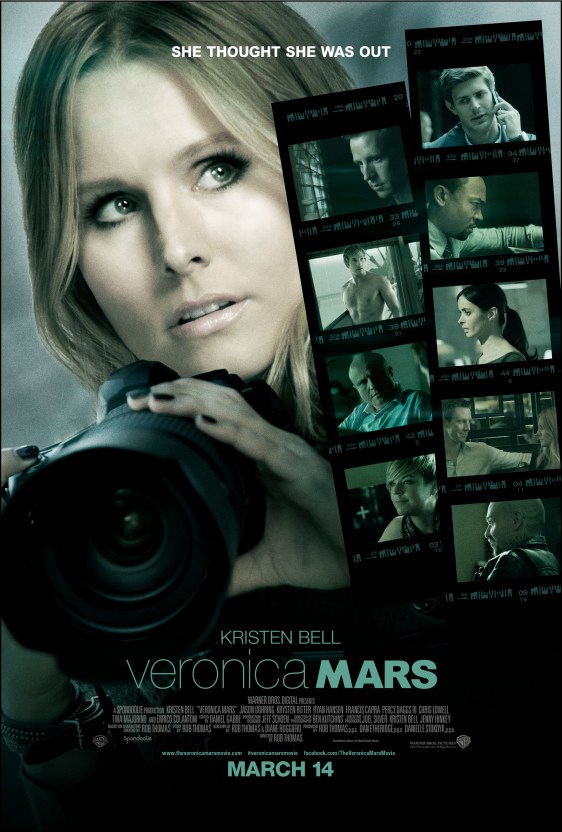
Poster for "Veronica Mars"

As a member of the reviewing press, I sometimes get the chance to see films early, for free, or both. And like most critics (perhaps despite Kevin Smith‘s objections), I’ve never felt the need to declare this as a potential conflict of interest. But in this case, it seems incumbent that I mention I was a backer of the Veronica Mars Kickstarter project, a curious experiment in online crowdsourcing in which a bunch of fans of a little-watched rag-tag TV show decided to make a $5.7 million charitable donation to Warner Bros, a film studio that had $12 billion in revenue last year, and which probably spends that amount at Starbucks every week. I don’t raise this point to object in any way to my participation in the Kickstarter, nor to raise any doubts that its runaway success was the proximate cause of this film’s existence. But this is still a surreal new frontier for film production, and as both a financial backer of the film and a fan of the original UPN TV show, I must admit that I’m doubly unqualified to review this film with any objectivity, and should probably recuse myself from the discussion. Now that we’ve gotten that out of the way, I’ll go ahead and review the film anyway!

Veronica Mars (Kristen Bell) is a former high school film-noir detective who returns to her hometown, the fictitious Neptune, CA, to help out her once and future boyfriend Logan Echolls (Jason Dohring), who has just been charged with the murder of his pop-star girlfriend, Bonnie DeVille, who is played in archive footage by Andrea Estrella, but is a conversion in both name and actress from original-series character Carrie Bishop, played at the time by Leighton Meester.

Confused yet? For the most part, you shouldn’t be. The connections to the original series seem almost purposefully tenuous. The film attempts to engage new viewers immediately with a quick recap of the major characters and accompanying voiceover from Bell. Like Serenity before it, this opening sequence sets the stage adequately while dispensing with most of the unnecessary backstory. Those few superfluous details that make it in from the show are little more than throwaway lines (remember when Logan’s father murdered his teenage girlfriend?), and merely serve to effectively build out the world of the film. Logan is a mostly reformed bad-boy, son of a disgraced (and deceased) movie star, and apparently on leave from an unspecified branch of the US Military. Veronica is a smart, capable, and occasionally ruthless woman who made it out of her corrupt (and filthy rich?) hometown to become a hotshot would-be attorney in New York City. And several other characters – Wallace (Percy Daggs III), Mac (Tina Majorino), and current boyfriend Stosh ‘Piz’ Piznarski (Chris Lowell) – seem unfortunately relegated to “old friend” status. We learn almost nothing about them, and they unfortunately contribute very little to the story. The same cannot be said for Veronica’s father, Keith Mars (Enrico Colantoni), who is a welcome and capable presence. The father-daughter dynamic is clear and unmistakable – and the tension as she asserts her adulthood and independence is both heartwarming and funny as the film goes on.

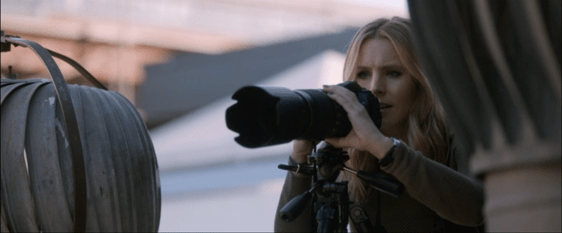
Still from "Veronica Mars"

All in all, the mystery was effective. To be honest, I was all set to call it “fun but predictable” before the last half hour rolled around, but the film takes many effective turns and crafts an elegant, if slightly hasty, solution to the Logan Echolls murder dilemma. I could mention several effective performances (including a stunning monologue by a talented and underused character actress – click here if you really want to know who I mean), but it honestly feels like a spoiler to even mention which performances spoke to me the most here. So I’ll just confine it to one: Kristen Bell herself. The most surprising adjective I could apply to the original property is “gritty”, especially when the protagonist is a high schooler. It takes an actor with an appropriate blend of intensity, humor, and (I daresay) vulnerability to pull off such a character, and Bell unambiguously owns the personage of Veronica Mars from the first frame.

Unfortunately, there is one problematic character in this film – the town of Neptune, CA itself. The film attempts to deliver a severely abridged rendition of The Wire, setting up a town with a corrupt police force (led by Jerry O’Connell) and a cycle of criminality that unrelentingly sucks good people back in. Much of this corruption centers around reformed gangbanger Eli ‘Weevil’ Navarro (Francis Capra), whose friendship with Veronica began when he smashed her headlights and threatened her life in the first episode of the series, and continues now that he has a wife, daughter, and legitimate business. This was always one of the most interesting characters on the show, and I regret to say, without that backstory to prop this character up, the film doesn’t earn the arc that it attempts to shoehorn in through about 10 minutes of total screentime for Navarro. And this wouldn’t be nearly so problematic if his arc didn’t inform Veronica’s decisionmaking so directly. Veronica’s central dilemma, of whether to move on to her high-profile job in NYC or stay and try to reform her broken hometown, feels like too big of a decision to resolve within the confines of a two-hour film that has its own story to contend with. The film seems to be trying to have its cake and eat it too, tying up and expanding the arc of the original series, while telling a higher-budget, self-contained, and PG-13 profanity-laden mystery story at the same time.

But I suppose that’s fine. A TV series continuing as a film always feels, to a degree, like expanded-universe fan-fiction. It simultaneously gives the fans what they want, and serves as a re-pilot for a series that will almost certainly never exist. And the more I describe this method, the more it reminds me of the aforementioned Serenity, another TV-show follow-on that I think handled its expanded universe slightly more effectively than Veronica Mars without feeling quite as beholden to the events of the original series. I enjoyed this film. And you should take that opinion for whatever it’s worth. And given the dearth of great standalone detective stories in the modern era, I suspect that a non-viewer of the original series would still get a great deal out of this. But can you trust me on that? Hell if I know. I’m just a marshmallow.

FilmWonk rating: 7 out of 10

FilmWonk Podcast – Episode #42 – “3 Days to Kill” (dir. McG)

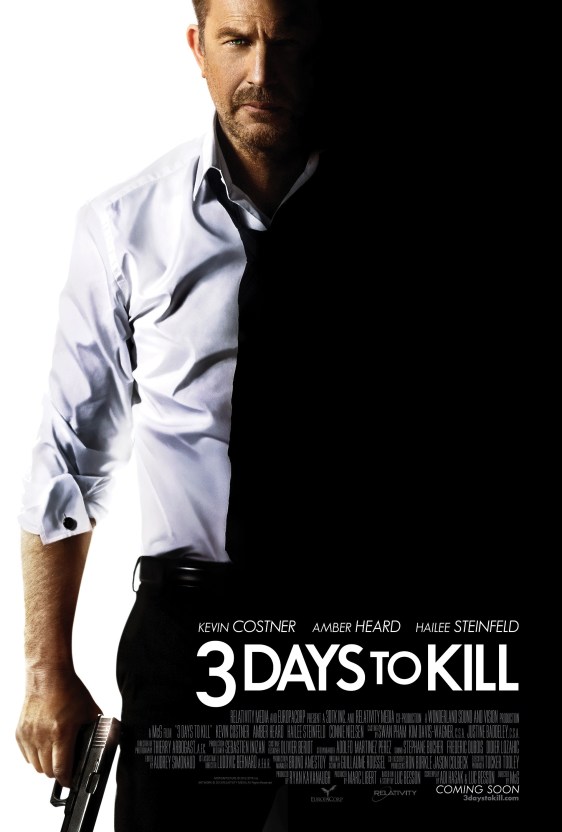
This week on the podcast, Glenn and Daniel bear witness to Luc Besson’s latest take on “An Aging American Action Star in Paris”, featuring Kevin Costner in 3 Days to Kill.

Spoiler alert: We’re not shy about our disdain for this film, and we are a bit more lax than usual about concealing plot details.

Check out our discussion below (28:58).

May contain some NSFW language.

FilmWonk rating: 2.5 out of 10

Show notes:

  • Music for tonight’s episode features Edith Piaf‘s “Non, je ne regrette rien”, and MC Solaar‘s “Sauvez le monde”.
  • Sarah Silverman was indeed credited as “Raving Bitch” in the 2000 Christopher McQuarrie film, The Way of the Gun. She appears directly below another actress credited as “Sloppy Prostitute”.
  • We also referred to a 2002 film featuring Anthony Hopkins and Chris Rock working for the “Dumb CIA”- that film was Bad Company, directed by Joel Schumacher (not Besson).
  • I couldn’t find a French legal citation, but I was able to find several references to the French squatters law, all quite similar in that they suggest that squatters cannot be evicted in winter. More info on EU squatting law here.

Listen above, or download: 3 Days to Kill (right-click, save as, or click/tap to play on a non-flash browser)

Movies, Podcasts, Kevin Costner, 3 Days to Kill, Luc Besson, McG, Amber Heard, Hailee Steinfeld

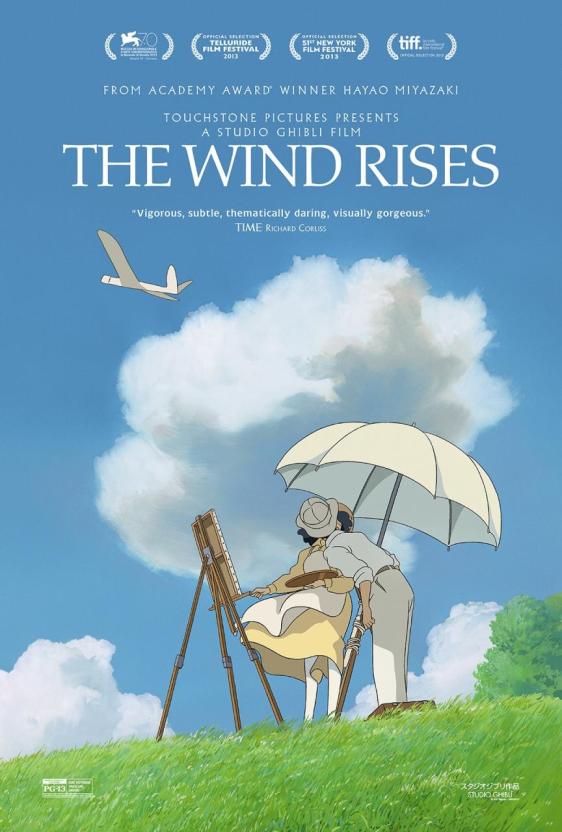
Hiyao Miyazaki’s “The Wind Rises” – Dream, invention, and responsibility

Poster for "The Wind Rises"

Editor’s note: This screening featured the US edition of the film, dubbed in English.

The first act of Hiyao Miyazaki‘s The Wind Rises, allegedly the director’s final film before retirement, contains many jarring transitions between childhood dream and reality. The young Jiro (voice of Zach Callison) dreams of becoming an aeronautical engineer at the dawn of aviation itself. Certainly, the technology would soon see its first use in global warfare, but at the dawn of the 20th century, it remained the stuff of fantasy and legend. The first airplane that we see is Jiro’s confabulation of something halfway between a World War II Japanese Zero and the split feathers and slowly flapping wings of an eagle or hawk. It is a gorgeous, mighty, preposterous thing – and young Jiro can’t stand the notion that his Harry-Potter-worthy spectacles will prevent him from ever being able to fly one himself. This fantasy is presided over by Italian aerial pioneer Giovanni Caproni (Stanley Tucci), or at least a magical caricature thereof, who is happy to stroll up and down the wings of his ridiculous six-winged creations, or jump off to a running stop in mid-flight.

These dream sequences are exhilarating, to be sure, but the transitions between dream and story were often accompanied by jarring shifts in tone and a lack of clear separation, to the point when adult Jiro (Joseph Gordon-Levitt) is caught in a monstrous earthquake and fire while traveling on a train to university, it is not immediately clear whether the towering, apocalyptic inferno that scorches the sky and countryside is real, or another imagined construct. But it quickly becomes clear that this is a very real event.

From this point on, what we’re seeing is a heavily fictionalized biopic of Dr. Jiro Horikoshi, the eventual designer of the Mitsubishi A6M Zero, a high-speed fighter that would be the scourge of the Pacific campaign during World War II, widely regarded as one of the finest pieces of aeronautical engineering ever produced for its time. But this Jiro is not the architect of a weapon of war; he’s just madly in love with airplanes.
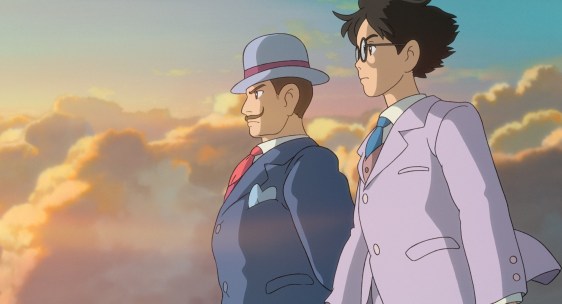
Still from "The Wind Rises"

The film broaches this theme quite explicitly in the imagined conversations between Jiro and Caproni. The Italian begins by telling Jiro that airplanes are not weapons of war, and that he dreams of eventually using them to ferry passengers and unite the world through travel. At this point, the audience is free to reject this sentiment as wildly absurd and disingenuous, as both Jiro and Caproni’s employment is at the behest of their governments, who were on the eve of engaging in expansionist warfare. And yet, even with the benefit of hindsight, The Wind Rises succeeds as a highly personal and humanized take on the age-old science fiction theme of whether an inventor is ultimately responsible for what his dream and invention might be used for. Aviation can unite mankind, or empower its capacity for mutual destruction. Nuclear energy can power a city, or destroy one. Many of our most valued technologies would not exist if not for their invention in the service of war. But this is really only the beginning of the film’s treatment of this theme.

The characters – both Jiro himself – tasked with building fighter planes, and his friend and colleague Honjo (Jon Krasinski), tasked with designing heavy bombers – seem quite aware that their inventions will be put to destructive use. But they just can’t help themselves. They collaborate and share ideas. They consume and improve upon technology with a ravenous passion. And the film essentially glorifies this drive to innovation. If The Wind Rises has a technological thesis, it is that invention is morally neutral at worst, and glorious at best, regardless of its eventual purpose.

In another imagined conversation, Caproni eventually asks Jiro if he would rather live in a world with or without pyramids. This is a curious question. Pyramids could be regarded as a one of the great, wondrous achievements of mankind – echoing their greatness with their endurance through the ages. Or they could be regarded as a monument to squandered resources and lives for no greater purpose. Much like warfare itself. It can be for glory and progress, but it will be for death and destruction. The Wind Rises is clearly in the former camp – air travel is a great wonder of mankind, and the film depicts each grand aerial vehicle as a larger-than-life, incredible machine – even some of the confabulated terrors from Jiro’s early dreams (including a massive zeppelin dropping vaguely human-shaped bombs) are impressively depicted. Jiro sets out to build a sleek and speedy fighter, and he tests it initially without a single gun, bomb, or bullet on board. If he has any nationalism within him, it is absent in this depiction. He just wants to build a beautiful plane. It is a fascinating theme – and one that the film explores with impressive depth, despite its rather perfunctory treatment of the ensuing war.
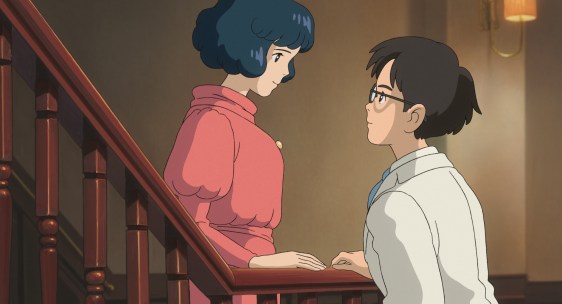
Still from "The Wind Rises"

In fact, Jiro experiences two sad and beautiful love stories – the first with his planes, and the second with his long-time love, Naoko (Emily Blunt). After meeting at a young age during the earthquake, the two carry on a lengthy courtship that eventually blossoms into an enduring romance. This relationship is really only given time to breathe in its later years, but it conveys some remarkably tender moments between the two. This relationship, like that of Jiro and Honjo, is depicted mostly from Jiro’s own perspective. Naoko is offscreen for the majority of the film, and yet, as the story advances through the years, the couple’s history convincingly hangs over their every interaction. And while this love story exists as a separate force and feeling from Jiro’s own drive toward designing the perfect plane, the two romances often mingle in interesting ways. A late scene depicts Jiro working at his drawing desk while Naoko rests on the floor beside him. He operates his slide rule with one hand while tenderly clutching Naoko’s outstretched palm with the other. It is a sweet moment, and one of many for this pair.

Once the film gets into Jiro’s story, it really finds its footing – but this is after a very rough first act in which it quotes a French poem so many times that it begins to lose all meaning both as the source of the film’s title, and as its explicitly stated theme. Le vent se lève, il faut tenter de vivre. The wind is rising, we must try to live. This poem is broad enough that it could be taken to endorse basically any position. But given that it is followed by the aforementioned earthquake and inferno, its application in the film seems clear and deliberate. Chaos, death, and destruction will ensue no matter what you do, and the best you can do is to live your life and try your best to do something valuable. But try not to think too hard about how you might be contributing to that first thing. I don’t wish to belabor this point, but the film invites this sort of introspection by essentially glossing over both the ultimate fates of several characters, as well as the entirety of World War II. It screeches to a halt and fast-forwards to the end of the war, and we see another charred countryside, identical to the one from earlier in the film (and evocative, perhaps deliberately, of another Studio Ghibli film, Grave of the Fireflies). And perhaps that’s what it all added up to in the end. The first conflagration was the accidental product of a natural disaster. The second was a deliberate invention of mankind. Another great and wondrous thing, crafted for the ages.

Ultimately, despite its bumps, The Wind Rises is a mature and thoughtful tale. It offers a treatment of scientific progress as a pure and desirable dream, even if it is sometimes driven by impure or destructive motives. The dreamers won’t be around forever – but their dreams live on, one way or another.

FilmWonk rating: 7.5 out of 10
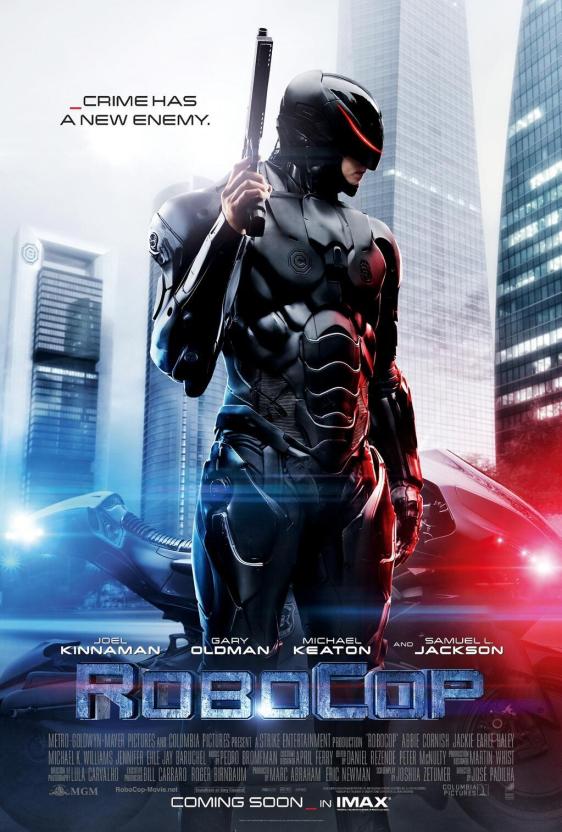
FilmWonk Podcast – Episode #41 – “RoboCop” (dir. José Padilha)

Poster for "RoboCop"

This week on the podcast, Glenn and Daniel are pleasantly surprised by another unnecessary remake of a 1980s film that manages to be a little bit more than the sum of its parts.

Check out our discussion below (49:00).

May contain some NSFW language.

FilmWonk rating: 6.5 out of 10

Show notes:

  • Music for tonight’s episode includes the track “First Day” from the RoboCop (2014) soundtrack, composed by Pedro Bromfman. It also includes a brief snippet from the original 1988 RoboCop theme song, composed by the late, great Basil Poledouris. I kept this cut brief because the soundtrack is out of print, so I was unfortunately unable to find a decent digital copy of the original track.
  • Read the full FilmWonk review of Elysium here.
  • We made a brief reference to philosopher Jeremy Bentham‘s concept of the Panopticon – you can read more on Wikipedia if you’re interested in the topic.
  • In case we lost anyone with our brief discussion on neurology and freewill, here is a quick rundown from Dr. Steven Novella at the NeuroLogica Blog regarding a 2008 study illustrating the decision-making phenomenon that we described:

    “The subjects were not necessarily consciously aware of their decision until they were about to move, but the cortex showing they were planning to move became activated a full 7 seconds prior to the movement. This supports prior research that suggests there is an unconscious phase of decision-making. In fact many decisions may be made subconsciously and then presented to the conscious bits of our brains. To us it seems as if we made the decision, but the decision was really made for us subconsciously.”

Listen above, or download: RoboCop (right-click, save as, or click/tap to play on a non-flash browser)

FilmWonk Podcast – Episode #40 – “The Lego Movie” (dir. Phil Lord and Christopher Miller)

Poster for "The Lego Movie"

This week on the podcast, Glenn and Daniel tackle the latest piece of zany versatility from Phil Lord and Christopher Miller, The Lego Movie.

Check out our discussion below (22:41).

May contain some NSFW language.

FilmWonk rating: 8 out of 10

Show notes:

  • Music for tonight’s episode includes the delightfully satirical tracks “Everything is Awesome” and “Untitled Self Portrait” (Batman’s song) from the film’s soundtrack.
  • The budget for The Lego Movie is officially $60 million, notwithstanding the “Hollywood math” constraints we mentioned. For more on this, check out Edward Jay Epstein‘s book, The Hollywood Economist. For reference, “the last couple of Pixar films” had official budgets of $185 million (Brave) and $200 million (Monsters University) respectively.

Listen above, or download: The Lego Movie (right-click, save as, or click/tap to play on a non-flash browser)

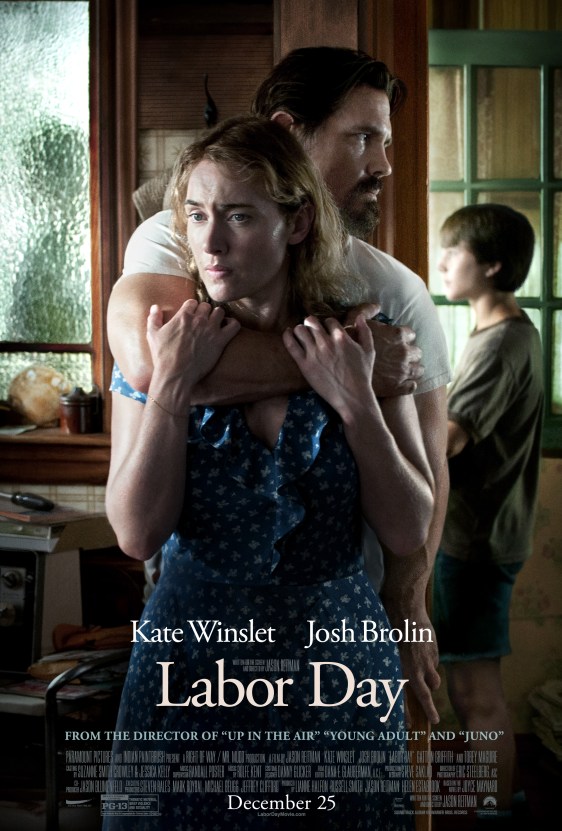
FilmWonk Podcast – Episode #39 – “Labor Day” (dir. Jason Reitman)

Poster for "Labor Day"

This week on the podcast, Glenn and Daniel dive into Labor Day, a surprising genre exercise from beloved director Jason Reitman, featuring Kate Winslet as a single mother who is taken hostage by – and finds herself falling for – an escaped convict named Frank Josh Brolin. Can a talented cast and filmmakers elevate a premise that seems, on the surface, to be the fodder of Nicholas Sparks novels?

We thought so – and we promise we’re not damning with faint praise. Check out our discussion below (42:32).

May contain some NSFW language.

FilmWonk rating: 7 out of 10

Show notes:

  • Music for tonight’s episode begins with “Criminal” by Britney Spears, and ends with Spanish guitarist Fernando Sor‘s “Exercises in B. Minor, Op. 35, No. 22” (as performed by Stephen Novacek) a variant of which appears on the Labor Day soundtrack. Why didn’t we use the version from the movie? Because it wasn’t available as a standalone track. Listen to the lovely guitar. And eat your vegetables. Punks.
  • Correction: Alexie Gilmore played Marjorie, Hank’s stepmother. Evelyn (the annoying neighbor) was played by Brooke Smith, best known from Grey’s Anatomy.
  • Correction: J.K. Simmons is indeed an insurance spokesman, but he represents Farmers Insurance, not Allstate (Dennis Haysbert) or State Farm (“Mayhem”/Dean Winters). As an advertising major, Daniel regrets the error.
  • Correction: It turns out 17-year-old Henry is actually played by a different actor, Dylan Minnette.

Listen above, or download: Labor Day (right-click, save as, or click/tap to play on a non-flash browser)

2013 Movie Catchup: “The Way, Way Back”, “The Conjuring”, “The Hobbit 2”

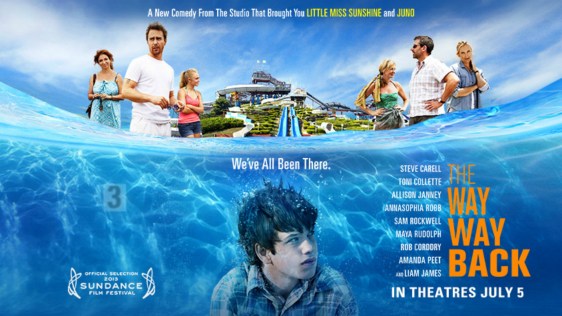
The Way, Way Back
Poster for

It’s not that The Way, Way Back is a bad film. But it really brings nothing new or interesting to the table. The film tries to succeed as a poignant coming-of-age tale, but really just feels like an exercise in dishonest nostalgia. Nearly every scene in this film is crafted in such a way as to glorify the motivations of its brooding, pure-at-heart teen protagonist, Duncan (Liam James), who I must admit is such a bland presence that I couldn’t even remember his name as I wrote this a day later. At all times, the film embraces his perspective, and while the awkwardness and pain of his dysfunctional family situation play with a modicum of plausibility, the details just seem a bit too perfect, like Duncan is the unreliable narrator spinning this particular yarn. Was his mom (Toni Collette) really this much of a doormat? Was the mom’s boyfriend Trent (Steve Carell) really this much of a monster? Was the genial water park manager Owen (Sam Rockwell) really this hilarious and likeable? Did Duncan really win the respect of some neighborhood hooligans (as well as the preposterously on-the-nose nickname “Pop’n’Lock”) in a dance contest scene right out of the 1980s?

Many of the performances above (with the exception of the lead) were quite nuanced and interesting, particularly that of Carell. But at no point does the film shake the sense that it’s just trying way, way too hard- whether to be a better coming-of-age dramedy like Adventureland, or at least a more interesting one like The Spectacular Now. And I doubt that’s the kind of nostalgia that The Way, Way Back wanted me to experience.

FilmWonk rating: 4 out of 10


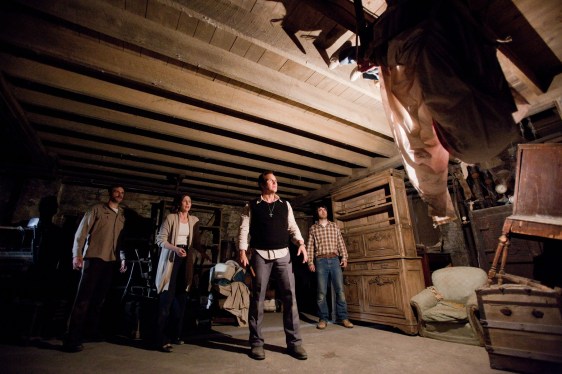
The Conjuring
Still from

In the world of James Wan‘s The Conjuring, ghosts and demons are real, all of this was based on a true story, and Ed and Lorraine Warren (Patrick Wilson and Vera Farmiga) are a couple of well-meaning, true-believing, honest-to-God ghostbusters with actual powers to vanquish genuine supernatural phenomena. For some reason, the film’s insistence on its own historicity initially rubbed me the wrong way more than usual, perhaps because we almost immediately get a scene in which Ed and Lorraine have a discussion alone together, and we the audience learn that yes, they really do believe that they’re vanquishing demons. But the film’s lack of interest in questioning the credibility of the real-life “experts” is matched by its interest in establishing them as interesting characters.

In the end, what makes this movie work so well is not just Wan’s well-developed sense of how to construct a taut supernatural thriller, but Wilson and Farmiga’s performances and credible, long-term affinity – both for each other, and for the important work that they believe they’re performing. By the time the film ends, when Lorraine insists to Ed that God brought them together for a reason, it has earned the audience’s credence that the couple genuinely believes this. Their faith, for lack of a better word, is inspiring, even if the “true story” is bewitching, fictitious nonsense like any good haunted house story.

FilmWonk rating: 7 out of 10


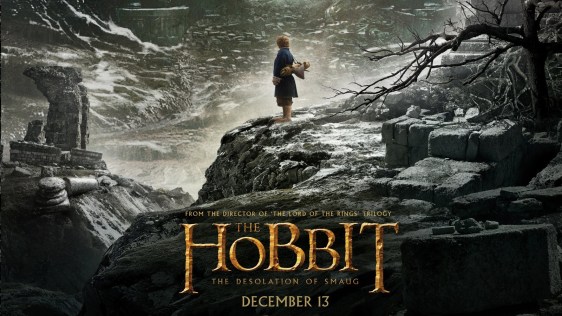
The Hobbit: The Desolation of Smaug
Poster for

I began my review of the thoroughly underwhelming first Hobbit film by questioning the need for its existence. But by the time the franchise’s equally lengthy second entry was near, I had not only come to terms with its existence, but I was weirdly, horribly excited for it. Whether the music, the 48fps 3D, the non-canonical addition of Legolas (Orlando Bloom) and a brand new elf-maiden named Tauriel (Evangeline Lilly), or the intense, shouty dude (Bard the Bowman, played by Fast and Furious 6 villain Luke Evans), something about this trailer got me right on board for it, and by and large, the film is a far superior entry to its predecessor.

It is still problematic in a number of ways. The dwarves – with the exceptions of Thorin (Richard Armitage), Balin (Ken Stott), Bombur (Stephen Hunter), and newly crowned heartthrob Kili (Aidan Turner) – remain interchangeable and undifferentiated as ever. The film’s insistence on sending away Gandalf (Ian McKellan) to fruitlessly poke at the mystery of the Dark Lord Sauron’s inevitable return is a complete waste of time – and when the film dispatched a septuagenarian wizard to the top of a mountain for a meeting that lasted literally two minutes, I couldn’t help but wonder if it knew exactly what the hell it was doing.

But this film did a lot of things right – by and large, it managed to make me believe it was making real progress toward telling a complete story. The action setpieces hung together much better this time. Everything surrounding the elven realm in Mirkwood – from the arachnid craziness on the way in, to the white-water rafting ride on the way out – was a ton of fun. And don’t let anyone tell you that Bowling With Bombur is any dumber than Legolas single-handedly dispatching an oliphaunt in Return of the King. Sometimes, a film just has to go a little crazy for the kids, and this sequence completely succeeded. As for the dragon Smaug (voice of Benedict Cumberbatch), I don’t have a lot to say, except that it was all very well-rendered, the scale of the sequence was impressive, and it ended with a bizarre thud. Despite an impressive performance by Evans, none of the Laketown sequence was well-established enough to make the stakes of the film’s ending (i.e. the town might soon be destroyed by a dragon) matter to me in the least. All it really made me do was lament the film’s criminal misuse of Stephen Fry, who is doing little more than a half-baked impression of Lord Denethor of Minas Tirith.

It would be easy for a non book-reader to look at the preceding paragraph as complete gibberish. And yet, this seems like a good time to point out the patent hypocrisy in many of The Hobbit films’ detractors. They criticize Peter Jackson in one breath for cynically inflating a 300-page children’s book into a meandering trilogy of films, and in the next, they can’t stand the notion of well-established characters from the existing Lord of the Rings universe stepping in to help round out the runtime and storytelling a bit. For the record, I thoroughly enjoyed the inclusion of pre-Gimli, dwarf-racist Legolas (and Evangeline Lilly feels like she was born to live in Middle Earth). But more importantly, I cannot and do not accept the notion that fidelity to half-remembered source material from one’s preadolescence is an intrinsic good. Are these bad films? Quite possibly. And feel free to blame Jackson and his team if you think so. But blame them for being poor screenwriters, not poor adapters. Because no matter how these films turn out, no one will come to your house and take away your dog-eared paperback copy of the source material. And we might just get something halfway entertaining out of this before the end.

FilmWonk rating: 6.5 out of 10

FilmWonk Podcast – Episode #38 – “12 Years a Slave” (dir. Steve McQueen)

Poster for "12 Years a Slave"

This week on the podcast, Glenn and Daniel witness the harrowing new film from director Steve McQueen, 12 Years a Slave, based on a memoir by kidnapped slave Solomon Northup (Chiwetel Ejiofor). Featuring one of the most sprawling and talented casts of the year, this film proved to be absolutely essential viewing. Check out our discussion below (53:09).

May contain some NSFW language.

FilmWonk rating: 9.5 out of 10

Show notes:

  • Music for tonight’s episode includes the tracks “Roll Jordan Roll” and “Solomon” from the soundtrack and score to the film. To hear the other Hans Zimmer track that came to mind during this film, check out “Time” from the original score to Inception.
  • The banality of evil” is a historical concept and phrase from Hannah Arendt‘s Eichmann in Jerusalem, and is not without controversy. Curiously, Northup expressed a similar idea near the end of his memoir, which can be read at the end of the NY Times article below.
  • Eric Herschthal wrote a fascinating article for the NY Times on the veracity of the memoir and real-life story: The Passion of Solomon Northup
  • The audio lecture series we referred to from The Great Courses is “The Other Side of History: Daily Life in the Ancient World,” from Colgate University history professor Robert Garland.

Listen above, or download: 12 Years a Slave (right-click, save as, or click/tap to play on a non-flash browser)