Glenn’s Indie Movie-Wank – Part 3: Marc Webb’s “(500) Days of Summer”

five_hundred_days_of_summer

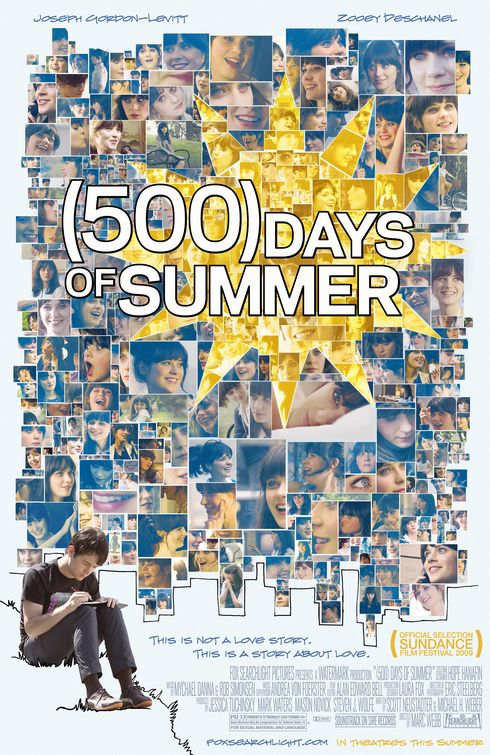
This is a story of boy meets girl, a stern, wry narrator informs us before the credits of Marc Webb’s self-styled “anti-romantic comedy”, (500) Days of Summer. The narrator goes on to warn us (not in so may words) that if we’re expecting a love story, we’ll be sobbing as hard as Tom Hansen (Joseph Gordon-Levitt) after he gets dumped by Summer Finn (Zooey Deschanel). This film doesn’t bury the lead; after a brief sequence on day 1 (when the two first meet), we jump forward to more than a year later (somewhere in the 380s), as Summer declares her love for pancakes and the relationship’s imminent demise. It makes sense in the scene.

This film revels in quirk and hipster sensibility almost as much as Juno (albeit less annoyingly so), and spins its relationship tale with as disjointed a timeline as Eternal Sunshine of the Spotless Mind. 500 Days makes a suitable companion piece to the latter film; both come from music video directors bringing some of their usual stylistic flourishes, and both use unconventional storytelling and a nonlinear timeline to offer their perspectives on love via exploration of a failed relationship.

But that’s where the similarities end… For a film in which the male romantic lead spends the majority of the time brooding and sobbing, 500 Days is remarkably uplifting and funny. The film takes place largely from Tom’s perspective, and at times, inside his head. It is a film about expectations. Summer, whose parents split up when she was a child, doesn’t expect anything from a relationship, and doesn’t really even want one. Tom, having internalized the lessons of a childhood of romantic songs and movies (and a total misread of the ending of The Graduate), doesn’t think he’ll be truly happy until he finds “the one”. Unfortunately, he only has the vaguest idea of what “the one” will be.

In the opening sequence of Eternal Sunshine, Joel Barish (Jim Carrey) ponders why he falls in love with any woman who shows him the slightest bit of attention (in that case, the enigmatic Clementine, played by Kate Winslet). Tom is a character that could easily end up in the same boat as Joel, even after the emotional smackdown that he experiences in 500 Days. While neither Kate Winslet nor Zooey Deschanel are true examples of a Manic Pixie Dream Girl in their respective films, their men seem bent on regarding them as such. They are each warned to manage their expectations as they begin the relationship, and they each pay a steep emotional price for failing to do so.

500_days_of_summer_movie_image_joeseph_gordon_levit_and_zooey_deschanel

The performances are quite adept. Joseph Gordon-Levitt once again proves his two central characteristics… He’s one of the finest young actors working today, and he hasn’t aged a day since “3rd Rock from the Sun”.

But even as Gordon-Levitt continues to prove as capable at reckless, romantic zeal as sullen, intractable brooding, it is Zooey Deschanel that steals this film. To put it bluntly, this is a character that the audience could easily have ended up despising. And while the character of Summer is mostly well-written, the characterization and non-linear progression of the story demand a great deal from Deschanel. And it is her performance that just manages to make the character sympathetic.

As Tom reflects on his relationship, many of his scenes with Summer are cast in a different light through subsequent flashbacks. On the second run through, the film’s editing calls attention to the slightest glance of the eyes, or twinge of the cheek muscles, or the most minor apathetic tone of voice… In each of these microexpressions, Deschanel’s performance is masterfully subtle. And throughout the film, she brings all the mystery, likeability, and sensuality that the character demands, but couples it with a subtle undertone of cold, mature pragmatism. She manages to force the audience through nearly the same process as Tom, despite our advantages of an outside perspective and sardonic narrator to keep us objective.

It is a lot easier to hate Chloe Moretz, a 12-year-old actress who may inadvertantly end up typecasting herself. In Matthew Vaughn’s upcoming adaptation of the graphic novel “Kick-Ass”, Moretz will play Hit Girl, a precocious, sword-wielding assassin. Here, she plays an equally unrealistic youngster in the form of Tom’s sister Rachel, who spends the entire film feeding him uncannily adept relationship advice in-between soccer matches. Despite Moretz’s solid performance, this character is the film’s biggest misfire. She could easily have been written out of the film without losing anything but doddering exposition. Perhaps I could have tolerated either an unrealistically savvy child or prolific movie trailer narration, but the inclusion of both nearly causes the film to collapse under the weight of its own cleverness.

And indeed, all of the characters occasionally feel overwritten. Summer intones with uncanny frequency how much she “loves” a particular band or food or [anything but Tom], and Tom’s job as a greeting card writer often seems like merely a clever setpiece for unrealistic emotional dialogue (consult your local Hallmark dealer for further examples). But somehow, the result is immensely enjoyable. This film is equal parts fable and reality, but it has a lot of insight to offer about love and relationships. (500) Days of Summer has earned its place alongside Eternal Sunshine and Forgetting Sarah Marshall in the “broken hearts” section of my pantheon of cinematic romances.

If you see this film, it will almost certainly speak to you on some level. If you don’t see yourself in one of these characters, then you might just see someone you know.

Or knew.

Or loved.
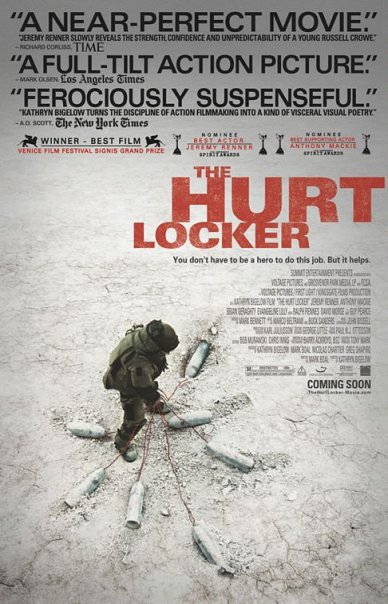
Glenn’s Indie Movie-Wank – Part 2: Kathryn Bigelow’s “The Hurt Locker”

hurtlocker

I would say that Kathryn Bigelow’s The Hurt Locker is the best film yet about the Iraq war, but it’s not as if it’s had much competition.The closest thing yet to a “good” Iraq war film was Paul Haggis’ small 2007 offering, In the Valley of Elah, which combined a heady realism and some strong performances with Haggis’ typically heavy-handed political message. The Hurt Locker has been described as “forcibly apolitical”. I’m not sure if I buy this sentiment, but more on this later.

The Hurt Locker tells the story of three members of an Explosive Ordnance Disposal (EOD) team – the army’s bomb squad. When soldiers discover one of the many IEDs hidden in trashpiles and animal carcasses around the streets, EOD is the team they bring in to disarm it. The film is ostensibly about adrenaline addiction (a pre-credits title screen informs us that war is, indeed, a drug), coupled with a portrayal of intense (and only slightly homoerotic) male friendship that Bigelow has previously depicted so effectively (Point Break), amidst a backdrop of intense action and violence.

The bomb diffusion sequences in this film are immensely entertaining and suspenseful, but it’s really the action where Bigelow distinguishes herself as a director. Ever since Paul Greengrass decided to start using shaky-cam in close-quarters (the Bourne series), it has been a problem endemic to modern action films that much of the action is incomprehensible. The physical environment, the characters, and where they are in relation to each other ends up being at least partially unclear. This has happened in good films (The Dark Knight), bad films (Transformers 2), and middling, mediocre films (Quantum of Solace), and I think it’s fair to say that Bigelow’s direction leaves many modern action films in its dust.

Every scene in this film is well established, and the audience always has an excellent sense of what’s going on. Staff Sergeant William James (Jeremy Renner) dons his protective suit (a relative misnomer) and marches through the blazing sun toward his objective. Civilians watch from every surrounding building, and bustle through the adjacent streets and alleys. The soldiers behind him take cover behind a Humvee and survey the crowd. Anyone with a cell phone could be trying to detonate the bomb. And all the while, the audience understands exactly where everything is in relation to everything else. And when all hell breaks loose, they can still understand what’s going on.

This commitment to well-directed and comprehensible action is one of the film’s persistent strengths, and it works immensely well against the backdrop of the Iraq War (in particular during a pitch-perfect long-distance sniper battle midway through the film).

Joining an appropriately intense performance by Jeremy Renner (28 Weeks Later, ABC’s “The Unusuals”) are strong supporters Anthony Mackie (We Are Marshall, 8 Mile) and Brian Geraghty (The Guardian, Jarhead). I can’t single out any of these performances as the superlative one; but as an ensemble, these three work immensely well. The film has Bigelow’s typically strong portrayal of male friendship in intense circumstances, when the characters aren’t sure if they want to embrace or murder each other. The dialogue feels authentic, and the characterization is solid. These men may be considered heroes, but as far as they’re concerned, they’re just doing what they have to do. They’re here, and they’re going to keep doing the job until they go home or get killed.

hurtlocker2

Shortly after diffusing a car bomb at a UN building, Sergeant James is approached by a colonel (David Morse, in a completely wasted cameo). “You’re a wild man”, the colonel says several times, practically giddy with excitement. Ralph Fiennes and Guy Pearce also appear in minor, if slightly meatier roles. With all the celebrities joining the party, I half-wondered if there was some thinly veiled anti-war message I wasn’t picking up on. The film is only anti-war inasmuch as a hyper-realistic war film inexorably conveys the notion that hey, perhaps it’s not such a fun place to be. But while the film may set out to be apolitical, it simultaneously exhibits unapologetic contempt toward any attempt to analyze or understand these men. The audience’s perspective is best exhibited by a well-meaning armchair psychologist colonel (Christian Camargo), whose story is easily the most overwritten and predictable part of an otherwise solid and suspenseful film.

That’s about as close as the film comes to a political message. You’re not there. You don’t know. Now go home, and enjoy the streets that aren’t filled with potentially explosive trashpiles. But this message is merely the subtle underpinning of one of the best action films this year, and it is well worth seeing. It is absolutely gorgeous to behold, and if you can catch it before it leaves theaters (it’s out in limited release), see it on the largest screen you can.

Glenn’s Indie Movie-Wank – Part 1: Duncan Jones’ “Moon”

moon-movie-poster

If nothing else, Duncan Jones’ Moon is a film you’ll have to talk about afterward.

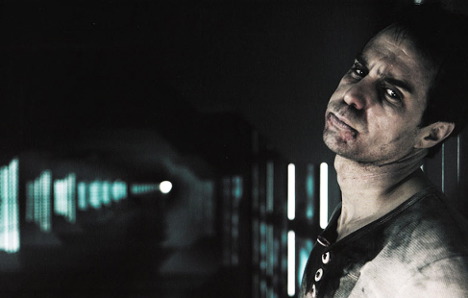
Sam Bell (Sam Rockwell) is the sole employee at a lunar mining facility, just a few weeks shy of finishing his three-year stint. He’s playing to familiar territory… bearded and slightly unhinged. His only company for the past three years has been GERTY, a super-intelligent computer, voiced by an eerily calm Kevin Spacey. Sam heads out in the rover one day to investigate a problem with one of the mining machines, and discovers he has company… Another man in a company-issue spacesuit. A man that looks and sounds exactly like him.

This “big spoiler” for the film is revealed in the first 15 minutes, but even as you’re patting yourself on the back and mouthing “CLOOOOOOOOONE” to anyone you came with (if you’re as obnoxious as me, at least), Moon just steps right on and continues to explore fresh and insightful territory. This film has two persistent strengths. The first is that it does a lot with very little. It flawlessly renders the surface of the moon and the base, despite an extremely modest budget. Clint Mansell’s (Requiem for a Dream, The Wrestler) haunting and beautiful score spends a great deal of time on solo piano, a style that compliments the story masterfully.

But the second strength is simply the film’s respect for its audience. So much of modern sci-fi is merely elaborate, CG-infused setup with no payoff. Behold! A world in which robots are everywhere! And spaceships! And aliens! Now, let’s throw em all together and watch them beat the shit out of Will Smith or Shia LaBoeuf (or both)! Annnd…roll credits!

This film does what few sci-fi films have managed in recent years. It sets up its world, but then respects its audience enough to subtly raise the myriad of profound ethical and existential questions that naturally follow. The clone “twist” happens early, and the rest of the film is spent exploring the idea. How would you feel, as either the clone or clonee? How would the two of you interact? And oh, as long as you’re here, what does it mean to be human?

It is this last question that pervades the ending of this film, and in that grain, it owes a great deal to such works as Blade Runner or the re-imagined Battlestar Galactica. And all the while, as we explore Sam’s relationship with GERTY, we see the trappings of 2001 as we wonder when the computer will go all HAL-homicidal. But that is the triumph of this film’s storytelling. It is aware of the works that have come before, and pays them the requisite service while simultaneously passing a dozen points when it could easily veer into an obvious and overwrought cliche. It plays with the audience’s expectations, but delivers some remarkable originality.

moon_Sam_Rockwell_pic

Sam Rockwell’s performance may be the finest I’ve seen this year, imbuing each of the Sam Bells with a distinct, but related personality. One of them is strong, but struggles to make sense of what he is, as the other becomes increasingly erratic. Kevin Spacey gives a fine voice performance, although I suspect the intrigue of GERTY is as much due to his performance as it is to an clever visual that the computer uses to express its “emotions”. In an age when we’re used to communicating in the emotionally stifling media of texting and instant messaging, seeing a computer make use of the same cutesy little emoticons in the place of body language and empathy is surprisingly effective.

The relationship between Sam and the computer ends up being almost as fascinating as the one between Sam and his clone, and its exact meaning is one of the many things you’ll continue to think about after you leave this film.

Moon‘s dialogue is rich and concise, conveying exactly what it needs to and not a bit more. The film explores all of the questions I mentioned above (to name a few), but does so in a subtle way, and relies on its audience to answer them on their own time. Even the very last line of the film, a half-garbled radio transmission that plays as the credits begin to roll, conveys a fascinating idea. And that’s what you’ll get with this film. It’s for people who love big ideas. It is a welcome return to true sci-fi, and showcases one of the best performances of the year.

My entirely over-long review of Greg Mottola’s “Adventureland”

adventureland
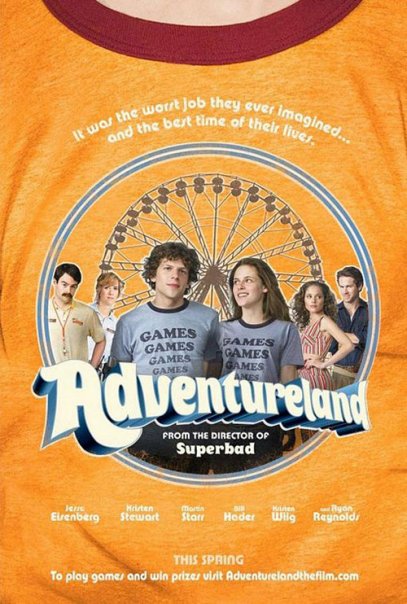
Kristen Stewart, budding teenage heartthrob, fresh off her role in the critically acclaimed epic vampire romance Twilight, returns to the screen alongside comedic greats and Judd Apatow alums Ryan Reynolds, Bill Hader and Kristen Wiig in Adventureland, a hilarious and carefree new comedy from the writer/director of Superbad.

…or not.

Adventureland was filmed in October of 2007 and sat on the shelf for a year and a half while Miramax figured out how best to release it. I can only speculate as to why they held onto it for so long. Eventually, it seems, a combination of residual favor from Greg Mottola’s previous film and Kristen Stewart’s increased profile following her turn as teenage vampire-lover Bella Swan in 2008’s creepy stare-fest, Twilight, was enough to get the film a release.

This film defied my expectations on every level. I went in expecting a comedy akin to Superbad – and the film’s marketing certainly encouraged this image of the film. Instead, I was presented with a mature, poignant drama that presented a brilliant portrait of the twentysomething post-college experience. It is the story of James Brennan (Jesse Eisenberg), a recent graduate who was all set to head for Europe on a post-college jaunt when his parents painfully admit that due to money problems, they will not be able to pay for his trip. Without warning, James is presented with the insurmountable task of finding a job with his liberal arts degree.

This aspect of the story was rather apropos for me – the poli sci major currently working in IT. But even the various absurdities of a helpdesk employee seem tame in comparison to an exciting career in crooked carnival gaming.

“You can do better, son,” says James’ father when he announces that Adventureland is the only place he can find employment. And yet, James can’t do better. He’s quickly realizing that his parents can’t help him, and that he has to take whatever job – and whatever life – he can find. It is this desperation and sudden, reluctant thrust into grownup life that the film captures so well.

Throughout the film, there’s a persistent feeling that these kids aren’t ready for their situation. They live with their parents. They’re old enough to drink legally, and yet they sneak around hiding liquor. They sit in their parents’ cars and make out in their driveways. They gossip, spread rumors, and weave a tangled and overlapping web of ambiguous relationships. They engage in whimsical, self-destructive behavior at the drop of a hat. These kids are not alright. They’re college graduates acting like high school students.

And yet, not a single moment in this film rings false. The story is a parable of modern life, and a ruthless exploration of modern relationships. The film’s treatment of romance, evoking sympathy for all manner of relationship fouls, reminds me greatly of last year’s Forgetting Sarah Marshall. And in much the same way as that film, you just have to stare resignedly at the characters and shake your head in bewilderment.

You know you shouldn’t do that, you’ll say. You know you’re just doing it because you’re in love and heartbroken and stupid. You know you’ll feel worse afterward. And you know you’re going to do it anyway.

The principal romance in this film was between James (Jesse Eisenberg) and Emily (Kristen Stewart). In a rare reversal of the usual pratfall of casting young characters, the then-17-year-old Stewart plays a seemingly 21-year-old college graduate.

kristenstewartAs much as it pains me following my experience with the abominable Twilight film, the moment has finally come when I must admit… Kristen Stewart is a damn fine actress. I can only speak to my reaction, but during every moment of Emily’s screen time, I was on the edge of my seat with anticipation. Stewart, in an incredibly nuanced and visual performance, managed to convey such a compelling sense of desperation and longing in every scene (both with and without Eisenberg) that I spent the entire film simultaneously rooting for and pitying her.

“You can’t just avoid all the people you’ve screwed up with!” is the conciliatory message of this romance, as delivered by James in the final romantic speech at the end of the film. This scene was obligatory, as it is in most romantic dramas, and yet (without giving too many details) Mottola’s take on this scene manages to ring truly unique. Jesse Eisenberg’s acting definitely deserves some of the credit for how well this scene (and the romance) plays, but it is Stewart that truly shines in this film.

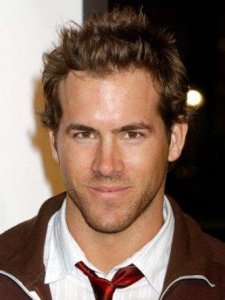
ryanreynoldsI must also give praise to Ryan Reynolds. Here is an actor whose work is consistently entertaining, but offers the same one-note, sociopathic, likeable douchebag performance in every film he’s in. You’ve probably met someone like this character in real life. Someone who evokes two simultaneous reactions – amusement and unsettlement. Someone who might be good for a laugh or two, but would probably toss you aside the moment he no longer needed you for something.

Reynolds returns in this film as that character, aged 10 years, saddled with a dead-end job and an unhappy marriage. And yet he manages to convey the truly pitiable nature of such a character. His antics and doubletalk no longer seem charming here. His underhanded and lecherous conduct comes off as sad, creepy, and immature for a man of his age. Reynolds does a fine job of portraying all the ugliness and truth of this character without any of the signature likeability that he brings to his other roles.

Adventureland is a poignant film with a lot to say about our generation. And I say this as a current twenty-something who is more than happy to coopt and internalize the lessons of this film. And yet, the story is actually Greg Mottola’s semi-autobiographical take on his experience after college in 1987. Does this indicate that the film’s message is at least somewhat timeless? Or that Mottola has merely spun a tale of modern twenty-somethings and added a bit of weird hair, outdated music, and a lack of cellular communication for ambiance? Impossible to say. But the result is well worth seeing.