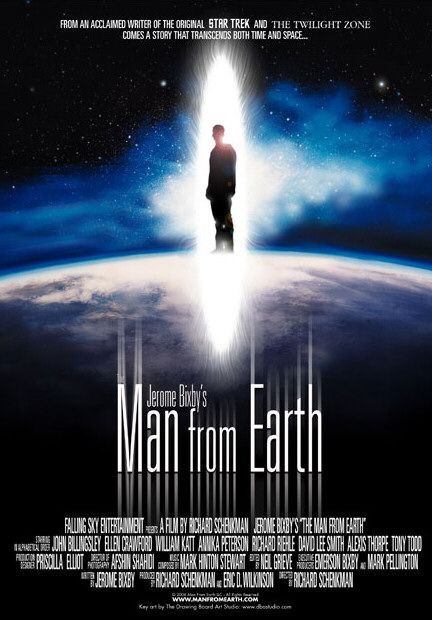
Jerome Bixby’s “The Man From Earth” – A brilliant and audacious journey

Poster for "The Man From Earth"

Produced in 2007 from a screenplay finished on the writer’s deathbed, Jerome Bixby’s sci-fi opus The Man From Earth feels more like a play than a film. Professor John Oldman (David Lee Smith) announces to his colleagues and friends that he’ll be moving on, but makes a surprise confession – he is immortal, and has lived for the past 14,000 years. The rest of the film takes place almost entirely in a single room, following the threads of the group’s conversation. And in a very theatrical touch, the assembled group of academics are perfectly suited to test his story. There’s Harry – a biologist (John Billingsley), Dan – an anthropologist (Tony Todd), Sandy – a historian (Annika Peterson), Art – an archaeologist (William Katt), and Edith (Ellen Crawford), a devout Christian with an unnamed specialty. As John’s story goes on, they are joined (quite expectedly) by Dr. Will Gruber (Richard Riehle), a psychologist.

I mention the character names, but these aren’t really characters anyway. They’re just filters through which the audience can analyze this man’s fantastical tale. There is even a student (Alexis Thorpe) present to ask a few simplistic questions so the professors can explain details that the group would already know. And even when the story strives for more dramatic and theatrical character moments (a confession of love, a surprise death threat, and so on), the situation never quite feels plausible, as these moments only serve to provoke new dimensions to John’s story.

But as I mention these character and narrative shortcomings, I must also say this – not a single one of them detracts from the film. David Lee Smith gives a remarkably subdued performance as John Oldman (one of many pun names he claims to have chosen over the years), the wise, humble, and pragmatic old soul. He reminded me somewhat of Doctor Who, but he feels far more authentic and human, because the film so excels at depicting the limitations of his purportedly vast knowledge and experience.

As they quiz him for every detail of the last 14,000 years, he points out that he doesn’t remember every detail any more than we can remember every moment of our childhoods. As he produces details of history, anthropology, and social and scientific advancement, they rightfully point out that he could have gleaned any of them from a textbook. But as one professor admits, it is no more possible for John to prove his story than it is for any of them to disprove it. And so the conversation goes on. He talks of love, friendship, life, and death – the one subject of which he has no more knowledge than anyone else. The film goes on to raise some startling religious themes, to the chagrin of Edith, the devout Christian… The ensuing theological discussion is easily the most provocative aspect of this film, and is quite well realized.

I don’t have much to say about the other performances, since there weren’t any other particularly strong characters. But even as a collection of variable filters for John’s conversation, the acting was solid overall. Todd, Crawford, and Riehle were superb, and Billingsley was enjoyable, albeit playing to familiar quirky territory. Annika Peterson does the best she can with some of the more contrived character moments, although her unlikely conversation with John about the nature of love is a surprisingly effective addition to the film. Katt and Thorpe don’t contribute much as skeptic and simpleton respectively, but I don’t really fault their performances, as they aren’t given much to do in the film (except make the audience wonder why a fifty-something doppelganger of James Cameron is permitted to date one of his students).

Jerome Bixby was a writer for the original “Star Trek” series, and it definitely shows here. The film’s end features Tony Todd announcing he’ll go home and “watch some ‘Star Trek’ for a little sanity”, and while it was a mildly self-indulgent reference, it does bring to mind a key difference between the two works. “Star Trek”, with its niche audience, was quite free to explore the big sci-fi ideas via alien allegory, since no one was too worried about offending the delicate sensibilities of the Tholian Empire. The Man From Earth takes on a far more daunting task – to deconstruct human history, values, and beliefs in a manner as shocking as it is insightful, and keep the audience adequately engaged to stop them squirming in their seats and fleeing the room. And it completely succeeds.

FilmWonk rating: 8 out of 10
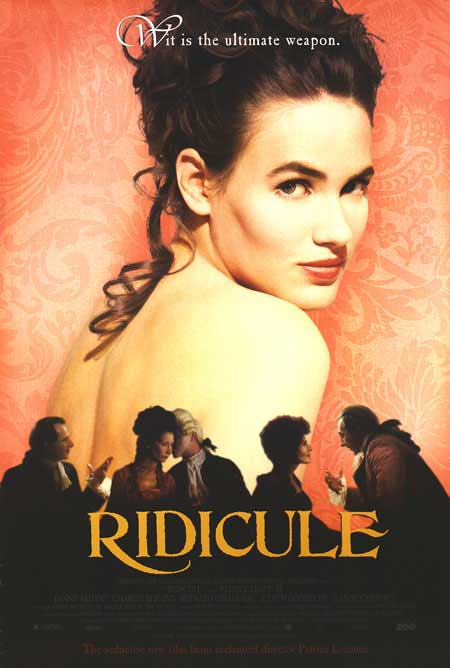
Patrice Leconte’s “Ridicule” – Presque perdu dans la traduction*

ridicule_poster
*Almost lost in translation.

Films about pre-revolutionary France tend to share a kind of sadistic fatalism. They present a picture of boorish aristocrats too consumed in their own petty affairs to see the opposition and hatred fomenting beneath them. They’re tragic characters, but in some sense, they deserve whatever they get.

Patrice Leconte’s Academy Award nominated 1996 film Ridicule is no exception.

In the court of Louis XVI, wealth and status rule the day, but the real king is belle esprit – literally, “beautiful mind”. Belle esprit is what the aristocrats call a sharp, biting wit. They craft a perfectly brutal and entirely zero-sum situation in which the only way to advance one’s status in the court is to publicly and brilliantly humiliate another (and avoid being ridiculed oneself).

Entering the fray is Grégoire Ponceludon de Malavoy (Charles Berling), a small-time nobleman from the Dombes province who seeks the support of the king to rid his country of the horrible swamps that kill the majority of his peasants via mosquito-borne illnesses. He meets the Marquis de Bellegarde (Jean Rochefort), an aged aristocrat whose wits are no longer sharp enough to compete in court. The Marquis takes Malavoy under his wing, teaching him the use of repartée, word games, rhyming epigrams, and other clever bits of malevolent wordplay that will bring him ever-closer to an audience with the king.

But never puns, warns the Marquis. Puns are the “death of wit”. And never laugh at your own jokes.

Malavoy takes to these rules famously, despite conflicting strategic and romantic interests in the gorgeous and cunning courtesan widow, Madame de Blayac (Fanny Ardant), and the Marquis de Bellegarde’s breathtaking and scientifically-minded daughter Mathilde (Judith Godrèche). He also faces opposition by Madame de Blayac’s current companion, the Abbot de Vilecourt (Bernard Giraudeau). While the film’s hollowly-crafted love triangle is made a good deal more convincing by marvelous performances on the part of the three leads, this film’s effectiveness is made entirely by the brilliantly crafted court dialogue.

Rémi Waterhouse’s script shines in these scenes. If Aaron Sorkin wrote about old-world aristocratic politics, this is almost certainly what it would sound like. However, the film strikes a somewhat bizarre tone. It revels in the cruelty of these scenes in a fashion that is almost darkly comedic, but also feels the need to impress upon us how deeply misguided and out-of-touch these people are.

The court scenes also contain such precise and esoteric language that they raise an unfortunate and seemingly unavoidable issue that comes when bringing a film to a new language – inaccurate translation. At times, the English subtitles accurately conveyed the language, and at times they were adjusted as the scene required, such as a scene in which the characters are rhyming. However, the language would occasionally be oversimplified in a way that seemingly contributed nothing to the scene, and in some cases, completely changed the meaning of the original line.

A few examples…

French line English subtitle Actual translation
Votre place n’est pas ici. We don’t belong here. Your place is not here.
Il est moins bête qu’il semble. He’s smarter than he looks He is less dumb than he seems.
Nous sommes de la même espèce. You and I are alike. We’re of the same species.
Il ne faut pas sacrifier tout à nos destins. Our plans come first. Do not sacrifice all for our destinies.
On voyait un diable devant la croix? Have you seen a ghost? Did you see a devil before the cross?

There was an outcry back in March of this year when Magnolia Pictures mangled the subtitles of Tomas Alfredson’s brilliant Swedish vampire coming-of-age film, Let the Right One In. Having seen (and loved) the theatrical version, I promptly returned my copy of this film to Amazon when I heard the news about the faulty subtitles. It’s always a tough balancing act when deciding how to watch a film in a language you don’t know (or even a language I do know, in the case of Ridicule). If you choose the dubbed version, you get a caliber of acting typically reserved for cereal commercials, but at least you don’t have to read any subtitles. If you choose the original version, the acting is better, but you still have to contend with lazy translation. Some films, such as those of popular animators like Hiyao Miyazaki, receive solid translations and dubs with real actors. Just have to take what you can get, I suppose.

But I digress.

Ridicule is a solid film, competently shot, and feels visually authentic (with the period backdrops and costumes). It’s probably more enjoyable if you know a bit of French, but the acerbic wit and incisive jabs are delivered well enough to transcend the language barrier.

Details about Ridicule‘s ending will follow.

7218_Ridicule-01

Like the court scenes, the film’s ending is tonally bizarre. It introduces a duel with a character that had not appeared in any prior scene, and seems to serve only to give Malavoy some minor triumph, or at least demonstrate his hypocritically selective pride. The love story is ended in a more satisfying manner, owing largely to Mathilde’s quite believable transformation (and Judith Godrèche’s brilliant performance), but the central conflict between Malavoy and Vilecourt is not resolved in any conventional sense. Vilecourt’s antagonism is compelling, but Malavoy only ever wins a few minor skirmishes. Vilecourt’s largely self-inflicted downfall seems to suggest that in such foul and petty company, it is quite possible to be too clever for one’s own good. Or perhaps, even more simply, the longer you spend in this court, the more likely you are to pass out of favor like last year’s fashions.

Ultimately, the characters’ machinations count for very little. And given the proximity of the film’s timeframe to the Reign of Terror, it’s probably better for Malavoy that he finds himself digging through the muck alongside his peasants in the end. Any success at court would’ve gained him, at best, a half-dug canal, and at worst, a guillotine blade to the back of the neck.

But at least he met a nice young lady for his troubles.

FilmWonk rating: 7.5 out of 10